Baeken Chris
Department of Psychiatry and Medical Psychology, Ghent University, Ghent, Belgium.
Ghent Experimental Psychiatry (GHEP) Lab, Ghent University, Ghent, Belgium.
Front Psychol. 2018 Oct 31;9:2017. doi: 10.3389/fpsyg.2018.02017. eCollection 2018.
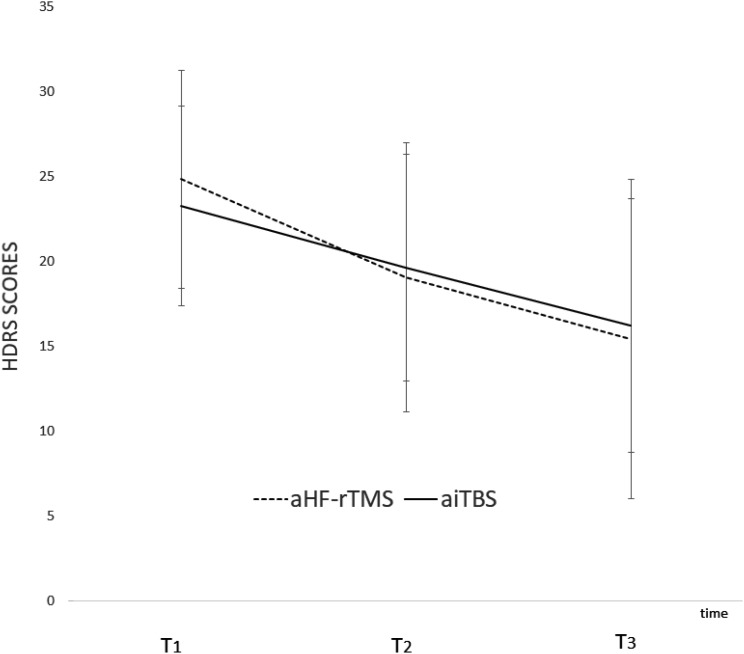
Three decades of clinical research on repetitive transcranial magnetic stimulation (rTMS) has yielded one clear treatment indication in psychiatry for major depression disorder (MDD). Although the clinical response equals the standard treatment algorithms, the effect sizes on the beneficial outcome remain rather modest. Over the last couple of years, to improve the efficacy in resistant depression, two new avenues have been developed: personalization and intensifying rTMS treatment. For the latter, we retrospectively compared accelerated high-frequency rTMS (arTMS) with accelerated intermittent theta burst stimulation (aiTBS) in the refractory depressed state. Although the clinical efficacy was not significantly different between both protocols, our observations substantiate the potential of the accelerated stimulation to shorten the treatment duration from the depressed state to the response state. Any time gain from the depressed state to the recovered state is in the patients' interest.
三十年来对重复经颅磁刺激(rTMS)的临床研究在精神病学领域为重度抑郁症(MDD)产生了一个明确的治疗指征。尽管临床反应等同于标准治疗方案,但有益结果的效应大小仍然相当有限。在过去几年中,为提高对难治性抑郁症的疗效,已开发出两条新途径:个性化和强化rTMS治疗。对于后者,我们回顾性地比较了难治性抑郁状态下的加速高频rTMS(arTMS)与加速间歇性theta爆发刺激(aiTBS)。尽管两种方案之间的临床疗效没有显著差异,但我们的观察结果证实了加速刺激有可能缩短从抑郁状态到反应状态的治疗持续时间。从抑郁状态到康复状态的任何时间缩短都符合患者的利益。