Bruno Antonia, Sandionigi Anna, Bernasconi Marzia, Panio Antonella, Labra Massimo, Casiraghi Maurizio
ZooPlantLab, Department of Biotechnology and Biosciences, University of Milano-Bicocca, Milan, Italy.
Metropolitana Milanese S.p.A., Milan, Italy.
Front Microbiol. 2018 Oct 31;9:2557. doi: 10.3389/fmicb.2018.02557. eCollection 2018.
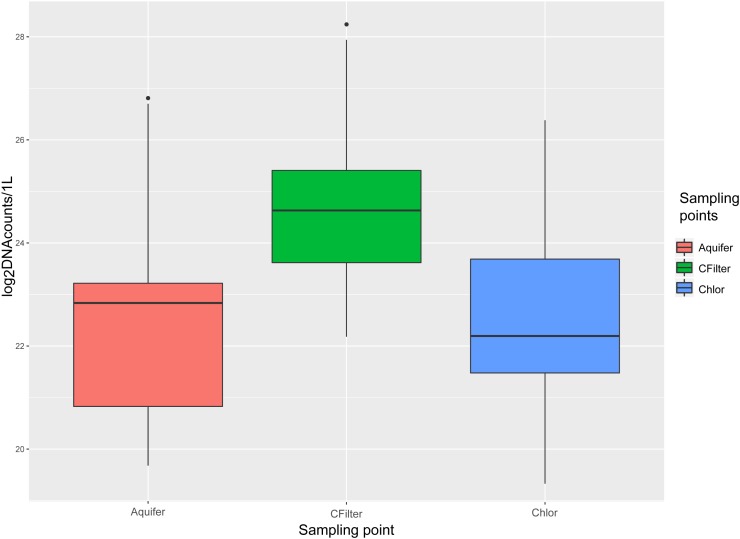
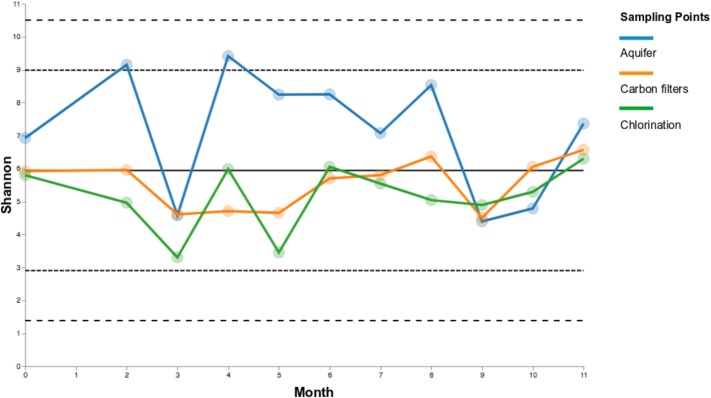
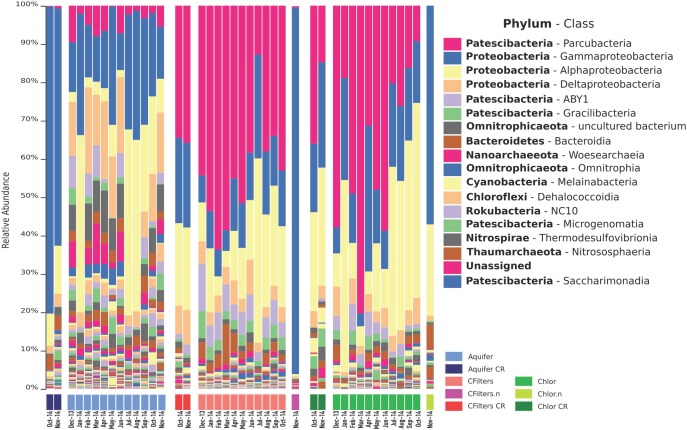
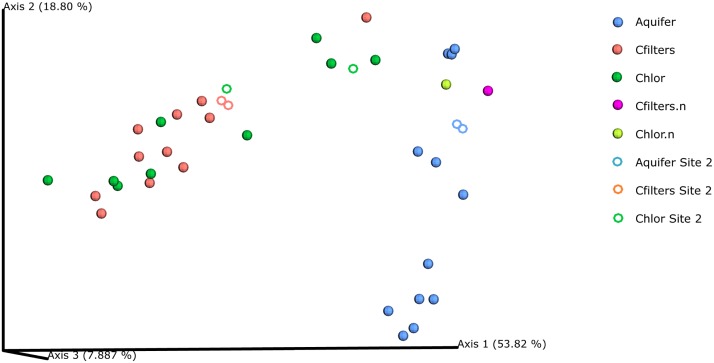
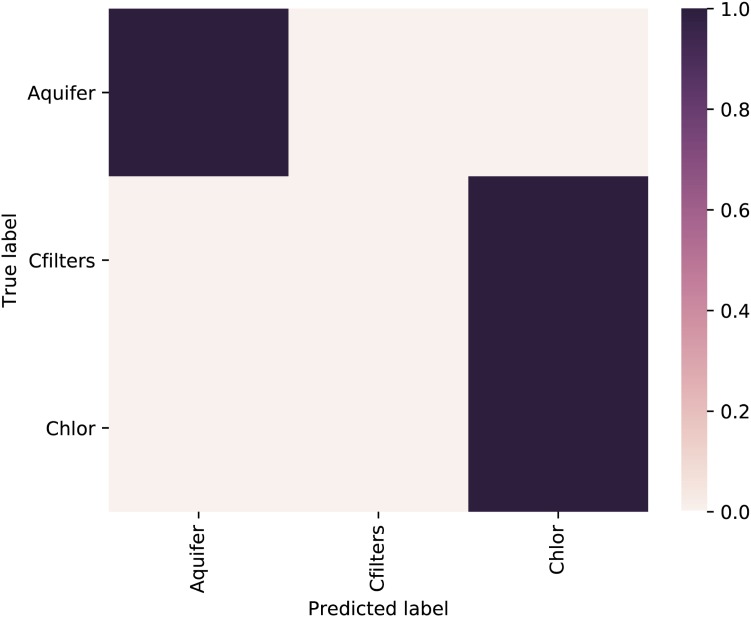
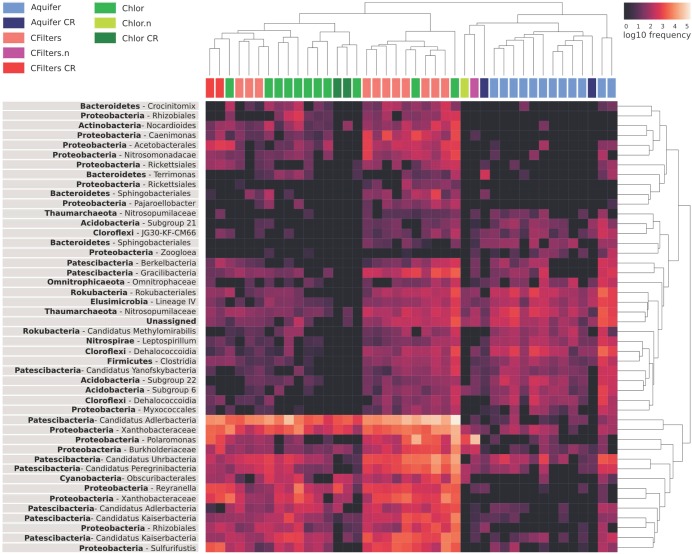
While safe and of high quality, drinking water can host an astounding biodiversity of microorganisms, dismantling the belief of its "biological simplicity." During the very few years, we are witnessing an exponential growth in scientific publications, exploring the ecology hidden in drinking water treatment plants (DWTPs) and drinking water distribution system (DWDS). We focused on what happens to the microbial communities from source water (groundwater) throughout the main steps of the potabilization process of a DWTP, located in an urbanized area in Northern Italy. Samples were processed by a stringent water filtration to retain even the smallest environmental bacteria and then analyzed with High-Throughput DNA Sequencing (HTS) techniques. We showed that carbon filters harbored a microbial community seeding and shaping water microbiota downstream, introducing a significant variation on incoming (groundwater) microbial community. Chlorination did not instantly affect the altered microbiota. We were also able to correctly predict (through machine learning analysis) samples belonging to groundwater (overall accuracy was 0.71), but the assignation was not reliable with carbon filter samples, which were incorrectly predicted as chlorination samples. The presence and abundance of specific microorganisms allowed us to hypothesize their role as indicators. In particular, Candidatus Adlerbacteria (Parcubacteria), together with microorganisms belonging to and , characterized treated water, but not raw water. An exception, confirming our hypothesis, is given by the samples downstream the filters renewal, which had a composition resembling groundwater. Volatility analysis illustrated how carbon filters represented an ecosystem that is stable over time, probably bearing the environmental conditions that promote the survival and growth of this peculiar microbial community.
尽管饮用水安全且质量高,但它可能含有数量惊人的微生物多样性,打破了人们认为其“生物简单性”的观念。在短短几年间,我们见证了科学出版物数量呈指数级增长,这些出版物探索了隐藏在饮用水处理厂(DWTPs)和饮用水分配系统(DWDS)中的生态学。我们聚焦于位于意大利北部城市化地区的一座DWTP在饮用水处理过程的主要步骤中,源水(地下水)中的微生物群落会发生什么变化。通过严格的水过滤处理样本,以保留哪怕是最小的环境细菌,然后用高通量DNA测序(HTS)技术进行分析。我们发现碳滤器中蕴藏着一个微生物群落,它会在下游播种并塑造水微生物群,给进入的(地下水)微生物群落带来显著变化。氯化处理并没有立即影响已改变的微生物群。我们还能够(通过机器学习分析)正确预测属于地下水的样本(总体准确率为0.71),但对于碳滤器样本的分类不可靠,这些样本被错误地预测为氯化处理样本。特定微生物的存在和丰度使我们能够推测它们作为指标的作用。特别是,候选阿德勒氏菌(Parcubacteria),以及属于 和 的微生物,是处理后水的特征,但原水中没有。过滤器更换后下游的样本证实了我们的假设,其组成类似于地下水。波动性分析表明碳滤器代表了一个随时间稳定的生态系统,可能承载着促进这种特殊微生物群落生存和生长的环境条件。