Kreins Nathalie, Buffin Rachel, Michel-Molnar Diane, Chambon Veronique, Pradat Pierre, Picaud Jean-Charles
Neonatal Intensive Care Unit, Croix Rousse University Hospital, Hospices Civils de Lyon, Lyon, France.
Regional Human Milk Bank, Croix Rousse University Hospital, Hospices Civils de Lyon, Lyon, France.
Front Pediatr. 2018 Oct 31;6:322. doi: 10.3389/fped.2018.00322. eCollection 2018.
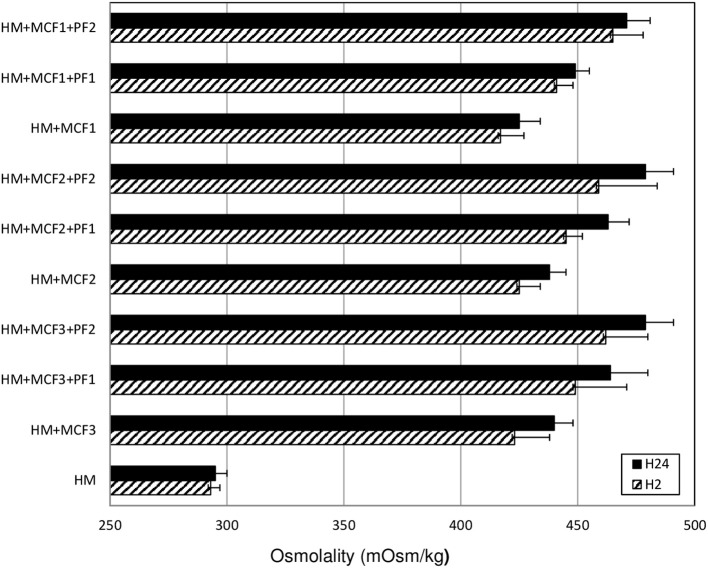
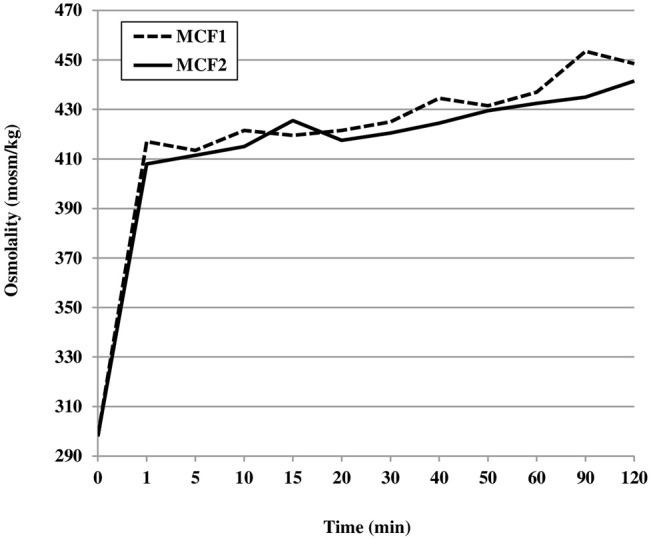
Fortification of human milk (HM) increases its osmolality, which is associated with an increased risk of necrotizing enterocolitis. The impact of new fortifiers on osmolality is not well-known, nor are the kinetics regarding the increase in osmolality. To determine the optimum fortifier composition for HM fortification by measuring the osmolality of fortified HM made with three powder multicomponent fortifiers (MCFs) and a protein fortifier (PF). The osmolality of HM was assessed at 2 (H2) and 24 (H24) h after fortification to compare the effects of MCF (MCF1-3) and PF used in quantities that ensured that infants' nutrient needs would be met (MCF: 4 g/100 ml HM; PF: 0.5 g or 1 g/100 ml HM). To evaluate the early kinetics associated with the osmolality increase, the osmolality of HM fortified with MCF1 or MCF2 was also measured at 0, 1, 5, 10, 15, 20, 30, 40, 50, 60, 90, and 120 min after fortification. The osmolality increased significantly immediately after fortification, depending on the type of fortification used and the quantity of MCF and PF used, rather than the time elapsed after fortification. The maximum value at H24 was 484 mOsm/kg. The mean increase in osmolality between H2 and H24 was 3.1% ( < 0.01) (range: 0.2-10.8%). Most of the increase (>70%) occurred immediately after fortification. When choosing a fortifier, its effect on HM osmolality should be considered. As most of the increase in osmolality occurred immediately, bedside fortification is not useful to prevent the increase in osmolality, and further research should focus on improving fortifier composition.
母乳强化会增加其渗透压,这与坏死性小肠结肠炎风险增加有关。新型强化剂对渗透压的影响尚不明确,渗透压升高的动力学情况也不清楚。通过测量用三种粉末多成分强化剂(MCF)和一种蛋白质强化剂(PF)制成的强化母乳的渗透压,来确定母乳强化的最佳强化剂组成。在强化后2小时(H2)和24小时(H24)评估母乳的渗透压,以比较使用能满足婴儿营养需求的量的MCF(MCF1 - 3)和PF的效果(MCF:4 g/100 ml母乳;PF:0.5 g或1 g/100 ml母乳)。为评估与渗透压升高相关的早期动力学,还在强化后0、1、5、10、15、20、30、40、50、60、90和120分钟测量用MCF1或MCF2强化的母乳的渗透压。强化后渗透压立即显著升高,这取决于所用强化类型以及MCF和PF的用量,而非强化后经过的时间。H24时的最大值为484 mOsm/kg。H2和H24之间渗透压的平均升高为3.1%(<0.01)(范围:0.2 - 10.8%)。大部分升高(>70%)发生在强化后立即出现。选择强化剂时,应考虑其对母乳渗透压的影响。由于大部分渗透压升高立即发生,床边强化对防止渗透压升高并无作用,进一步研究应聚焦于改善强化剂组成。