Korenman Stanley G, Grotts Jonathan F, Bell Douglas S, Elashoff David A
Department of Medicine, David Geffen School of Medicine at UCLA and the UCLA Clinical and Translational Science Institute, Los Angeles, California.
J Endocr Soc. 2018 Sep 21;2(11):1306-1313. doi: 10.1210/js.2018-00137. eCollection 2018 Nov 1.
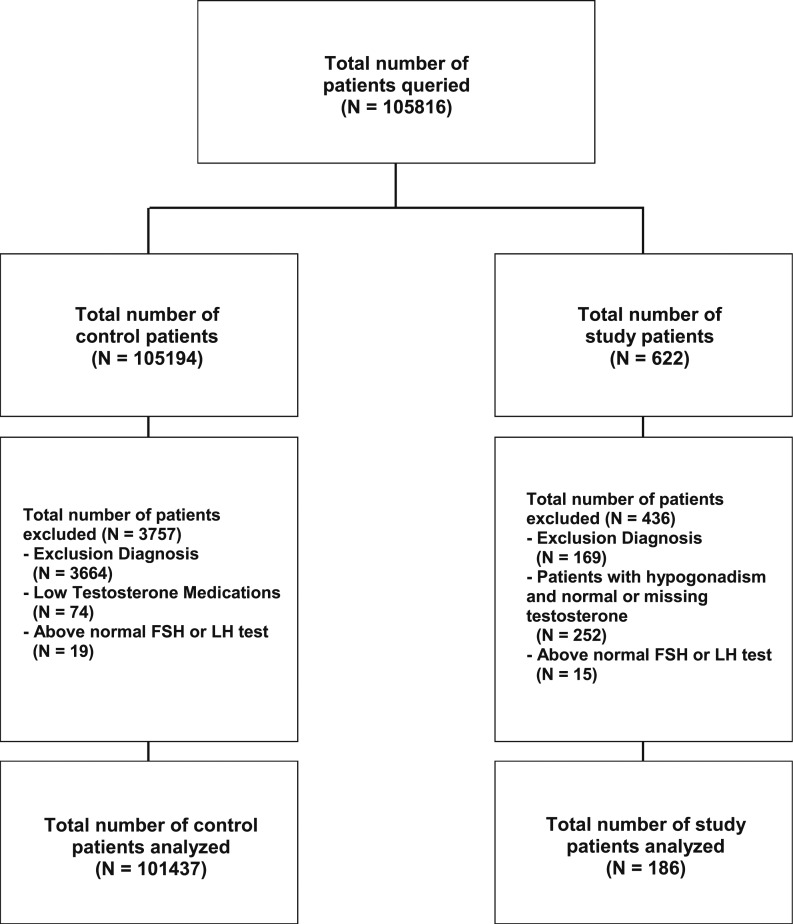
The specific objective of this study was to test the clinically derived hypothesis associating a high prevalence of depression in young men with nonclassical hypogonadism. We studied the entire population of men aged 18 to 40 years who had an outpatient visit at an academic health system in the years 2013 to 2015. The study group comprised 186 patients with a diagnosis of eugonadotropic hypogonadism and a testosterone value below 10.4 nmol/L with no apparent cause. We compared their demographic factors, other diagnoses, and treatments with those of (i) the entire population, (ii) a matched population of 930 controls, and (iii) 404 controls with normal testosterone determinations, and no hypogonadism diagnosis. Depression, defined as either an () diagnosis or treatment with an antidepressant medication, was found in 22.6% of cases vs 6.6% of population controls [ < 0.001; OR: 1.13 (1.09 to 1.17); 95% CI]. Obesity was also higher in the cases ( < 0.001). The matched controls had a depression rate of 13.4% compared with the case rate of 22.6% [ < 0.002; OR 1.14 (1.08 to 1.17)]. Controls with normal testosterone determinations had a depression rate of 16.8% [ = 0.121; OR: 1.04 (0.96 to 1.12)], suggesting that clinicians may have ordered a testosterone determination because of symptoms consistent with both depression and hypogonadism. The high incidence of depression in nonclassical hypogonadism in young men, although only associative, supports a depression evaluation and treatment as appropriate as well as investigation of the proximate causes of this form of hypogonadism.
本研究的具体目的是检验临床上得出的一项假设,即年轻男性中抑郁症的高患病率与非经典性腺功能减退有关。我们研究了2013年至2015年期间在一家学术健康系统进行门诊就诊的所有18至40岁男性。研究组包括186例诊断为促性腺激素正常性腺功能减退且睾酮值低于10.4 nmol/L且无明显病因的患者。我们将他们的人口统计学因素、其他诊断和治疗情况与以下三组进行了比较:(i)全体人群;(ii)930名匹配对照人群;(iii)404名睾酮测定正常且无性腺功能减退诊断的对照人群。抑郁症定义为有抑郁症诊断或使用抗抑郁药物治疗,在病例组中发现抑郁症的比例为22.6%,而在人群对照组中为6.6%[P<0.001;OR:1.13(1.09至1.17);95%CI]。病例组中的肥胖率也更高(P<0.001)。匹配对照组的抑郁症发生率为13.4%,而病例组为22.6%[P<0.002;OR 1.14(1.08至1.17)]。睾酮测定正常的对照组抑郁症发生率为16.8%[P = 0.121;OR:1.04(0.96至1.12)],这表明临床医生可能因与抑郁症和性腺功能减退均相符的症状而进行了睾酮测定。年轻男性非经典性腺功能减退中抑郁症的高发生率虽然只是相关性的,但支持进行适当的抑郁症评估和治疗以及对这种形式的性腺功能减退的直接原因进行调查。