Neurology Clinic, Marek Cieślak, Toruń, Poland.
Department of Biochemistry, Faculty of Biology and Environmental Protection, Nicolaus Copernicus University in Toruń, 1 Lwowska St, 87-100, Toruń, Poland.
Purinergic Signal. 2019 Mar;15(1):1-15. doi: 10.1007/s11302-018-9633-4. Epub 2018 Nov 14.
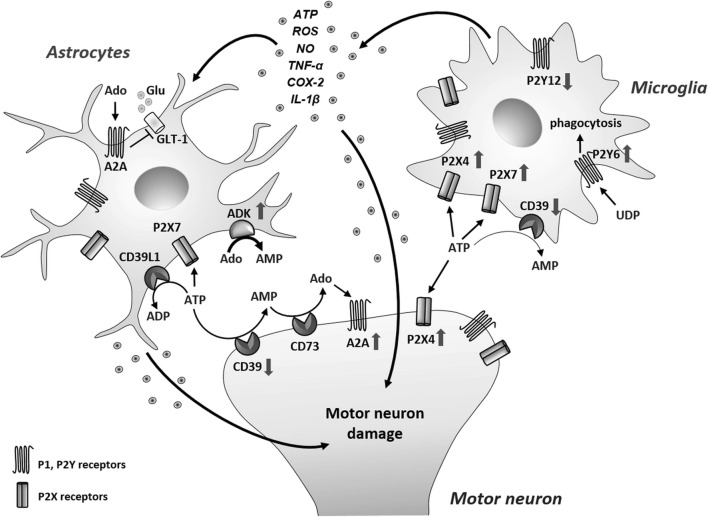
Amyotrophic lateral sclerosis (ALS) is a clinically heterogeneous disorder characterized by degeneration of upper motor neurons in the brainstem and lower motor neurons in the spinal cord. Multiple mechanisms of motor neuron injury have been implicated, including more than 20 different genetic factors. The pathogenesis of ALS consists of two stages: an early neuroprotective stage and a later neurotoxic. During early phases of disease progression, the immune system through glial and T cell activities provides anti-inflammatory factors that sustain motor neuron viability. As the disease progresses and motor neuron injury accelerates, a rapidly succeeding neurotoxic phase develops. A well-orchestrated purine-mediated dialog among motor neurons, surrounding glia and immune cells control the beneficial and detrimental activities occurring in the nervous system. In general, low adenosine triphosphate (ATP) concentrations protect cells against excitotoxic stimuli through purinergic P2X4 receptor, whereas high concentrations of ATP trigger toxic P2X7 receptor activation. Finally, adenosine is also involved in ALS progression since A2A receptor antagonists prevent motor neuron death. Given the complex cellular cross-talk occurring in ALS and the recognized function of extracellular nucleotides and adenosine in neuroglia communication, the comprehensive understanding of purinome dynamics might provide new research perspectives to decipher ALS and help to design more efficient and targeted drugs. This review will focus on the purinergic players involved in ALS etiology and disease progression and current therapeutic strategies to enhance neuroprotection and suppress neurotoxicity.
肌萎缩侧索硬化症(ALS)是一种临床异质性疾病,其特征是脑干的上运动神经元和脊髓的下运动神经元退化。多种运动神经元损伤机制已被涉及,包括 20 多种不同的遗传因素。ALS 的发病机制包括两个阶段:早期神经保护阶段和晚期神经毒性阶段。在疾病进展的早期阶段,免疫系统通过胶质细胞和 T 细胞的活动提供抗炎因子,维持运动神经元的活力。随着疾病的进展和运动神经元损伤的加速,会出现一个迅速发展的神经毒性阶段。运动神经元、周围神经胶质细胞和免疫细胞之间协调良好的嘌呤介导对话控制着神经系统中有益和有害的活动。一般来说,低三磷酸腺苷(ATP)浓度通过嘌呤能 P2X4 受体保护细胞免受兴奋毒性刺激,而高浓度的 ATP 则触发有毒的 P2X7 受体激活。最后,由于 A2A 受体拮抗剂可防止运动神经元死亡,因此腺苷也参与了 ALS 的进展。鉴于 ALS 中发生的复杂细胞交叉对话以及细胞外核苷酸和腺苷在神经胶质通讯中的已知功能,全面了解嘌呤体动力学可能为破译 ALS 提供新的研究视角,并有助于设计更有效和有针对性的药物。本综述将重点介绍参与 ALS 病因和疾病进展的嘌呤能参与者以及目前增强神经保护和抑制神经毒性的治疗策略。