Institut Pasteur, Montevideo, Uruguay.
J Neuroinflammation. 2010 Jun 9;7:33. doi: 10.1186/1742-2094-7-33.
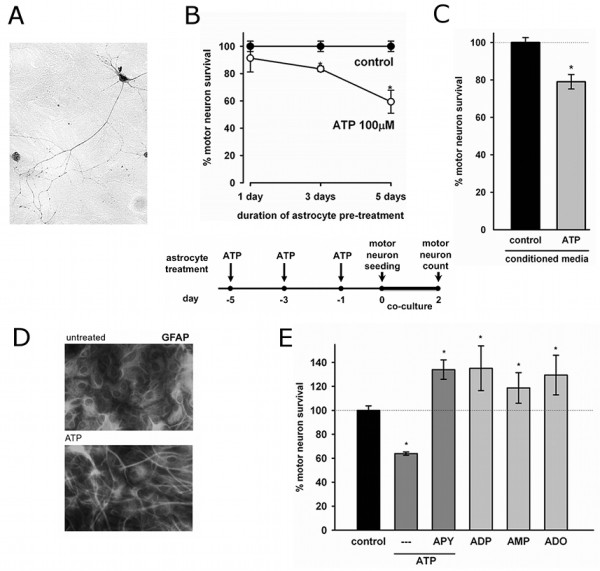
During pathology of the nervous system, increased extracellular ATP acts both as a cytotoxic factor and pro-inflammatory mediator through P2X(7) receptors. In animal models of amyotrophic lateral sclerosis (ALS), astrocytes expressing superoxide dismutase 1 (SOD1G93A) mutations display a neuroinflammatory phenotype and contribute to disease progression and motor neuron death. Here we studied the role of extracellular ATP acting through P2X(7) receptors as an initiator of a neurotoxic phenotype that leads to astrocyte-mediated motor neuron death in non-transgenic and SOD1G93A astrocytes.
We evaluated motor neuron survival after co-culture with SOD1G93A or non-transgenic astrocytes pretreated with agents known to modulate ATP release or P2X(7) receptor. We also characterized astrocyte proliferation and extracellular ATP degradation.
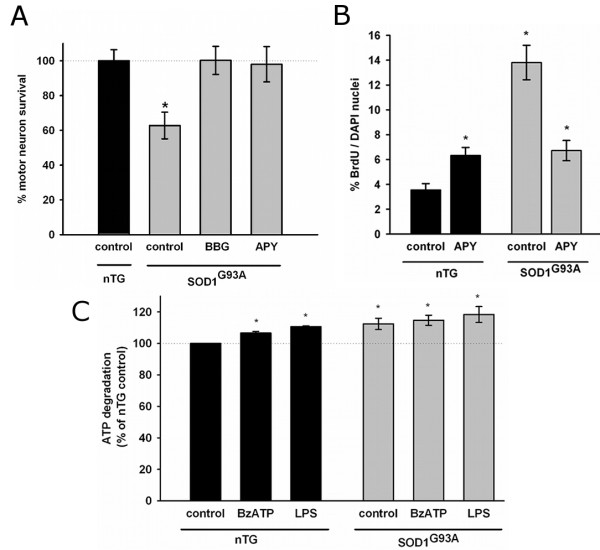
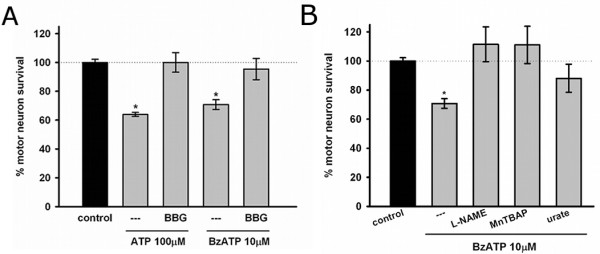
Repeated stimulation by ATP or the P2X(7)-selective agonist BzATP caused astrocytes to become neurotoxic, inducing death of motor neurons. Involvement of P2X(7) receptor was further confirmed by Brilliant blue G inhibition of ATP and BzATP effects. In SOD1G93A astrocyte cultures, pharmacological inhibition of P2X(7) receptor or increased extracellular ATP degradation with the enzyme apyrase was sufficient to completely abolish their toxicity towards motor neurons. SOD1G93A astrocytes also displayed increased ATP-dependent proliferation and a basal increase in extracellular ATP degradation.
Here we found that P2X(7) receptor activation in spinal cord astrocytes initiated a neurotoxic phenotype that leads to motor neuron death. Remarkably, the neurotoxic phenotype of SOD1G93A astrocytes depended upon basal activation the P2X(7) receptor. Thus, pharmacological inhibition of P2X(7) receptor might reduce neuroinflammation in ALS through astrocytes.
在神经系统病理学中,细胞外 ATP 的增加既作为细胞毒性因子,又作为通过 P2X(7)受体的促炎介质起作用。在肌萎缩侧索硬化症 (ALS) 的动物模型中,表达超氧化物歧化酶 1 (SOD1G93A) 突变的星形胶质细胞表现出神经炎症表型,并有助于疾病进展和运动神经元死亡。在这里,我们研究了细胞外 ATP 通过 P2X(7)受体发挥作用作为引发神经毒性表型的作用,该表型导致非转基因和 SOD1G93A 星形胶质细胞介导的运动神经元死亡。
我们评估了与经预处理以调节 ATP 释放或 P2X(7)受体的药物共培养后的运动神经元存活情况。我们还对星形胶质细胞的增殖和细胞外 ATP 降解进行了表征。
重复刺激 ATP 或 P2X(7)-选择性激动剂 BzATP 导致星形胶质细胞产生神经毒性,诱导运动神经元死亡。Brilliant blue G 抑制 ATP 和 BzATP 作用进一步证实了 P2X(7)受体的参与。在 SOD1G93A 星形胶质细胞培养物中,P2X(7)受体的药理学抑制或用酶 apyrase 增加细胞外 ATP 降解足以完全消除它们对运动神经元的毒性。SOD1G93A 星形胶质细胞还表现出增加的 ATP 依赖性增殖和基础上增加的细胞外 ATP 降解。
在这里,我们发现脊髓星形胶质细胞中 P2X(7)受体的激活引发了导致运动神经元死亡的神经毒性表型。值得注意的是,SOD1G93A 星形胶质细胞的神经毒性表型取决于基础激活的 P2X(7)受体。因此,P2X(7)受体的药理学抑制可能通过星形胶质细胞减少 ALS 中的神经炎症。