University of Nigeria Department of Medical Rehabilitation, Enugu, Nigeria.
Glasgow Caledonian University School of Health and Life Sciences, Glasgow, United Kingdom.
PLoS One. 2018 Nov 15;13(11):e0207456. doi: 10.1371/journal.pone.0207456. eCollection 2018.
Peripheral arterial disease (PAD) has a significant negative impact on the quality of life of individuals. Understanding the experiences of people living with PAD will be useful in developing comprehensive patient-centred secondary prevention therapies for this population.
The aim of this study is to identify first-hand accounts of patients' experiences of living with PAD.
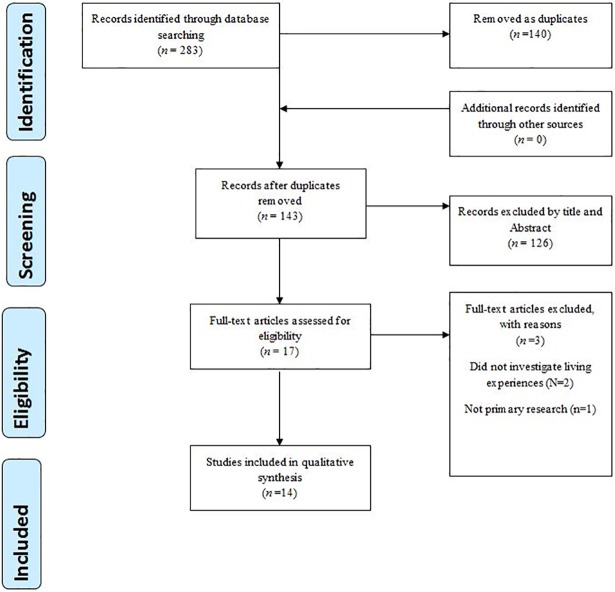
Six databases (CINALH, PsyclNFO, MEDLINE, AMED, EMBASE, Social citation index/Science citation index via Web of Science (WOS)) and reference lists of identified studies were searched until September 2017 (updated February 2018). Qualitative studies reporting patients' account of living with PAD were eligible for inclusion. A framework thematic synthesis was implemented.
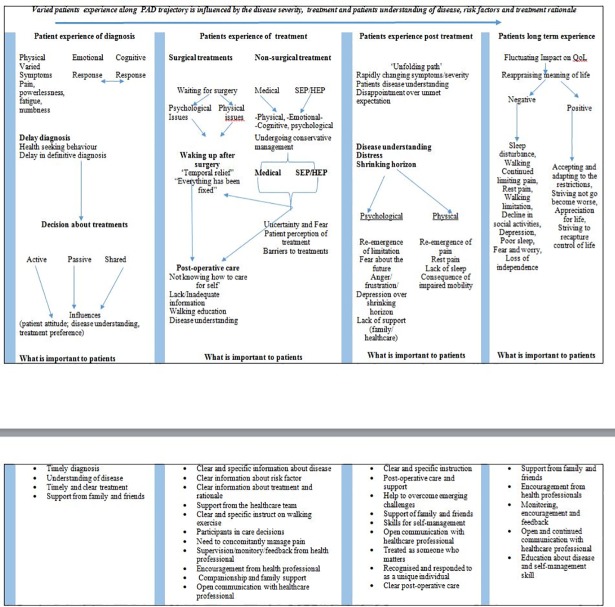
Fourteen studies with 360 participants were included. Pain and walking limitation were recurrent among the varied symptom descriptions. Patients' ignorance and trivialisation of symptoms contributed to delays in diagnosis. Inadequate engagement in disease understanding and treatment decisions meant patients had poor attitudes towards walking treatments and unrealistic expectations about surgery. Depending on symptom progression, patients battle with walking impairment, powerlessness, and loss of independence which were a source of burden to them. Lack of disease understanding is central through patients' journey with PAD and, although they subsequently began adaptation to long term living with PAD, many worried about their future.
Disease understanding is vital across the illness trajectory in patients with PAD. Although certain experiences are common throughout patient journey, some might be unique to a particular stage (e.g. unrealistic expectation about surgery, or rationale of walking in spite of pain in a supervised exercise program). Given that PAD is an overarching construct ranging from the mildest form of intermittent claudication to severe critical limb ischemia with ulceration and gangrene, consideration of important patient constructs specific to each stage of the disease may enhance treatment success. Systematic review registration CRD42017070417.
外周动脉疾病(PAD)会显著降低个体的生活质量。了解患有 PAD 的人群的体验对于为该人群开发全面的以患者为中心的二级预防治疗方法将非常有帮助。
本研究旨在确定患者对 PAD 生活体验的第一手描述。
直到 2017 年 9 月(2018 年 2 月更新),共检索了 6 个数据库(CINALH、PsyclNFO、MEDLINE、AMED、EMBASE、通过 Web of Science(WOS)的社会引文索引/科学引文索引)和已确定研究的参考文献列表。有资格入选的研究是报告患者 PAD 生活体验的定性研究。实施了框架主题综合分析。
纳入了 14 项研究,共 360 名参与者。在各种症状描述中,疼痛和行走受限是反复出现的。患者对症状的忽视和轻视导致了诊断的延误。对疾病的理解和治疗决策的参与不足意味着患者对行走治疗的态度较差,对手术的期望不切实际。根据症状的进展,患者与行走障碍、无力和丧失独立性作斗争,这给他们带来了负担。缺乏疾病的认识贯穿患者 PAD 之旅的始终,尽管他们随后开始适应长期的 PAD 生活,但许多人担心自己的未来。
在 PAD 患者的疾病病程中,疾病理解至关重要。虽然整个患者旅程中存在某些共同的经历,但有些可能是特定阶段特有的(例如对手术的不切实际的期望,或在监督下的锻炼计划中尽管有疼痛仍坚持行走的理由)。鉴于 PAD 是一个从最轻微的间歇性跛行到严重的肢体缺血伴有溃疡和坏疽的广泛疾病,考虑到疾病每个阶段的重要患者特征可能会提高治疗成功率。系统评价注册 CRD42017070417。