1 Department of Neurosurgery, Affiliated Hospital of Southwest Medical University, Luzhou, Sichuan, China.
2 Department of Vasculocardiology, Affiliated Hospital of Southwest Medical University, Luzhou, Sichuan, China.
Cell Transplant. 2019 Jan;28(1):26-35. doi: 10.1177/0963689718812054. Epub 2018 Nov 16.
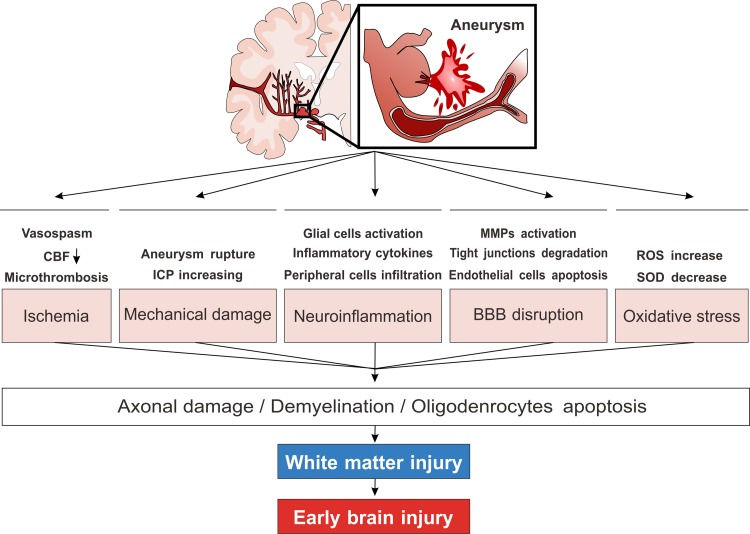
Subarachnoid hemorrhage (SAH) is a major cause of high morbidity, disability, and mortality in the field of neurovascular disease. Most previous SAH studies have focused on improving cerebral blood flow, reducing cerebral vasospasm, reducing neuronal calcium overload, and other treatments. While these studies showed exciting findings in basic science, therapeutic strategies based on the findings have not significantly improved neurological outcomes in patients with SAH. Currently, the only drug proven to effectively reduce the neurological defects of SAH patients is nimodipine. Current advances in imaging technologies in the field of stroke have confirmed that white matter injury (WMI) plays an important role in the prognosis of types of stroke, and suggests that WMI protection is essential for functional recovery and poststroke rehabilitation. However, WMI injury in relation to SAH has remained obscure until recently. An increasing number of studies suggest that the current limitations for SAH treatment are probably linked to overlooked WMI in previous studies that focused only on neurons and gray matter. In this review, we discuss the biology and functions of white matter in the normal brain, and discuss the potential pathophysiology and mechanisms of early brain injury after SAH. Our review demonstrates that WMI encompasses multiple substrates, and, therefore, more than one pharmacological approach is necessary to preserve WMI and prevent neurobehavioral impairment after SAH. Strategies targeting both neuronal injury and WMI may potentially provide a novel future for SAH knowledge and treatment.
蛛网膜下腔出血(SAH)是神经血管疾病领域高发病率、高致残率和高死亡率的主要原因。大多数先前的 SAH 研究都集中在改善脑血流、减少脑血管痉挛、减少神经元钙超载等治疗方法上。虽然这些研究在基础科学方面取得了令人兴奋的发现,但基于这些发现的治疗策略并没有显著改善 SAH 患者的神经预后。目前,唯一被证明能有效降低 SAH 患者神经缺陷的药物是尼莫地平。目前中风领域成像技术的进步已经证实,脑白质损伤(WMI)在各种中风类型的预后中起着重要作用,并且表明 WMI 保护对于功能恢复和中风后康复至关重要。然而,直到最近,SAH 与 WMI 的关系仍然不清楚。越来越多的研究表明,目前 SAH 治疗的局限性可能与以前只关注神经元和灰质的研究中忽视的 WMI 有关。在这篇综述中,我们讨论了正常大脑中白质的生物学和功能,并讨论了 SAH 后早期脑损伤的潜在病理生理学和机制。我们的综述表明,WMI 包含多个底物,因此,需要不止一种药理学方法来保护 WMI 并防止 SAH 后的神经行为障碍。针对神经元损伤和 WMI 的策略可能为 SAH 的知识和治疗提供新的未来。