Bruhns Ryan P, James Whitney S, Torabi Mohammad, Borgstrom Mark, Roussas Adam, Lemole Michael
Surgery, Banner University Medical Center, Tucson, USA.
Neurological Surgery, Banner University Medical Center, Tucson, USA.
Cureus. 2018 Sep 10;10(9):e3277. doi: 10.7759/cureus.3277.
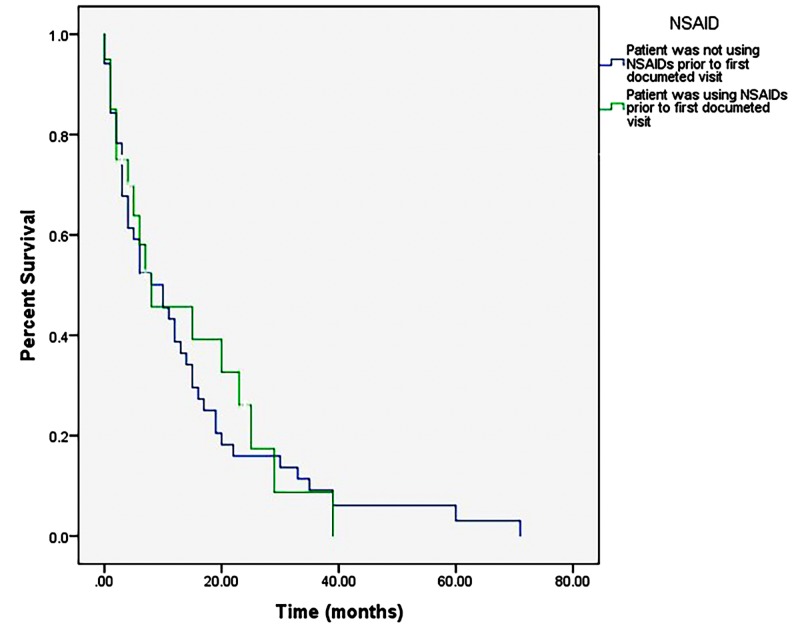
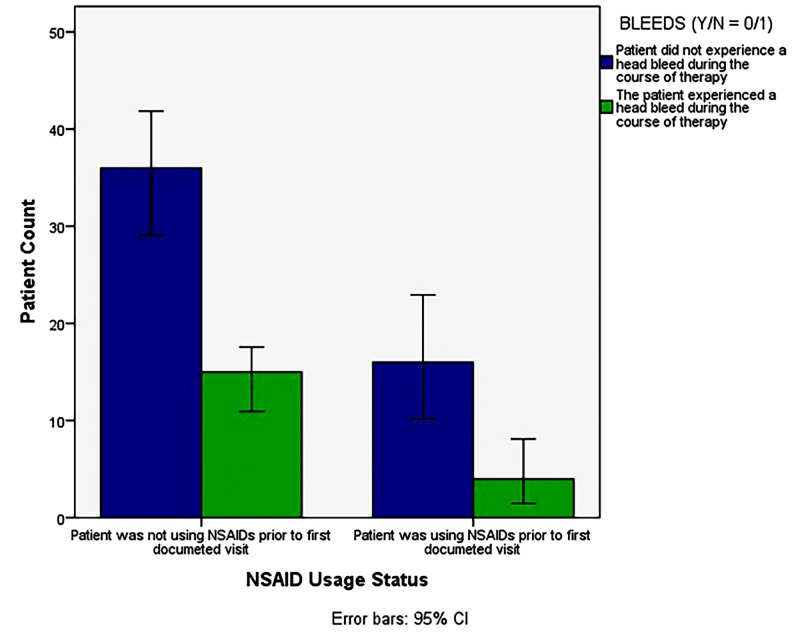
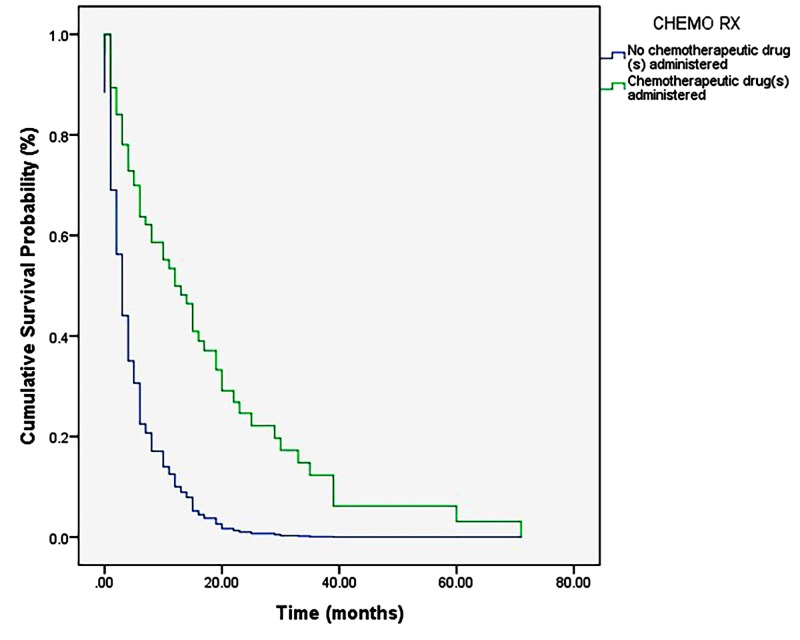
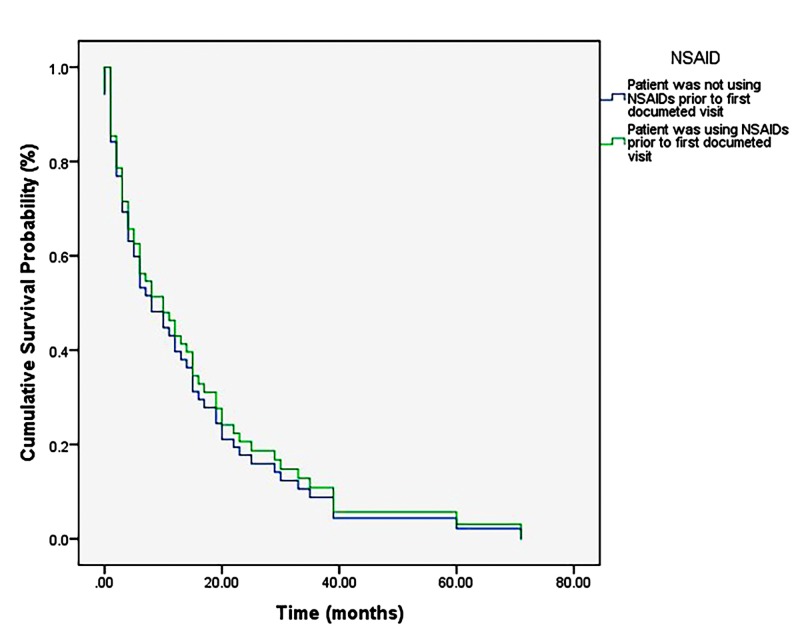
Background Findings of both case control and in vitro investigations suggest that non-steroidal anti-inflammatory drugs (NSAIDs) may play a beneficial role in the occurrence, growth, and subsistence of glioblastoma multiforme (GBM) brain tumor in humans. Objective In the present retrospective cohort study, we assessed the impact of NSAID use on survival in patients diagnosed with and treated for GBM brain tumors. Methods The impact of NSAID use and six other potential prognostic indicators of survival were assessed in 71 patients treated for GBM brain tumors from February 2011 to June 2016. Survival analysis and cross-tabulation analyses were performed to examine the potential relationship between NSAID use and occurrence of intracranial hemorrhage over the course of treatment for GBM. Results Kaplan-Meier analysis revealed no significant difference in survival between patients with and without NSAID use (p = 0.75; 95% CI: 10.12, 18.13). Multiple Cox regression analysis identified only treatment with chemotherapy as imposing any statistically significant effect on survival (Hazard Ratio (HR) = 3.31; p < 0.001; 95% CI: 1.80, 6.07). Cross-tabulation revealed no significant effect of NSAID use on occurrence of hemorrhage during treatment, X (2, N = 71) = 0.65, p = 0.42, (Fisher's Exact Test: p2-sided = 0.56, p1-sided = 0.31). Conclusion These results suggest that history of NSAID use is not a determinant of survival in GBM patients. More rigorous, prospective investigations of the effect of NSAID use on tumor progression are necessary before the utility of this family of drugs in the treatment of GBM can be adequately appraised.
病例对照研究和体外研究的结果均表明,非甾体抗炎药(NSAIDs)可能在人类多形性胶质母细胞瘤(GBM)脑肿瘤的发生、生长和存活中发挥有益作用。目的:在本回顾性队列研究中,我们评估了使用NSAIDs对被诊断为GBM脑肿瘤并接受治疗的患者生存情况的影响。方法:对2011年2月至2016年6月期间接受GBM脑肿瘤治疗的71例患者,评估了使用NSAIDs和其他六个潜在的生存预后指标的影响。进行生存分析和交叉表分析,以研究在GBM治疗过程中使用NSAIDs与颅内出血发生之间的潜在关系。结果:Kaplan-Meier分析显示,使用NSAIDs和未使用NSAIDs的患者在生存方面无显著差异(p = 0.75;95%CI:10.12,18.13)。多因素Cox回归分析仅确定化疗对生存有任何统计学上的显著影响(风险比(HR)= 3.31;p < 0.001;95%CI:1.80,6.07)。交叉表显示,使用NSAIDs对治疗期间出血的发生无显著影响,X(2,N = 71) = 0.65,p = 0.42,(Fisher精确检验:双侧p = 0.56,单侧p = 0.31)。结论:这些结果表明,使用NSAIDs的病史不是GBM患者生存的决定因素。在能够充分评估这类药物在GBM治疗中的效用之前,有必要对使用NSAIDs对肿瘤进展的影响进行更严格的前瞻性研究。