Kamaruzaman Naila A Che, Mašán Peter, Velásquez Yelitza, González-Medina Alejandro, Lindström Anders, Braig Henk R, Perotti M Alejandra
Ecology and Evolutionary Biology Section, School of Biological Sciences, University of Reading, RG6 6AS, Reading, UK.
Institute of Zoology, Slovak Academy of Sciences, 845 06, Bratislava, Slovakia.
Exp Appl Acarol. 2018 Dec;76(4):453-471. doi: 10.1007/s10493-018-0321-4. Epub 2018 Nov 15.
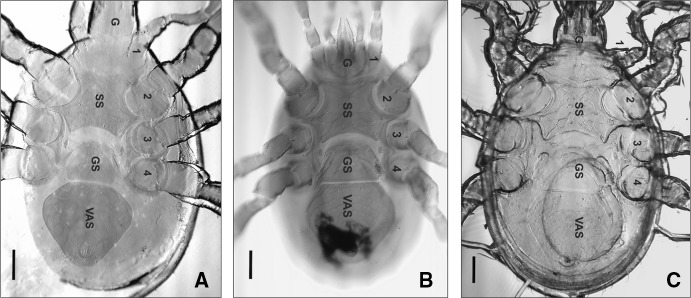
The biology of macrochelid mites might offer new venues for the interpretation of the environmental conditions surrounding human death and decomposition. Three human corpses, one from Sweden and two from Spain, have been analysed for the occurrence of Macrochelidae species. Macrocheles muscaedomesticae (Scopoli) females were associated with a corpse that was found in a popular beach area of southeast Spain. Their arrival coincides with the occurrence of one of their major carrier species, the filth fly Fannia scalaris, the activity of which peaks during mid-summer. Macrocheles glaber (Müller) specimens were collected from a corpse in a shallow grave in a forest in Sweden at the end of summer, concurrent with the arrival of beetles attracted by odours from the corpse. Macrocheles perglaber Filipponi and Pegazzano adults were sampled from a corpse found indoors in the rural surroundings of Granada city, south Spain. The phoretic behaviour of this species is similar to that of M. glaber, but it is more specific to Scarabaeidae and Geotrupidae dung beetles, most of which favour human faeces. Macrocheles muscaedomesticae is known from urban and rural areas and poultry farms, M. glaber from outdoors, particularly the countryside, whereas M. perglaber is known from outdoor, rural, and remote, potentially mountainous locations. Macrocheles muscaedomesticae and M. perglaber are reported for the first time from the Iberian Peninsula. This is the first record of M. perglaber from human remains.
巨螯螨的生物学特性可能为解读人类死亡和尸体分解周围的环境条件提供新的途径。对三具人类尸体进行了分析,其中一具来自瑞典,两具来自西班牙,以确定巨螯螨科物种的存在情况。家蝇巨螯螨(Scopoli)雌螨与一具在西班牙东南部一个热门海滩地区发现的尸体有关。它们的到来与它们的主要携带物种之一——污蝇扇尾蝇的出现相吻合,扇尾蝇的活动在仲夏达到高峰。光滑巨螯螨(Müller)标本是在夏末从瑞典一片森林中浅坟里的一具尸体上采集到的,同时还有被尸体气味吸引而来的甲虫。佩氏巨螯螨菲利波尼和佩加扎诺成虫是从西班牙南部格拉纳达市农村地区一户室内发现的尸体上采集到的。该物种的携播行为与光滑巨螯螨相似,但它更特异地与金龟科和粪金龟科粪甲虫有关,其中大多数喜欢人类粪便。家蝇巨螯螨在城市和农村地区以及家禽养殖场都有发现,光滑巨螯螨在户外,特别是农村地区有发现,而佩氏巨螯螨在户外、农村和偏远的、可能是山区的地点有发现。家蝇巨螯螨和佩氏巨螯螨首次在伊比利亚半岛被报道。这是佩氏巨螯螨在人类遗体上的首次记录。