Valencia Rachel, Wang Li Yan, Dunville Richard, Sharma Akshay, Sanchez Travis, Rosenberg Eli
Department of Epidemiology, Emory University Rollins School of Public Health, 1518 Clifton Road NE, Atlanta, GA, 30322, USA.
Division of Adolescent and School Health, Centers for Disease Control and Prevention, Atlanta, GA, 30329, USA.
J Prim Prev. 2018 Dec;39(6):619-645. doi: 10.1007/s10935-018-0525-8.
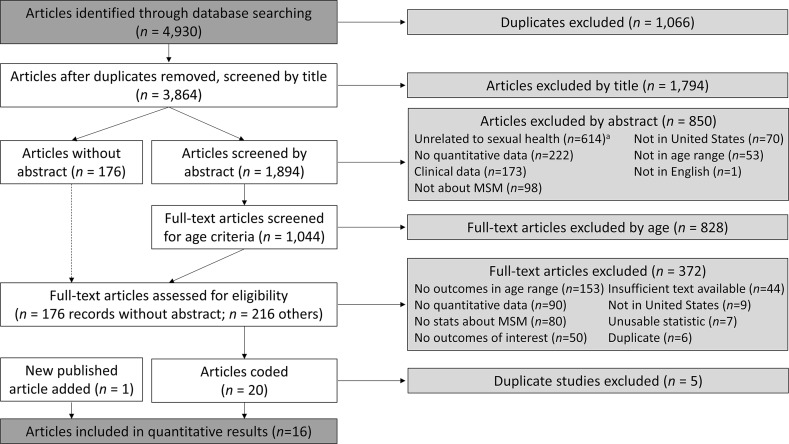
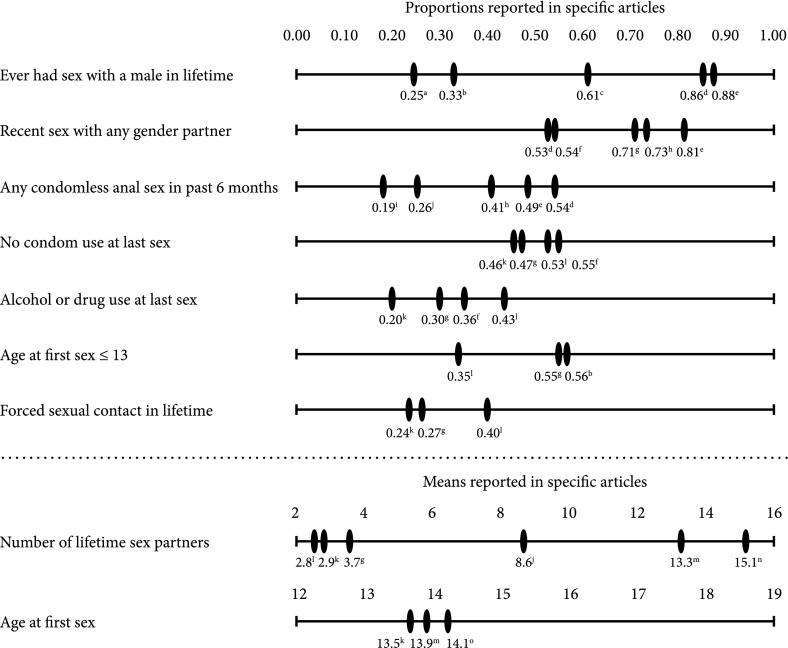
Although adolescent sexual minority males (ASMM) are at increased risk for human immunodeficiency virus (HIV) in the United States (US), studies that estimate sexual risk behaviors that contribute to HIV risk in ASMM are limited. We completed a systematic review and meta-analysis to compile available data and estimate the prevalence of risk behaviors in this population. We searched four databases for key terms related to ASMM, defined as males aged 14 through 19 who identified as gay or bisexual, reported sex with a male in their lifetime, and/or were considered sexual minority by the study. Articles eligible for inclusion were in English, from US studies, and reported quantitative data on sexual risk behaviors among ASMM. We extracted data from eligible articles and meta-analyzed outcomes reported in three or more articles using random effects. Of 3864 articles identified, 21 were eligible for data extraction. We meta-analyzed nine outcomes. Sixty-two percent of adolescent males self-identifying as gay or bisexual ever had sex with a male, and 67% of participants from ASMM studies recently had sex. Among ASMM who had sex in the last 6 months or were described as sexually active, 44% had condomless anal intercourse in the past 6 months, 50% did not use a condom at last sex, and 32% used alcohol or drugs at their last sexual experience. Available data indicate that sexual risk behaviors are prevalent among ASMM. We need more data to obtain estimates with better precision and generalizability. Understanding HIV risk in ASMM will assist in intervention development and evaluation, and inform behavioral mathematical models.
在美国,尽管青少年性少数男性(ASMM)感染人类免疫缺陷病毒(HIV)的风险有所增加,但评估导致ASMM感染HIV风险的性风险行为的研究却很有限。我们完成了一项系统综述和荟萃分析,以汇总现有数据并估计该人群中风险行为的流行率。我们在四个数据库中搜索了与ASMM相关的关键词,ASMM定义为年龄在14至19岁之间、自我认同为同性恋或双性恋、报告一生中与男性发生过性行为和/或被该研究视为性少数群体的男性。符合纳入标准的文章需为英文、来自美国的研究,并报告了ASMM中性风险行为的定量数据。我们从符合条件的文章中提取数据,并对三篇或更多文章中报告的结果进行随机效应荟萃分析。在识别出的3864篇文章中,有21篇符合数据提取条件。我们对九个结果进行了荟萃分析。自我认同为同性恋或双性恋的青少年男性中有62%曾与男性发生过性行为,ASMM研究中的参与者有67%最近有过性行为。在过去6个月内有过性行为或被描述为性活跃的ASMM中,44%在过去6个月内有无保护肛交行为,50%在最近一次性行为中未使用避孕套,32%在最近一次性经历中使用了酒精或毒品。现有数据表明,性风险行为在ASMM中很普遍。我们需要更多数据以获得更精确和更具普遍性的估计值。了解ASMM中的HIV风险将有助于制定和评估干预措施,并为行为数学模型提供信息。