Beck Ekkehard C, Birkett Michelle, Armbruster Benjamin, Mustanski Brian
*Department of Industrial Engineering and Management Science, Northwestern University McCormick School of Engineering, Evanston, IL; and †Department of Medical Social Sciences, Feinberg School of Medicine, Northwestern University, Chicago, IL.
J Acquir Immune Defic Syndr. 2015 Oct 1;70(2):186-94. doi: 10.1097/QAI.0000000000000733.
Young men who have sex with men (YMSM) in the United States have a high HIV incidence with substantial racial disparities that are poorly understood. We use a data-driven simulation model to understand the impact of network-level mechanisms and sexually transmitted infections on the spread of HIV among YMSM.
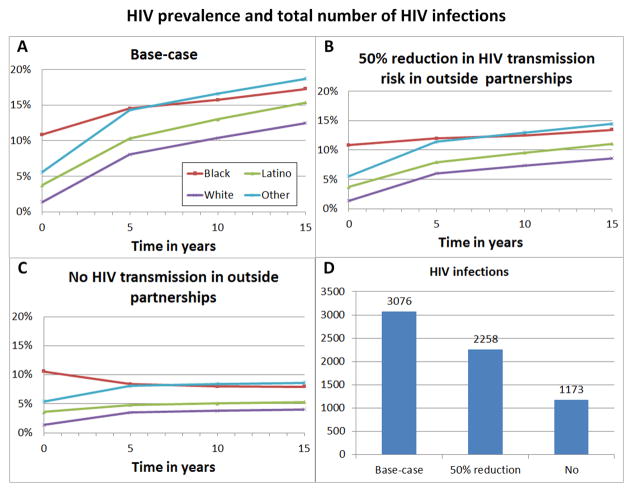
We designed and parameterized a stochastic agent-based network simulation model using results of a longitudinal cohort study of YMSM in Chicago. Within this model, YMSM formed and dissolved partnerships over time, and partnership types were stratified by length of partnership, sex, and age of the partner. In each partnership, HIV, gonorrhea, and chlamydia could be transmitted. Counterfactual scenarios were run to examine drivers of HIV.
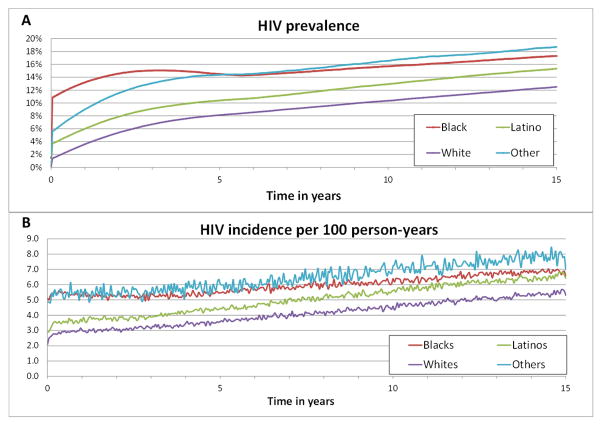
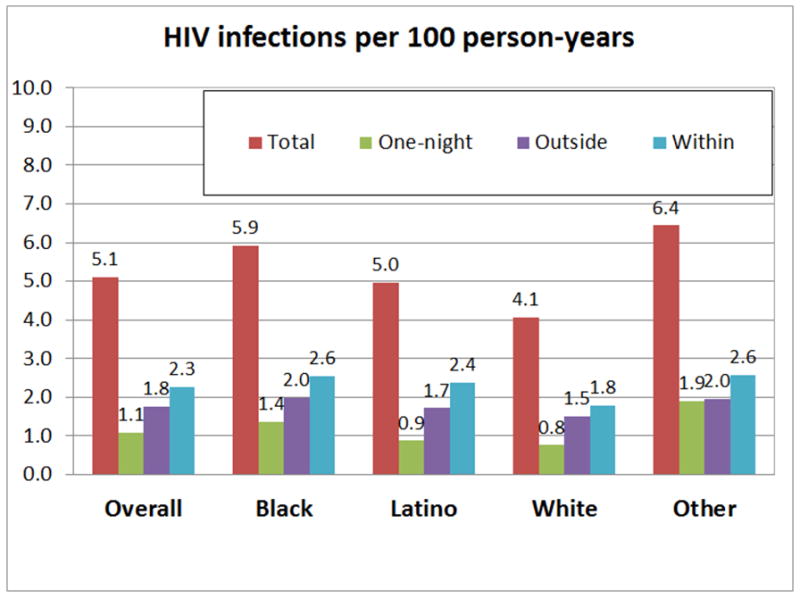
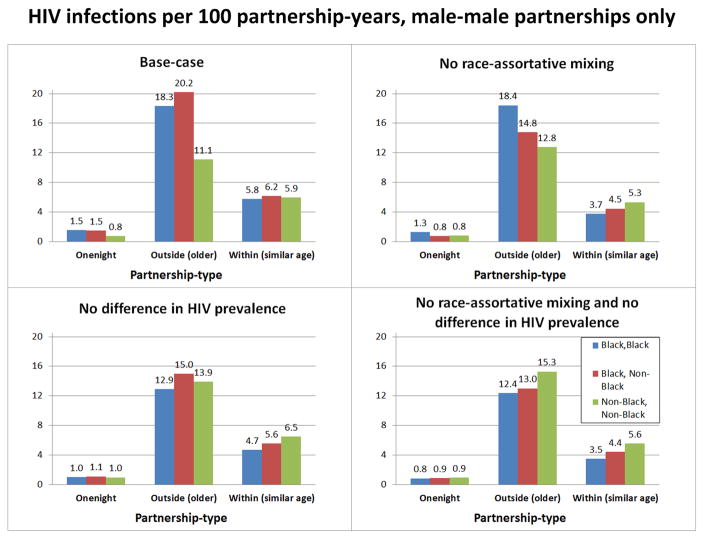
Over a 15-year simulation, the HIV epidemic among YMSM continued to rise, with Latino/white YMSM facing a steeper increase in the HIV burden compared with black YMSM. YMSM in partnerships with older MSM, in particular black YMSM with older black MSM, were at highest risk for HIV, and 1 infection prevented with an older partner would prevent 0.8 additional infections among YMSM. Additionally, racial disparities in HIV were driven by differences in the HIV prevalence of YMSM partners. Finally, of all HIV infections among YMSM, 14.6% were attributable to NG and CT infections.
Network-level mechanisms and sexually transmitted infections play a significant role in the spread of HIV and in racial disparities among YMSM. HIV prevention efforts should target YMSM across race, and interventions focusing on YMSM partnerships with older MSM might be highly effective.
美国男男性行为者(YMSM)的艾滋病毒感染率很高,且存在严重的种族差异,对此人们了解甚少。我们使用数据驱动的模拟模型来了解网络层面机制和性传播感染对YMSM中艾滋病毒传播的影响。
我们利用芝加哥YMSM纵向队列研究的结果,设计并参数化了一个基于主体的随机网络模拟模型。在这个模型中,YMSM随着时间的推移建立和解除性伴侣关系,性伴侣关系类型按关系持续时间、性别和伴侣年龄进行分层。在每段性伴侣关系中,艾滋病毒、淋病和衣原体都可能传播。通过运行反事实情景来研究艾滋病毒传播的驱动因素。
在为期15年的模拟中,YMSM中的艾滋病毒疫情持续上升,与黑人YMSM相比,拉丁裔/白人YMSM面临的艾滋病毒负担增长更为陡峭。与年长男男性行为者建立性伴侣关系的YMSM,尤其是与年长黑人男男性行为者建立性伴侣关系的黑人YMSM,感染艾滋病毒的风险最高,与年长伴侣发生一次性关系可预防0.8次YMSM之间的额外感染。此外,艾滋病毒的种族差异是由YMSM性伴侣的艾滋病毒流行率差异驱动的。最后,在YMSM的所有艾滋病毒感染中,14.6%可归因于淋病和衣原体感染。
网络层面机制和性传播感染在YMSM中艾滋病毒的传播以及种族差异方面发挥着重要作用。艾滋病毒预防工作应针对所有种族的YMSM,针对YMSM与年长男男性行为者性伴侣关系的干预措施可能非常有效。