Health Systems and Population Studies Division, icddr,b , Dhaka, Bangladesh.
Systematic Review Centre (SRC), Bangabandhu Sheikh Mujib Medical University (BSMMU), Dhaka, Bangladesh.
Syst Rev. 2018 Nov 17;7(1):196. doi: 10.1186/s13643-018-0867-6.
Universal health coverage (UHC) is a key area in post-2015 global agenda which has been incorporated as target for achieving health-related Sustainable Development Goals (SDGs). A global framework has been developed to monitor SDG indicators disaggregated by socioeconomic and demographic markers. This review identifies the indices used to measure socio-economic status (SES) in South Asian urban health studies.
Two reviewers searched six databases including Cochran Library, Medline, LILACS, Web of Science, Science Direct, and Lancet journals independently. All South Asian health studies covering urban population, with any research-designs, written in English language, and published between January 2000 and June 2016 were included. Two reviewers independently screened and assessed for selection of eligible articles for inclusion. Any conflict between the reviewers was resolved by a third reviewer.
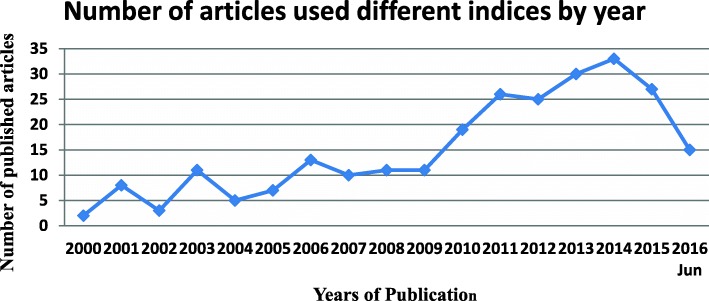
We retrieved 3529 studies through initial search. Through screening and applying inclusion and exclusion criteria, this review finally included 256 articles for full-text review. A total of 25 different SES indices were identified. SES indices were further categorized into 5 major groups, e.g., (1) asset-based wealth index, (2) wealth index combining education, (3) indices based on income and expenditure, (4) indices based on education and occupation, and (5) "indices without description." The largest proportion of studies, irrespective of country of origin, thematic area, and study design, used asset-based wealth index (n = 142, 54%) as inequality markers followed by the index based on income and expenditure (n = 80, 30%). Sri Lankan studies used income- and expenditure-based indices more than asset-based wealth index. Majority of the reviewed studies were on "maternal, neonatal, and child health" (n = 98, 38%) or on "non-communicable diseases" (n = 84, 33%). Reviewed studies were mostly from India (n = 145, 57%), Bangladesh (n = 42, 16%), and Pakistan (n = 27, 11%). Among the reviewed articles, 55% (n = 140) used primary data while the rest 45% studies used secondary data.
This scoping review identifies asset-based wealth index as the most frequently used indices for measuring socioeconomic status in South Asian urban health studies. This review also provides a clear idea about the use of other indices for the measurement SES in the region.
全民健康覆盖(UHC)是后 2015 年全球议程的一个关键领域,已被纳入实现与卫生相关的可持续发展目标(SDG)的目标。已经制定了一个全球框架来监测按社会经济和人口统计标志分类的 SDG 指标。本综述确定了用于衡量南亚城市健康研究中社会经济地位(SES)的指数。
两名审查员独立检索了六个数据库,包括 Cochrane 图书馆、Medline、LILACS、Web of Science、Science Direct 和 Lancet 期刊。所有涵盖城市人口的南亚健康研究,无论研究设计如何,均以英文撰写,并于 2000 年 1 月至 2016 年 6 月期间发表,均包括在内。两名审查员独立筛选并评估纳入符合条件的文章。如果审查员之间存在任何冲突,则由第三名审查员解决。
我们通过初步搜索检索到 3529 项研究。通过筛选并应用纳入和排除标准,本综述最终纳入了 256 篇全文综述文章。共确定了 25 种不同的 SES 指数。SES 指数进一步分为 5 大组,例如:(1)基于资产的财富指数,(2)结合教育的财富指数,(3)基于收入和支出的指数,(4)基于教育和职业的指数,以及(5)“无描述的指数”。无论原籍国、主题领域和研究设计如何,大多数研究(n=142,54%)都使用基于资产的财富指数作为不平等标志物,其次是基于收入和支出的指数(n=80,30%)。斯里兰卡的研究比基于资产的财富指数更倾向于使用收入和支出为基础的指数。综述的大多数研究都集中在“母婴、新生儿和儿童健康”(n=98,38%)或“非传染性疾病”(n=84,33%)。综述的研究主要来自印度(n=145,57%)、孟加拉国(n=42,16%)和巴基斯坦(n=27,11%)。在综述的文章中,55%(n=140)使用了原始数据,其余 45%的研究使用了二手数据。
本范围界定综述确定基于资产的财富指数是南亚城市健康研究中用于衡量社会经济地位的最常用指数。本综述还提供了有关该地区用于衡量 SES 的其他指数的使用情况的清晰思路。