Department of Psychology, University of Houston, Houston, Texas.
Department of Psychological and Brain Sciences, University of Delaware, Newark, Delaware.
Biol Psychiatry. 2019 Feb 15;85(4):326-335. doi: 10.1016/j.biopsych.2018.09.020. Epub 2018 Oct 5.
Growing work points to the negative impact of early adverse experiences on the developing brain. An outstanding question concerns the extent to which early intervention can normalize trajectories of brain development in at-risk children. We tested this within the context of a randomized clinical trial of an early parenting program, the Attachment and Biobehavioral Catch-up (ABC), delivered to parents and infants monitored for maltreatment by Child Protective Services.
Families participated in the randomized clinical trial when children were 2.5 years of age or younger. Parenting and home adversity was measured at baseline. Children were followed longitudinally, and resting brain activity was measured electrophysiologically (n = 106) when children reached 8 years of age. Spectral power was quantified and compared across children assigned to the experimental intervention (ABC), a control intervention, and a low-risk comparison group (n = 76) recruited at the follow-up assessment.
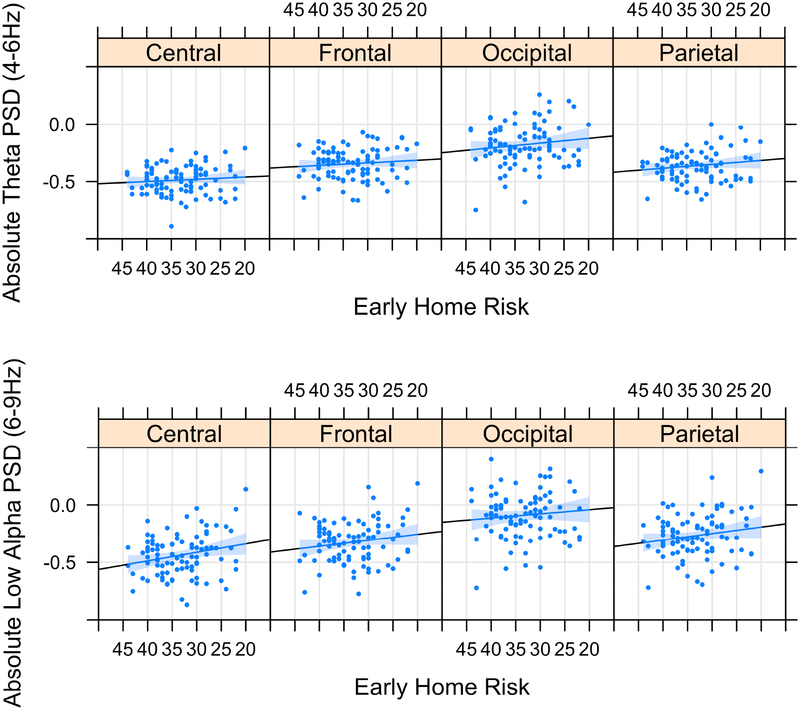
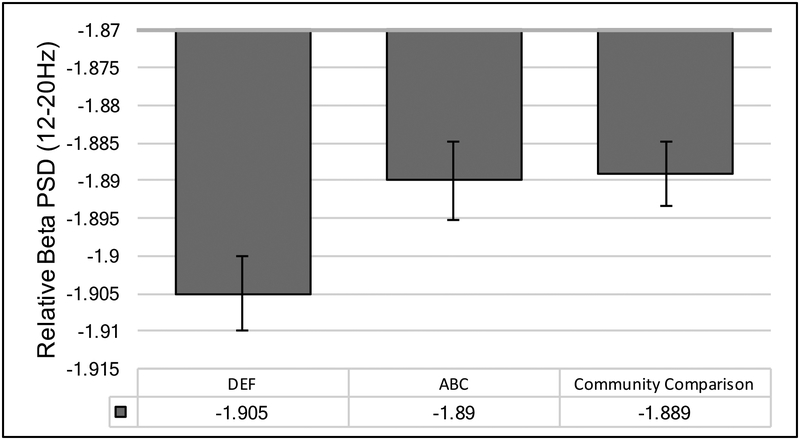
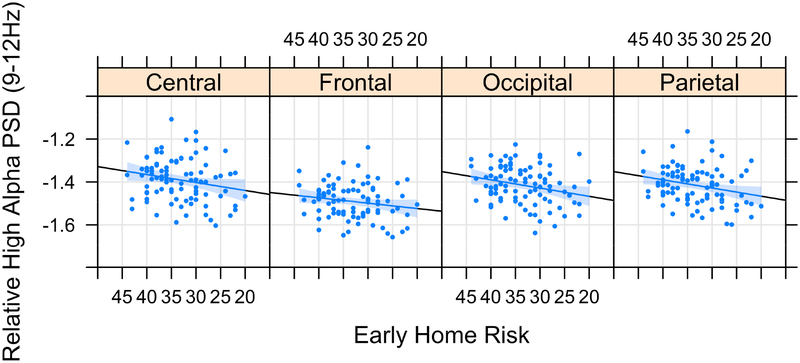
Higher early home adversity was associated with electrophysiological profiles indicative of cortical delays/immaturity in middle childhood, based on relatively greater power in lower frequency bands (theta, 4-6 Hz, and low alpha, 6-9 Hz) and lower power in a higher frequency band (high alpha, 9-12 Hz). Children assigned to ABC showed relatively greater high-frequency power (beta, 12-20 Hz) than children assigned to the control intervention. Beta power in the ABC did not differ from that of the low-risk comparison group.
Maltreatment risk and home adversity can affect indicators of middle childhood brain maturation. Early parenting programs can support more normative patterns of neural function during middle childhood.
越来越多的研究表明,早期不良经历对大脑发育有负面影响。一个悬而未决的问题是,早期干预在多大程度上可以使处于高危状态的儿童的大脑发育轨迹正常化。我们在一项针对早期育儿计划的随机临床试验中对此进行了测试,该计划名为依恋和生物行为追赶(ABC),针对的是受到儿童保护服务机构监测的虐待风险的父母和婴儿。
当孩子在 2.5 岁或更小的时候,家庭参与了随机临床试验。在基线时测量了育儿和家庭逆境。对孩子进行了纵向跟踪,当孩子达到 8 岁时,用电生理学方法测量了他们的静息大脑活动(n=106)。对被分配到实验组(ABC)、对照组和在随访评估中招募的低风险对照组(n=76)的儿童进行了频谱功率量化和比较。
较高的早期家庭逆境与电生理特征相关,表明皮质延迟/不成熟,表现为较低频率带(θ,4-6 Hz 和低α,6-9 Hz)的功率较高,较高频率带(高α,9-12 Hz)的功率较低。被分配到 ABC 的儿童表现出相对较高的高频功率(β,12-20 Hz),比被分配到对照组的儿童更高。ABC 中的β功率与低风险对照组没有差异。
虐待风险和家庭逆境会影响儿童中期大脑成熟的指标。早期育儿计划可以在儿童中期支持更正常的神经功能模式。