Seol Young Mi, Kwon Chae Hwa, Lee So Jeong, Lee Seon Jin, Choi Yuri, Choi Young Jin, Kim Hyojeong, Park Do Youn
Department of Hemato-oncology, Pusan National University Hospital and Pusan National University School of Medicine, 179, Gudeok-ro, Seo-gu, Busan 49241, Republic of Korea; BioMedical Research Institute, Pusan National University Hospital, 1-10 Ami-Dong, Seo-Gu, Busan 602-739, Republic of Korea.
BioMedical Research Institute, Pusan National University Hospital, 1-10 Ami-Dong, Seo-Gu, Busan 602-739, Republic of Korea.
Transl Oncol. 2019 Feb;12(2):301-307. doi: 10.1016/j.tranon.2018.10.011. Epub 2018 Nov 16.
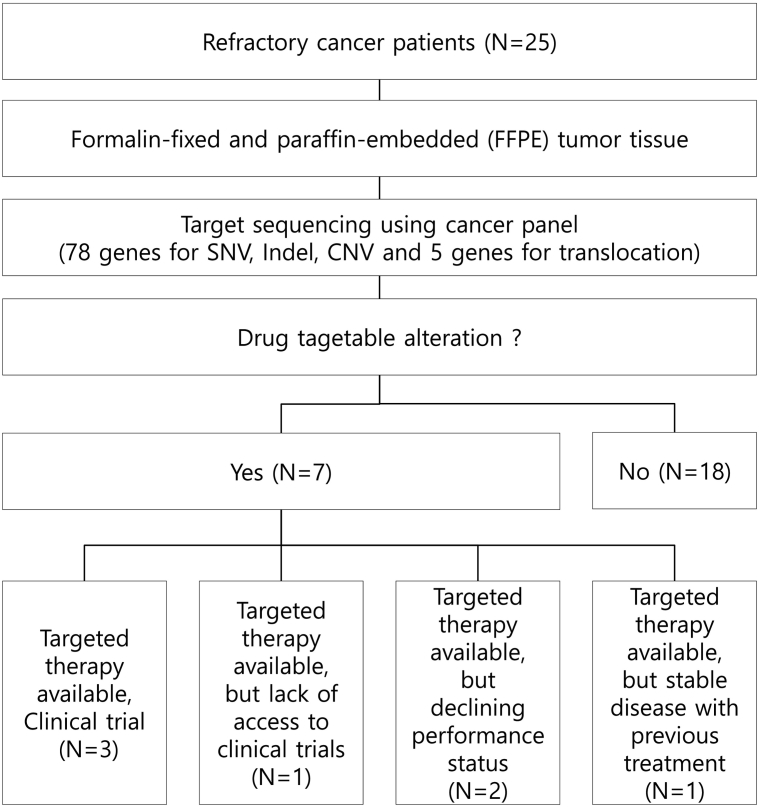
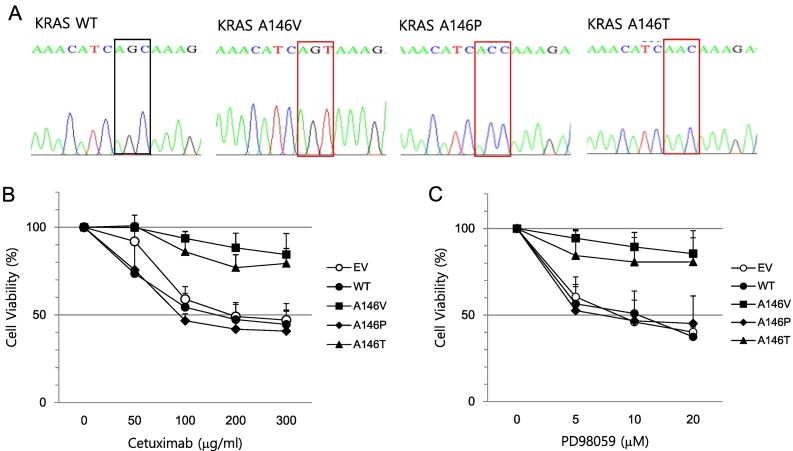
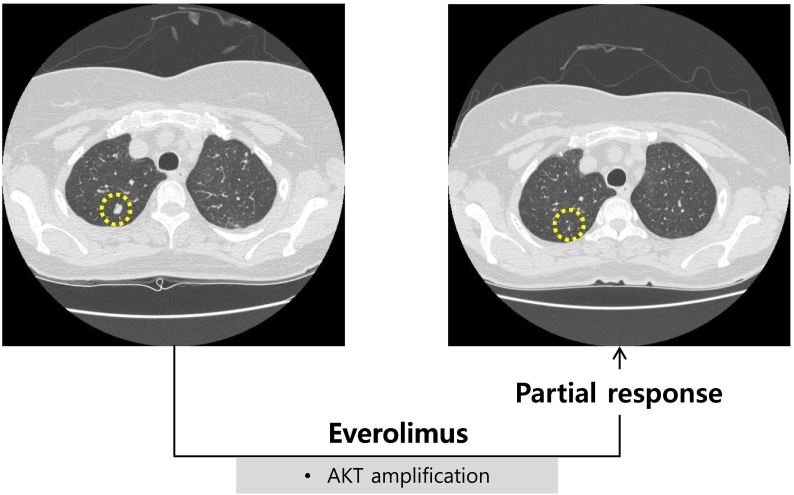
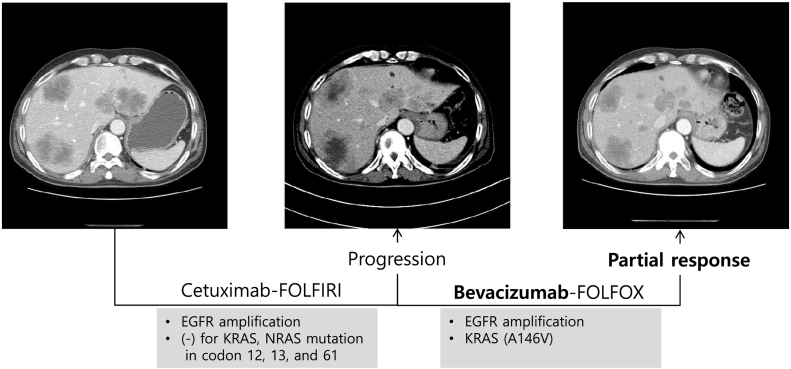
With the advent of next-generation sequencing (NGS), targeted sequencing is now contributing to decision making for which chemotherapeutics to administer to cancer patients, especially in refractory and metastatic cancer. Given that most patients with refractory cancer develop resistance to chemotherapy and have few treatment options, we performed NGS test to evaluate the efficacy and clinical feasibility of NGS-based targeted anticancer therapy. We used a gene panel for capturing target regions covering 83 cancer-related genes. A total of 25 refractory metastatic solid tumor patients were enrolled in this study. Among the 25 patients, 7 had FDA-approved drug-responsive or -resistant alterations. However, the effectiveness of targeted therapy was assessed by follow-up in three patients (12%). These included crizotinib for ALK-EML4 fusion in a malignancy of undefined origin patient and everolimus for AKT3 amplification in a uterine sarcoma patient. In addition, we identified a KRAS codon 146 mutation (A146V), which is associated with resistance to anti-EGFR, in a cetuximab-resistant colon cancer patient with wild-type KRAS exons 2 and 12, and EGFR amplification. He received bevacizumab therapy. All three patients showed partial response after targeted therapy. Furthermore, we characterized KRAS A146V biologically using colon cancer cells. In conclusion, this study suggests that targeted therapy based on NGS test may be a good choice for improving the care of patients with refractory solid tumors.
随着下一代测序(NGS)技术的出现,靶向测序如今正在为癌症患者化疗药物的选择提供决策依据,尤其是在难治性和转移性癌症中。鉴于大多数难治性癌症患者会对化疗产生耐药性且治疗选择有限,我们进行了NGS检测,以评估基于NGS的靶向抗癌治疗的疗效和临床可行性。我们使用了一个基因panel来捕获覆盖83个癌症相关基因的目标区域。本研究共纳入了25例难治性转移性实体瘤患者。在这25例患者中,7例存在FDA批准的药物敏感或耐药性改变。然而,仅对3例患者(12%)进行了随访以评估靶向治疗的有效性。其中包括对1例来源不明的恶性肿瘤患者使用克唑替尼治疗ALK-EML4融合,以及对1例子宫肉瘤患者使用依维莫司治疗AKT3扩增。此外,我们在1例野生型KRAS外显子2和12且EGFR扩增的西妥昔单抗耐药结肠癌患者中鉴定出与抗EGFR耐药相关的KRAS密码子146突变(A146V)。该患者接受了贝伐单抗治疗。所有3例患者在靶向治疗后均显示部分缓解。此外,我们使用结肠癌细胞对KRAS A146V进行了生物学特性分析。总之,本研究表明基于NGS检测的靶向治疗可能是改善难治性实体瘤患者治疗效果的一个不错选择。