Koya Yudai, Shibata Michihiko, Senju Michio, Honma Yuichi, Hiura Masaaki, Ishii Masahiro, Matsumoto Shirou, Harada Masaru
Third Department of Internal Medicine, School of Medicine, University of Occupational and Environmental Health, Japan.
Department of Pediatrics, School of Medicine, University of Occupational and Environmental Health, Japan.
Intern Med. 2019 Apr 1;58(7):937-942. doi: 10.2169/internalmedicine.1851-18. Epub 2018 Nov 19.
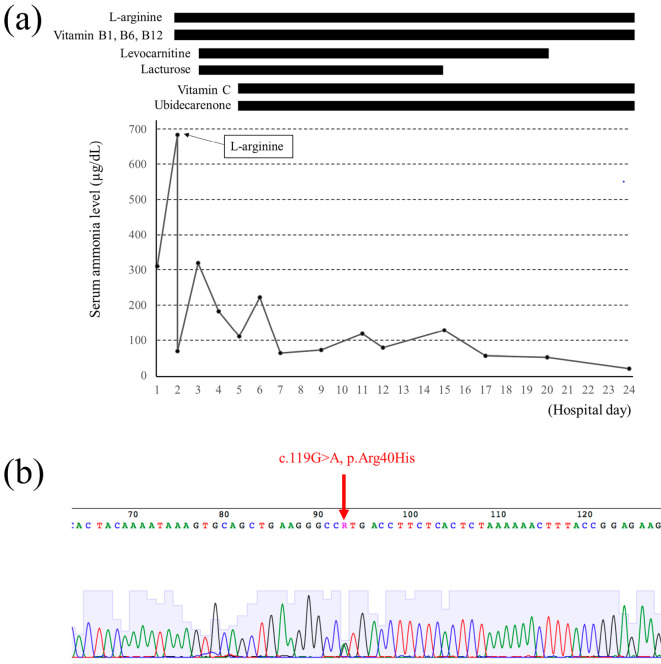
A 52-year-old woman developed vomiting and disturbance of consciousness after consuming raw fish and sushi on a trip. A blood test showed hyperammonemia (310 μg/dL) with a normal liver function. She fell into a deep coma, and her serum ammonia level increased to 684 μg/dL. L-arginine was administered as a diagnostic treatment for urea cycle disorder (UCD) and serum ammonia, and her consciousness levels improved. She was diagnosed with ornithine transcarbamylase deficiency (OTCD) by analyses of plasma amino acids, urinary orotic acid, and the OTC gene mutation. UCD should be considered for patients with hyperammonemia without severe liver function abnormalities.
一名52岁女性在旅行中食用生鱼和寿司后出现呕吐和意识障碍。血液检查显示高氨血症(310μg/dL),肝功能正常。她陷入深度昏迷,血清氨水平升至684μg/dL。给予L-精氨酸作为尿素循环障碍(UCD)和血清氨的诊断性治疗,其意识水平有所改善。通过血浆氨基酸、尿乳清酸分析及OTC基因突变检测,她被诊断为鸟氨酸转氨甲酰酶缺乏症(OTCD)。对于无严重肝功能异常的高氨血症患者,应考虑尿素循环障碍。