Warren Nicholas J, Derry Matthew J, Mykhaylyk Oleksandr O, Lovett Joseph R, Ratcliffe Liam P D, Ladmiral Vincent, Blanazs Adam, Fielding Lee A, Armes Steven P
Department of Chemistry, University of Sheffield, Brook Hill, Sheffield S3 7HF, U.K.
School of Chemical and Process Engineering, University of Leeds, Leeds LS2 9JT, U.K.
Macromolecules. 2018 Nov 13;51(21):8357-8371. doi: 10.1021/acs.macromol.8b01617. Epub 2018 Oct 16.
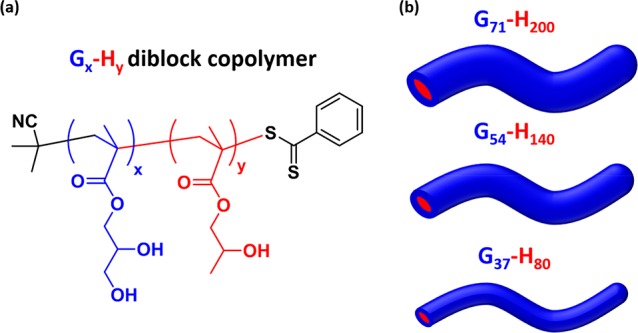
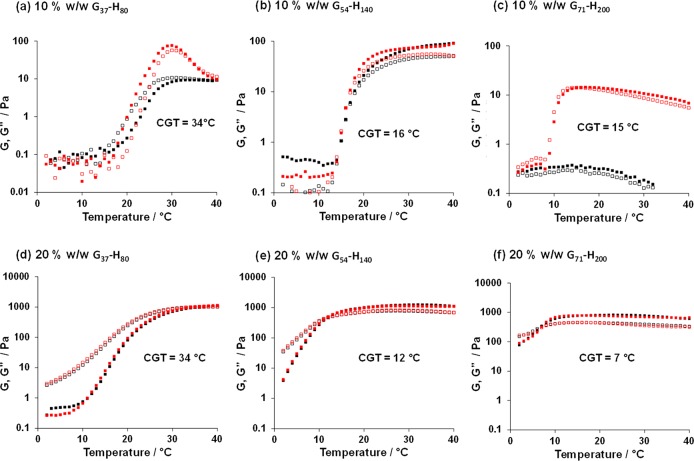
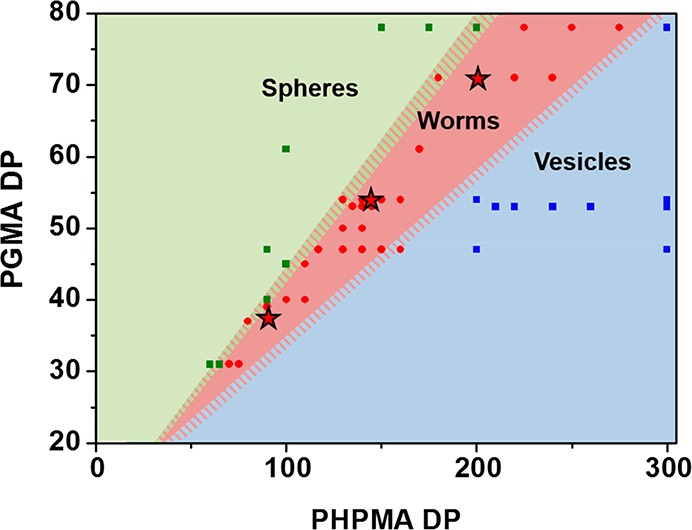
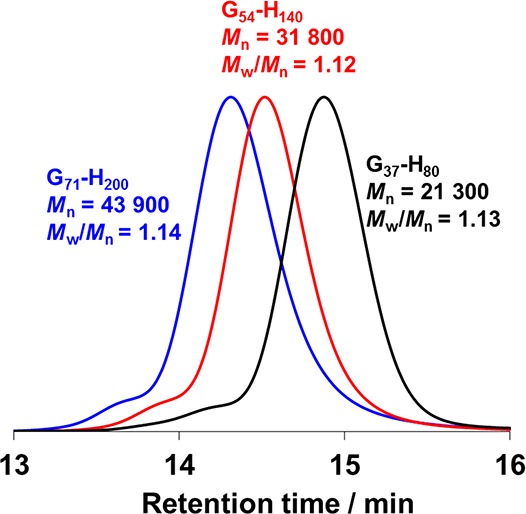
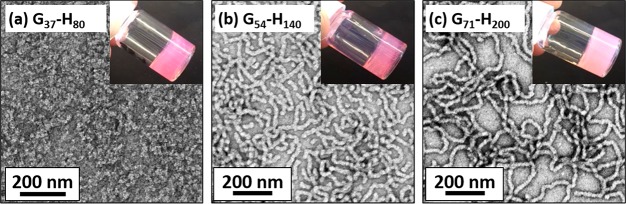
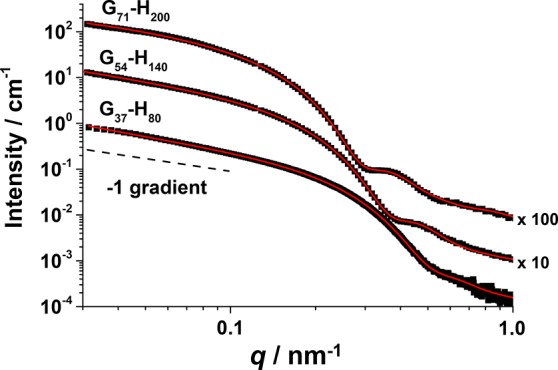
Reversible addition-fragmentation chain transfer (RAFT) aqueous dispersion polymerization of 2-hydroxypropyl methacrylate was used to prepare three poly(glycerol monomethacrylate) -poly(2-hydroxypropyl methacrylate) (denoted G -H or PGMA-PHPMA) diblock copolymers, namely G-H, G-H, and G-H. A master phase diagram was used to select each copolymer composition to ensure that a pure worm phase was obtained in each case, as confirmed by transmission electron microscopy (TEM) and small-angle x-ray scattering (SAXS) studies. The latter technique indicated a mean worm cross-sectional diameter (or worm width) ranging from 11 to 20 nm as the mean degree of polymerization (DP) of the hydrophobic PHPMA block was increased from 80 to 200. These copolymer worms form soft hydrogels at 20 °C that undergo degelation on cooling. This thermoresponsive behavior was examined using variable temperature DLS, oscillatory rheology, and SAXS. A 10% w/w G-H worm dispersion dissociated to afford an aqueous solution of molecularly dissolved copolymer chains at 2 °C; on returning to ambient temperature, these chains aggregated to form first spheres and then worms, with the original gel strength being recovered. In contrast, the G-H and G-H worms each only formed spheres on cooling to 2 °C, with thermoreversible (de)gelation being observed in the former case. The sphere-to-worm transition for G-H was monitored by variable temperature SAXS: these experiments indicated the gradual formation of longer worms at higher temperature, with a concomitant reduction in the number of spheres, suggesting worm growth via multiple 1D sphere-sphere fusion events. DLS studies indicated that a 0.1% w/w aqueous dispersion of G-H worms underwent an worm-to-sphere transition on cooling to 2 °C. Furthermore, degelation over the time scale of the experiment was also observed during rheological studies of a 10% w/w G-H worm dispersion. Shear-induced polarized light imaging (SIPLI) studies revealed qualitatively different thermoreversible behavior for these three copolymer worm dispersions, although worm alignment was observed at a shear rate of 10 s in each case. Subsequently conducting this technique at a lower shear rate of 1 s combined with ultra small-angle x-ray scattering (USAXS) also indicated that worm branching occurred at a certain critical temperature since an upturn in viscosity, distortion in the birefringence, and a characteristic feature in the USAXS pattern were observed. Finally, SIPLI studies indicated that the characteristic relaxation times required for loss of worm alignment after cessation of shear depended markedly on the copolymer molecular weight.
采用甲基丙烯酸2-羟丙酯的可逆加成-断裂链转移(RAFT)水分散聚合反应制备了三种聚(甘油单甲基丙烯酸酯)-聚(甲基丙烯酸2-羟丙酯)(记为G-H或PGMA-PHPMA)二嵌段共聚物,即G-H、G-H和G-H。利用主相图选择每种共聚物的组成,以确保在每种情况下都能得到纯蠕虫相,这一点通过透射电子显微镜(TEM)和小角X射线散射(SAXS)研究得到了证实。后一种技术表明,随着疏水的PHPMA嵌段的平均聚合度(DP)从80增加到200,蠕虫的平均横截面直径(或蠕虫宽度)在11到20nm之间。这些共聚物蠕虫在20℃时形成软凝胶,冷却时会发生凝胶解体。使用可变温度动态光散射(DLS)、振荡流变学和SAXS对这种热响应行为进行了研究。10%w/w的G-H蠕虫分散体在2℃时解离,得到分子溶解的共聚物链的水溶液;回到室温后,这些链聚集形成先球形后蠕虫状的结构,恢复了原来的凝胶强度。相比之下,G-H和G-H蠕虫在冷却到2℃时各自仅形成球形,在前一种情况下观察到了热可逆(去)凝胶化现象。通过可变温度SAXS监测了G-H的球-蠕虫转变:这些实验表明,在较高温度下逐渐形成更长的蠕虫,同时球的数量减少,这表明蠕虫是通过多个一维球-球融合事件生长的。DLS研究表明,0.1%w/w的G-H蠕虫水分散体在冷却到2℃时会发生蠕虫-球转变。此外,在对10%w/w的G-H蠕虫分散体进行流变学研究的过程中,还观察到了在实验时间尺度上的凝胶解体现象。剪切诱导偏振光成像(SIPLI)研究揭示了这三种共聚物蠕虫分散体在热可逆行为上存在质的差异,尽管在每种情况下,在剪切速率为10 s时都观察到了蠕虫的排列。随后,在1 s的较低剪切速率下结合超小角X射线散射(USAXS)进行这项技术研究,也表明蠕虫分支在某个临界温度下发生,因为观察到了粘度上升、双折射畸变以及USAXS图谱中的一个特征。最后,SIPLI研究表明,剪切停止后蠕虫排列消失所需的特征弛豫时间明显取决于共聚物的分子量。