Myles Hannah, Myles Nicholas, Coetzer Ching Li Chai, Adams Robert, Chandratilleke Madhu, Liu Dennis, Mercer Jeremy, Vakulin Andrew, Vincent Andrew, Wittert Gary, Galletly Cherrie
School of Medicine, Adelaide University, Adelaide, Australia.
Country Health SA, Mental Health, Australia.
Schizophr Res Cogn. 2018 Nov 6;15:14-20. doi: 10.1016/j.scog.2018.09.001. eCollection 2019 Mar.
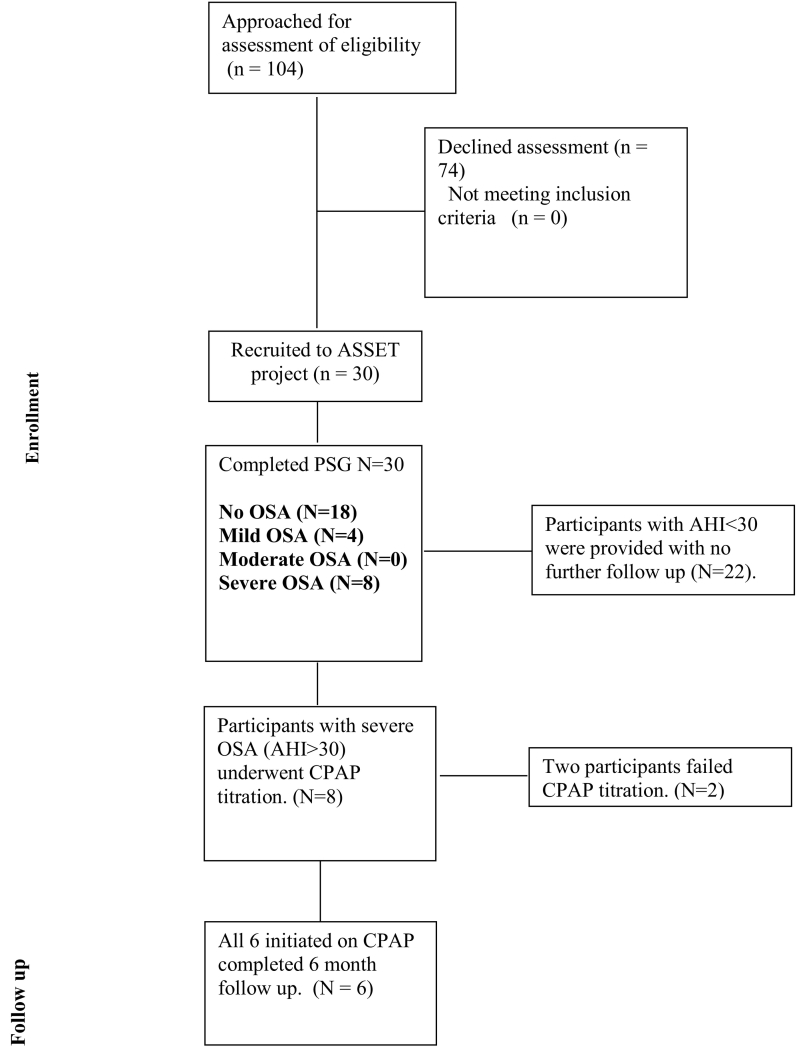
Previous studies have shown that people with schizophrenia have high rates of Obstructive Sleep Apnoea (OSA). Despite this, intervention studies to treat OSA in this population have not been undertaken. The ASSET (Assessing Sleep in Schizophrenia and Evaluating Treatment) pilot study investigated Continuous Positive Airway Pressure (CPAP) treatment of severe OSA in participants recruited from a clozapine clinic in Adelaide. Participants with severe untreated OSA (Apnoea-Hypopnoea Index (AHI) > 30), were provided with CPAP treatment, and assessed at baseline and six months across the following domains: physical health, quality of sleep, sleepiness, cognition, psychiatric symptoms and CPAP adherence. Six of the eight ASSET participants with severe OSA accepted CPAP. At baseline, half of the cohort had hypertension, all were obese with a mean BMI of 45, and they scored on average 1.47 standard deviations below the normal population in cognitive testing. The mean AHI was 76.8 and sleep architecture was markedly impaired with mean rapid eye movement (REM) sleep 4.1% and mean slow wave sleep (SWS) 4.8%. After six months of treatment there were improvements in cognition (BACS Z score improved by an average of 0.59) and weight loss (mean weight loss 7.3 ± 9 kg). Half of the participants no longer had hypertension and sleep architecture improved with mean REM sleep 31.4% of the night and mean SWS 24% of the night. Our data suggests CPAP may offer novel benefits to address cognitive impairment and sleep disturbance in people with schizophrenia.
以往研究表明,精神分裂症患者阻塞性睡眠呼吸暂停(OSA)的发生率很高。尽管如此,尚未开展针对该人群OSA的干预研究。ASSET(精神分裂症睡眠评估与治疗评估)试点研究调查了在阿德莱德一家氯氮平诊所招募的参与者中,持续气道正压通气(CPAP)治疗重度OSA的效果。患有未经治疗的重度OSA(呼吸暂停低通气指数(AHI)>30)的参与者接受了CPAP治疗,并在基线和六个月时在以下领域进行评估:身体健康、睡眠质量、嗜睡程度、认知、精神症状和CPAP依从性。八名患有重度OSA的ASSET参与者中有六人接受了CPAP治疗。在基线时,该队列中有一半人患有高血压,所有人都肥胖,平均体重指数为45,在认知测试中,他们的得分平均比正常人群低1.47个标准差。平均AHI为76.8,睡眠结构明显受损,平均快速眼动(REM)睡眠为4.1%,平均慢波睡眠(SWS)为4.8%。经过六个月的治疗,认知能力有所改善(BACS Z评分平均提高了0.59),体重减轻(平均体重减轻7.3±9千克)。一半的参与者不再患有高血压,睡眠结构得到改善,夜间平均REM睡眠为31.4%,夜间平均SWS为24%。我们的数据表明,CPAP可能为改善精神分裂症患者的认知障碍和睡眠障碍带来新的益处。