Department of Biochemistry and Molecular Biology, University of Florida, Gainesville, FL, United States of America.
University of Florence, NEUROFARBA Department, Sezione di Farmaceutica e Nutraceutica, Sesto Fiorentino (Florence), Italy.
PLoS One. 2018 Nov 19;13(11):e0207417. doi: 10.1371/journal.pone.0207417. eCollection 2018.
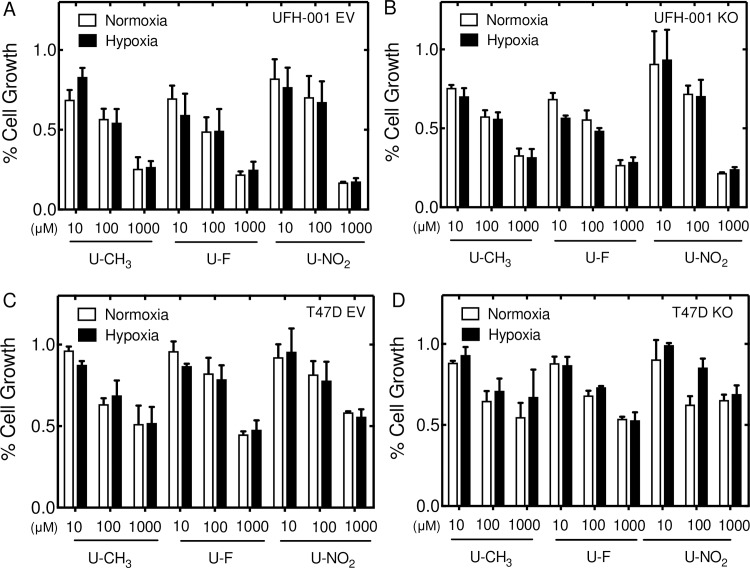
Carbonic anhydrases (CAs) have been linked to tumor progression, particularly membrane-bound CA isoform IX (CA IX). The role of CA IX in the context of breast cancer is to regulate the pH of the tumor microenvironment. In contrast to CA IX, expression of CA XII, specifically in breast cancer, is associated with better outcome despite performing the same catalytic function. In this study, we have structurally modeled the orientation of bound ureido-substituted benzene sulfonamides (USBs) within the active site of CA XII, in comparison to CA IX and cytosolic off-target CA II, to understand isoform specific inhibition. This has identified specific residues within the CA active site, which differ between isoforms that are important for inhibitor binding and isoform specificity. The ability of these sulfonamides to block CA IX activity in breast cancer cells is less effective than their ability to block activity of the recombinant protein (by one to two orders of magnitude depending on the inhibitor). The same is true for CA XII activity but now they are two to three orders of magnitude less effective. Thus, there is significantly greater specificity for CA IX activity over CA XII. While the inhibitors block cell growth, without inducing cell death, this again occurs at two orders of magnitude above the Ki values for inhibition of CA IX and CA XII activity in their respective cell types. Surprisingly, the USBs inhibited cell growth even in cells where CA IX and CA XII expression was ablated. Despite the potential for these sulfonamides as chemotherapeutic agents, these data suggest that we reconsider the role of CA activity on growth potentiation.
碳酸酐酶(CA)与肿瘤的进展有关,特别是膜结合的 CA 同工型 IX(CA IX)。CA IX 在乳腺癌中的作用是调节肿瘤微环境的 pH 值。与 CA IX 相反,CA XII 的表达,特别是在乳腺癌中,与更好的预后相关,尽管它们执行相同的催化功能。在这项研究中,我们对结合的脲取代苯磺酰胺(USB)在 CA XII 的活性部位内的取向进行了结构建模,与 CA IX 和胞质非靶标 CA II 进行了比较,以了解同工型特异性抑制。这确定了同工型之间在活性部位内不同的特定残基,这些残基对于抑制剂结合和同工型特异性很重要。这些磺酰胺类物质在乳腺癌细胞中阻断 CA IX 活性的能力不如它们阻断重组蛋白活性的能力有效(取决于抑制剂,相差一到两个数量级)。CA XII 活性也是如此,但现在它们的效果相差两到三个数量级。因此,CA IX 活性的特异性明显高于 CA XII。虽然抑制剂能阻止细胞生长,但不会诱导细胞死亡,但这再次发生在抑制 CA IX 和 CA XII 活性的 Ki 值之上两个数量级,在各自的细胞类型中。令人惊讶的是,即使在 CA IX 和 CA XII 表达被消除的细胞中,USBs 也能抑制细胞生长。尽管这些磺酰胺类物质有作为化疗药物的潜力,但这些数据表明我们需要重新考虑 CA 活性对生长增强的作用。