Department of Medicine, Division of Oncology, Washington University School of Medicine, St. Louis, Missouri, United States of America.
Department of Pediatrics, Division of Hematology/Oncology, Washington University School of Medicine, St. Louis, Missouri, United States of America.
PLoS One. 2018 Nov 19;13(11):e0207609. doi: 10.1371/journal.pone.0207609. eCollection 2018.
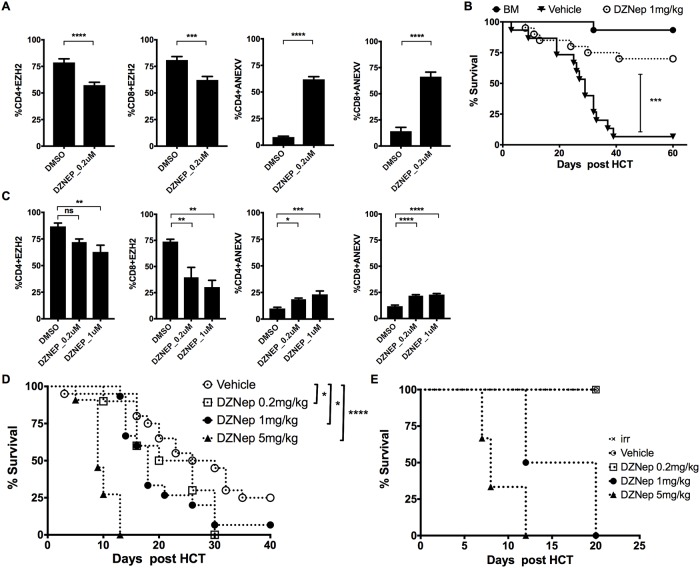
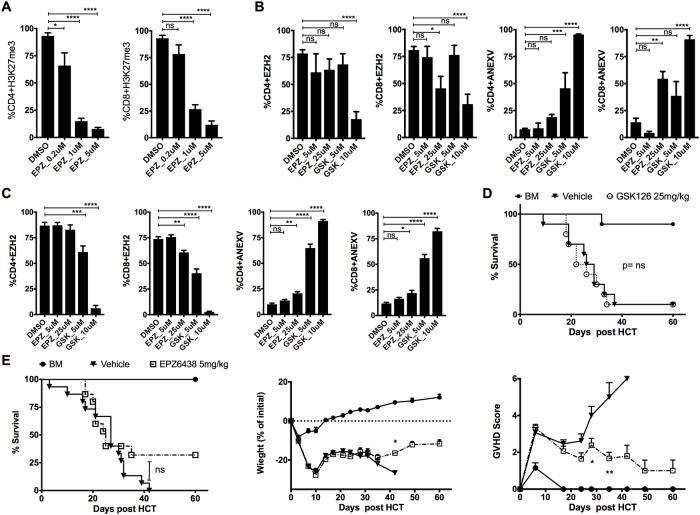
Allogeneic hematopoietic cell transplantation is often complicated by graft versus host disease (GvHD), primarily mediated through allo-reactive donor T cells in the donor stem cell graft. Enhancer of Zeste Homolog 2 (EZH2), a histone-lysine N-methyltransferase and a component of the Polycomb Repressive Complex 2, has been shown to play a role in GvHD pathology. Although not yet clear, one proposed mechanism is through selective tri-methylation of lysine 27 in histone 3 (H3K27me3) that marks the promoter region of multiple pro-apoptotic genes, leading to repression of these genes in allo-reactive T cells. We found that selective pharmacologic inhibition of H3K27me3 with EPZ6438 or GSK126 did not prevent murine GvHD. This suggests the GvHD mitigating properties of DZNep are independent from H3K27me3 inhibition. Furthermore, while pharmacologic inhibition of EZH2 by DZNep has been shown to be effective in abrogating mouse GvHD, we found that DZNep was not effective in preventing GvHD in a human T cell xenograft mouse model. Although EZH2 is an attractive target to harness donor allo-reactive T cells in the post-transplant setting to modulate GvHD and the anti-leukemia effect, our results suggest that more selective and effective ways to inhibit EZH2 in human T cells are required.
同种异体造血细胞移植常伴有移植物抗宿主病(GvHD),主要由供体干细胞移植物中的同种异体反应性供体 T 细胞介导。EZH2(增强子的锌指蛋白 2)是一种组蛋白赖氨酸 N-甲基转移酶,也是多梳抑制复合物 2 的一个组成部分,已被证明在 GvHD 病理中发挥作用。虽然目前尚不清楚,但一种提出的机制是通过组蛋白 3(H3)赖氨酸 27 的选择性三甲基化(H3K27me3),该修饰标记多个促凋亡基因的启动子区域,导致这些基因在同种异体反应性 T 细胞中被抑制。我们发现,用 EPZ6438 或 GSK126 选择性地抑制 H3K27me3 并不能预防小鼠 GvHD。这表明 DZNep 的 GvHD 缓解特性与 H3K27me3 抑制无关。此外,虽然 DZNep 抑制 EZH2 的药理作用已被证明可有效减轻小鼠 GvHD,但我们发现 DZNep 在人 T 细胞异种移植小鼠模型中不能有效预防 GvHD。尽管 EZH2 是一种有吸引力的靶点,可以在移植后利用供体同种异体反应性 T 细胞来调节 GvHD 和抗白血病效应,但我们的结果表明,需要更具选择性和更有效的方法来抑制人 T 细胞中的 EZH2。