Division of Gastroenterology and Hepatology, Mayo Clinic College of Medicine and Science, Rochester, Minnesota.
Integrated TCM & Western Medicine Department, 302 Military Hospital, Beijing, China.
Cancer Med. 2018 Dec;7(12):5870-5878. doi: 10.1002/cam4.1797. Epub 2018 Nov 19.
BACKGROUND/AIMS: Hypothyroidism has been associated with hepatocellular carcinoma (HCC) incidence; however, the relationship between hypothyroidism and HCC patient outcomes is unclear. We investigated the impact of hypothyroidism on outcomes after liver transplantation for HCC.
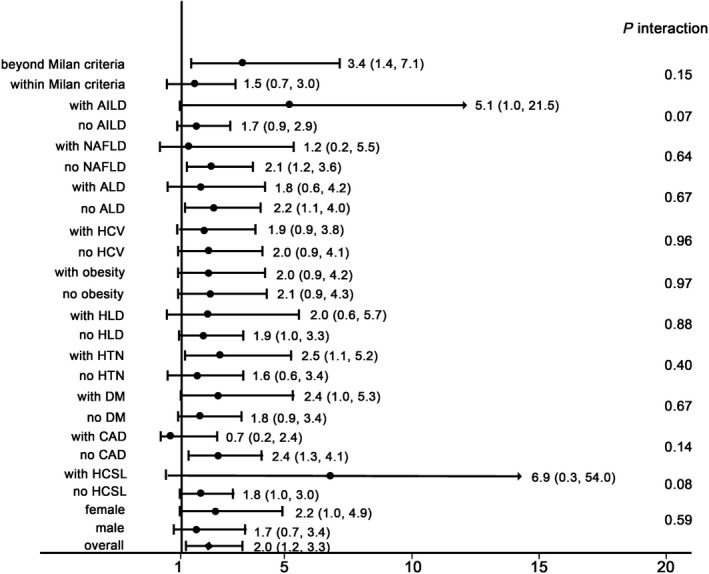
We retrospectively studied HCC patients transplanted between January 2000 and December 2015. Hypothyroidism was defined as a thyroid-stimulating hormone (TSH) level continuously greater than 5 mIU/L, a documented history of hypothyroidism, or treatment with thyroid hormone replacement therapy. Multivariate Cox regression was used to assess the impact of hypothyroidism on overall survival (OS) and recurrence-free survival (RFS) adjusting for potential confounders. Subgroup analyses and interaction tests were conducted to compare the impact of hypothyroidism in different subgroups and assess for possible synergistic effects. Sensitivity analyses were performed among different cohorts to verify the stability of the results.
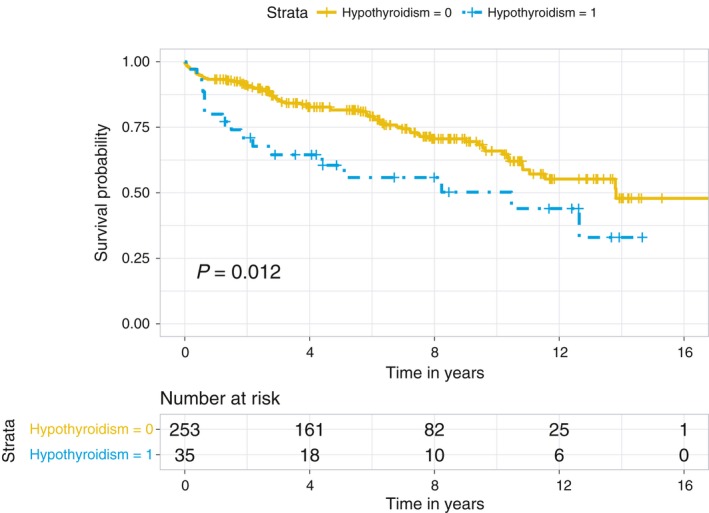
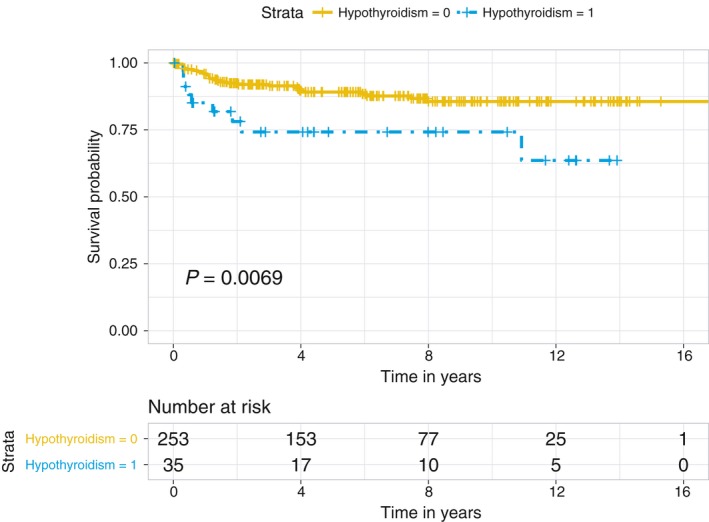
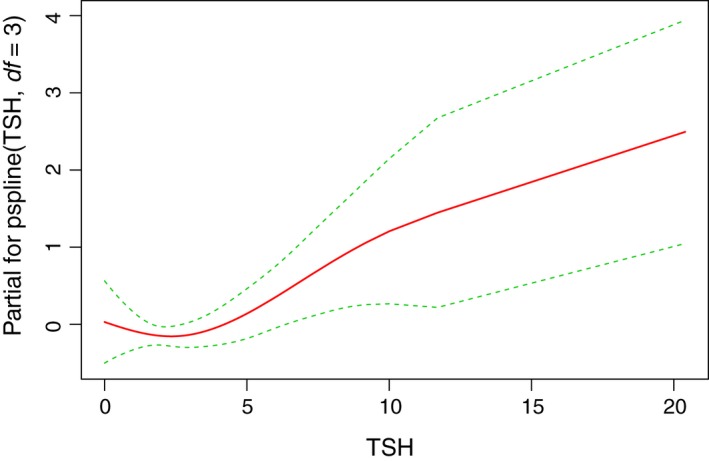
A total of 343 HCC patients who underwent liver transplantation were included in the analysis. The primary analysis was conducted among 288 patients diagnosed with HCC prior to transplantation. Hypothyroidism was independently associated with worse OS and RFS, as was elevated TSH. The adjusted hazard ratio (AHR) of hypothyroidism was 2.45 (95% confidence interval [CI], 1.44-4.18) for OS and 5.54 (2.36, 13.01) for RFS. The AHR of TSH for OS was 1.05 (1.02, 1.09) and 1.08 (1.03, 1.13) for RFS. No interaction was found among different subgroups categorized by etiology and comorbidity. The results were stable to sensitivity analyses.
Hypothyroidism is associated with poorer overall and recurrence-free survival of HCC patients receiving liver transplantation. These results require validation.
背景/目的:甲状腺功能减退症与肝细胞癌(HCC)的发生有关;然而,甲状腺功能减退症与 HCC 患者预后的关系尚不清楚。我们研究了甲状腺功能减退症对 HCC 患者肝移植后结局的影响。
我们回顾性研究了 2000 年 1 月至 2015 年 12 月期间接受肝移植的 HCC 患者。甲状腺功能减退症定义为促甲状腺激素(TSH)水平持续大于 5 mIU/L、有甲状腺功能减退症病史或接受甲状腺激素替代治疗。多变量 Cox 回归用于评估甲状腺功能减退症对总生存(OS)和无复发生存(RFS)的影响,同时调整潜在混杂因素。进行亚组分析和交互检验,以比较不同亚组中甲状腺功能减退症的影响,并评估是否存在协同作用。进行敏感性分析以验证结果的稳定性。
共纳入 343 例接受肝移植的 HCC 患者进行分析。主要分析在 288 例移植前诊断为 HCC 的患者中进行。甲状腺功能减退症与较差的 OS 和 RFS 独立相关,TSH 升高也是如此。甲状腺功能减退症的调整后的危险比(AHR)为 OS 2.45(95%置信区间[CI],1.44-4.18)和 RFS 5.54(2.36,13.01)。TSH 对 OS 的 AHR 为 1.05(1.02,1.09)和 RFS 为 1.08(1.03,1.13)。不同病因和合并症亚组之间未发现交互作用。结果在敏感性分析中是稳定的。
甲状腺功能减退症与接受肝移植的 HCC 患者总体和无复发生存率较差相关。这些结果需要验证。