• 文献检索
  • 文档翻译
  • 深度研究
  • 学术资讯
  • Suppr Zotero 插件Zotero 插件
  • 邀请有礼
  • 套餐&价格
  • 历史记录
应用&插件
Suppr Zotero 插件Zotero 插件浏览器插件Mac 客户端Windows 客户端微信小程序
定价
高级版会员购买积分包购买API积分包
服务
文献检索文档翻译深度研究API 文档MCP 服务
关于我们
关于 Suppr公司介绍联系我们用户协议隐私条款
关注我们

Suppr 超能文献

核心技术专利:CN118964589B侵权必究
粤ICP备2023148730 号-1Suppr @ 2026

文献检索

告别复杂PubMed语法,用中文像聊天一样搜索,搜遍4000万医学文献。AI智能推荐,让科研检索更轻松。

立即免费搜索

文件翻译

保留排版,准确专业,支持PDF/Word/PPT等文件格式,支持 12+语言互译。

免费翻译文档

深度研究

AI帮你快速写综述,25分钟生成高质量综述,智能提取关键信息,辅助科研写作。

立即免费体验

自闭症儿童面部表情生成的计算评估。

Computational Assessment of Facial Expression Production in ASD Children.

机构信息

Institute of Applied Sciences and Intelligent Systems, National Research Council of Italy, via Monteroni, 73100 Lecce, Italy.

Amici di Nico Onlus, Via Campania, 6, 73046 Lecce, Italy.

出版信息

Sensors (Basel). 2018 Nov 16;18(11):3993. doi: 10.3390/s18113993.

DOI:10.3390/s18113993
PMID:30453518
原文链接:https://pmc.ncbi.nlm.nih.gov/articles/PMC6263710/
Abstract

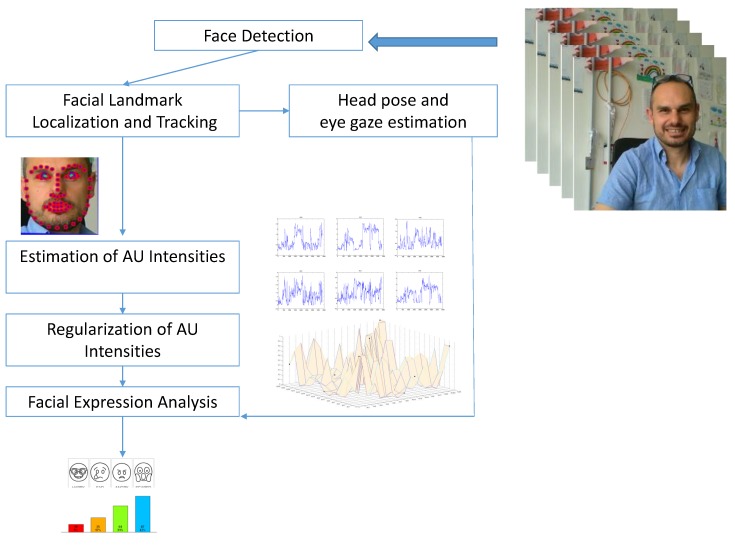
In this paper, a computational approach is proposed and put into practice to assess the capability of children having had diagnosed Autism Spectrum Disorders (ASD) to produce facial expressions. The proposed approach is based on computer vision components working on sequence of images acquired by an off-the-shelf camera in unconstrained conditions. Action unit intensities are estimated by analyzing local appearance and then both temporal and geometrical relationships, learned by Convolutional Neural Networks, are exploited to regularize gathered estimates. To cope with stereotyped movements and to highlight even subtle voluntary movements of facial muscles, a personalized and contextual statistical modeling of non-emotional face is formulated and used as a reference. Experimental results demonstrate how the proposed pipeline can improve the analysis of facial expressions produced by ASD children. A comparison of system's outputs with the evaluations performed by psychologists, on the same group of ASD children, makes evident how the performed quantitative analysis of children's abilities helps to go beyond the traditional qualitative ASD assessment/diagnosis protocols, whose outcomes are affected by human limitations in observing and understanding multi-cues behaviors such as facial expressions.

摘要

本文提出并实践了一种计算方法,以评估被诊断患有自闭症谱系障碍(ASD)的儿童产生面部表情的能力。所提出的方法基于计算机视觉组件,这些组件可对在非约束条件下由现成的摄像机获取的图像序列进行操作。动作单元强度通过分析局部外观来估计,然后利用卷积神经网络学习的时间和几何关系来正则化所收集的估计值。为了应对刻板运动并突出面部肌肉的甚至微妙的自愿运动,制定并使用个性化和上下文相关的非情感面部的统计建模作为参考。实验结果表明,所提出的管道如何可以改善对 ASD 儿童产生的面部表情的分析。将系统输出与心理学家对同一组 ASD 儿童进行的评估进行比较,清楚地表明对儿童能力进行的定量分析如何有助于超越传统的 ASD 评估/诊断协议,这些协议的结果受到人类在观察和理解多线索行为(如面部表情)方面的限制。
https://cdn.ncbi.nlm.nih.gov/pmc/blobs/8e10/6263710/c82199be9658/sensors-18-03993-g011a.jpg
https://cdn.ncbi.nlm.nih.gov/pmc/blobs/8e10/6263710/b00580533d44/sensors-18-03993-g001.jpg
https://cdn.ncbi.nlm.nih.gov/pmc/blobs/8e10/6263710/8673fd2b4e23/sensors-18-03993-g002.jpg
https://cdn.ncbi.nlm.nih.gov/pmc/blobs/8e10/6263710/0ba8a38fe4e5/sensors-18-03993-g003.jpg
https://cdn.ncbi.nlm.nih.gov/pmc/blobs/8e10/6263710/830d89289377/sensors-18-03993-g004.jpg
https://cdn.ncbi.nlm.nih.gov/pmc/blobs/8e10/6263710/6952755d5c73/sensors-18-03993-g005.jpg
https://cdn.ncbi.nlm.nih.gov/pmc/blobs/8e10/6263710/981915ac8787/sensors-18-03993-g006.jpg
https://cdn.ncbi.nlm.nih.gov/pmc/blobs/8e10/6263710/f4c8ea2d7b7e/sensors-18-03993-g007.jpg
https://cdn.ncbi.nlm.nih.gov/pmc/blobs/8e10/6263710/50407b22e568/sensors-18-03993-g008.jpg
https://cdn.ncbi.nlm.nih.gov/pmc/blobs/8e10/6263710/fe97313a1d39/sensors-18-03993-g009a.jpg
https://cdn.ncbi.nlm.nih.gov/pmc/blobs/8e10/6263710/ecc8ccc7ccc1/sensors-18-03993-g010.jpg
https://cdn.ncbi.nlm.nih.gov/pmc/blobs/8e10/6263710/c82199be9658/sensors-18-03993-g011a.jpg
https://cdn.ncbi.nlm.nih.gov/pmc/blobs/8e10/6263710/b00580533d44/sensors-18-03993-g001.jpg
https://cdn.ncbi.nlm.nih.gov/pmc/blobs/8e10/6263710/8673fd2b4e23/sensors-18-03993-g002.jpg
https://cdn.ncbi.nlm.nih.gov/pmc/blobs/8e10/6263710/0ba8a38fe4e5/sensors-18-03993-g003.jpg
https://cdn.ncbi.nlm.nih.gov/pmc/blobs/8e10/6263710/830d89289377/sensors-18-03993-g004.jpg
https://cdn.ncbi.nlm.nih.gov/pmc/blobs/8e10/6263710/6952755d5c73/sensors-18-03993-g005.jpg
https://cdn.ncbi.nlm.nih.gov/pmc/blobs/8e10/6263710/981915ac8787/sensors-18-03993-g006.jpg
https://cdn.ncbi.nlm.nih.gov/pmc/blobs/8e10/6263710/f4c8ea2d7b7e/sensors-18-03993-g007.jpg
https://cdn.ncbi.nlm.nih.gov/pmc/blobs/8e10/6263710/50407b22e568/sensors-18-03993-g008.jpg
https://cdn.ncbi.nlm.nih.gov/pmc/blobs/8e10/6263710/fe97313a1d39/sensors-18-03993-g009a.jpg
https://cdn.ncbi.nlm.nih.gov/pmc/blobs/8e10/6263710/ecc8ccc7ccc1/sensors-18-03993-g010.jpg
https://cdn.ncbi.nlm.nih.gov/pmc/blobs/8e10/6263710/c82199be9658/sensors-18-03993-g011a.jpg

相似文献

1
Computational Assessment of Facial Expression Production in ASD Children.自闭症儿童面部表情生成的计算评估。
Sensors (Basel). 2018 Nov 16;18(11):3993. doi: 10.3390/s18113993.
2
Digital Behavioral Phenotyping Detects Atypical Pattern of Facial Expression in Toddlers with Autism.数字行为表型分析可检测出自闭症幼儿面部表情的异常模式。
Autism Res. 2021 Mar;14(3):488-499. doi: 10.1002/aur.2391. Epub 2020 Sep 14.
3
Automated recognition of spontaneous facial expression in individuals with autism spectrum disorder: parsing response variability.自闭症谱系障碍个体自发面部表情的自动识别:解析反应可变性。
Mol Autism. 2020 May 11;11(1):31. doi: 10.1186/s13229-020-00327-4.
4
Toward the detection of reduced emotion expression intensity: an autism sibling study.朝向情绪表达强度降低的检测:自闭症同胞研究。
J Clin Exp Neuropsychol. 2023 May;45(3):219-229. doi: 10.1080/13803395.2023.2225234. Epub 2023 Jun 15.
5
Electromyographic responses to emotional facial expressions in 6-7 year olds with autism spectrum disorders.自闭症谱系障碍6至7岁儿童对情绪性面部表情的肌电图反应
J Autism Dev Disord. 2015 Feb;45(2):354-62. doi: 10.1007/s10803-013-1890-z.
6
Children with autism spectrum disorder produce more ambiguous and less socially meaningful facial expressions: an experimental study using random forest classifiers.自闭症谱系障碍儿童产生的面部表情更模糊,社会意义更小:使用随机森林分类器的实验研究。
Mol Autism. 2020 Jan 13;11(1):5. doi: 10.1186/s13229-020-0312-2. eCollection 2020.
7
The Nature of Facial Emotion Recognition Impairments in Children on the Autism Spectrum.自闭症谱系儿童面部情绪识别障碍的本质。
Child Psychiatry Hum Dev. 2019 Aug;50(4):661-667. doi: 10.1007/s10578-019-00870-z.
8
Selective Impairment of Basic Emotion Recognition in People with Autism: Discrimination Thresholds for Recognition of Facial Expressions of Varying Intensities.自闭症患者基本情绪识别的选择性损伤:识别不同强度面部表情的辨别阈值。
J Autism Dev Disord. 2018 Jun;48(6):1886-1894. doi: 10.1007/s10803-017-3428-2.
9
Intact mirror mechanisms for automatic facial emotions in children and adolescents with autism spectrum disorder.自闭症谱系障碍儿童和青少年中完整的面部表情自动镜像机制。
Autism Res. 2017 Feb;10(2):298-310. doi: 10.1002/aur.1654. Epub 2016 Jun 28.
10
Evidence for shared deficits in identifying emotions from faces and from voices in autism spectrum disorders and specific language impairment.自闭症谱系障碍和特定语言障碍患者在通过面部和声音识别情绪方面存在共同缺陷的证据。
Int J Lang Commun Disord. 2015 Jul;50(4):452-66. doi: 10.1111/1460-6984.12146. Epub 2015 Jan 14.

引用本文的文献

1
A multi-filter deep transfer learning framework for image-based autism spectrum disorder detection.一种用于基于图像的自闭症谱系障碍检测的多滤波器深度迁移学习框架。
Sci Rep. 2025 Apr 24;15(1):14253. doi: 10.1038/s41598-025-97708-7.
2
Vocal and Facial Behavior During Affect Production in Autism Spectrum Disorder.自闭症谱系障碍中情感产生过程中的发声和面部行为。
J Speech Lang Hear Res. 2025 Feb 4;68(2):419-434. doi: 10.1044/2024_JSLHR-23-00080. Epub 2024 Dec 19.
3
Temporal characteristics of facial ensemble in individuals with autism spectrum disorder: examination from arousal and attentional allocation.

本文引用的文献

1
Feasibility of Automated Training for Facial Emotion Expression and Recognition in Autism.自闭症患者面部情绪表达和识别的自动化训练的可行性。
Behav Ther. 2018 Nov;49(6):881-888. doi: 10.1016/j.beth.2017.12.010. Epub 2017 Dec 28.
2
EAC-Net: Deep Nets with Enhancing and Cropping for Facial Action Unit Detection.EAC-Net:用于面部动作单元检测的增强和裁剪的深度网络。
IEEE Trans Pattern Anal Mach Intell. 2018 Nov;40(11):2583-2596. doi: 10.1109/TPAMI.2018.2791608. Epub 2018 Jan 10.
3
A Computational Study of Expressive Facial Dynamics in Children with Autism.
自闭症谱系障碍个体面部整体的时间特征:从唤醒和注意力分配角度进行的考察
Front Psychiatry. 2024 Feb 19;15:1328708. doi: 10.3389/fpsyt.2024.1328708. eCollection 2024.
4
Digitally assisted diagnostics of autism spectrum disorder.自闭症谱系障碍的数字辅助诊断
Front Psychiatry. 2023 Feb 1;14:1066284. doi: 10.3389/fpsyt.2023.1066284. eCollection 2023.
5
Identifying and describing subtypes of spontaneous empathic facial expression production in autistic adults.识别和描述自闭症成人自发同理心面部表情产生的亚类型。
J Neurodev Disord. 2022 Aug 1;14(1):43. doi: 10.1186/s11689-022-09451-z.
6
Emotional Expression in Children With ASD: A Pre-Study on a Two-Group Pre-Post-Test Design Comparing Robot-Based and Computer-Based Training.自闭症谱系障碍儿童的情感表达:一项关于基于机器人训练和基于计算机训练的两组前后测设计的预研究。
Front Psychol. 2021 Jul 21;12:678052. doi: 10.3389/fpsyg.2021.678052. eCollection 2021.
7
Psychological Impact of COVID-19 Outbreak on Families of Children with Autism Spectrum Disorder and Typically Developing Peers: An Online Survey.新冠疫情爆发对自闭症谱系障碍儿童家庭及发育正常儿童家庭的心理影响:一项在线调查
Brain Sci. 2021 Jun 18;11(6):808. doi: 10.3390/brainsci11060808.
8
Deep-Emotion: Facial Expression Recognition Using Attentional Convolutional Network.深情感知:基于注意力卷积网络的表情识别
Sensors (Basel). 2021 Apr 27;21(9):3046. doi: 10.3390/s21093046.
9
Automated Computer Vision Assessment of Hypomimia in Parkinson Disease: Proof-of-Principle Pilot Study.自动化计算机视觉评估帕金森病的运动减少:原理验证性初步研究。
J Med Internet Res. 2021 Feb 22;23(2):e21037. doi: 10.2196/21037.
10
Facial Imitation Improves Emotion Recognition in Adults with Different Levels of Sub-Clinical Autistic Traits.面部模仿可改善具有不同程度亚临床自闭症特征的成年人的情绪识别能力。
J Intell. 2021 Jan 13;9(1):4. doi: 10.3390/jintelligence9010004.
自闭症儿童面部表情动态的计算研究
IEEE Trans Affect Comput. 2018 Jan-Mar;9(1):14-20. doi: 10.1109/TAFFC.2016.2578316. Epub 2016 Jun 8.
4
Modeling multiple time series annotations as noisy distortions of the ground truth: An Expectation-Maximization approach.将多个时间序列注释建模为真实情况的噪声失真:一种期望最大化方法。
IEEE Trans Affect Comput. 2018 Jan-Mar;9(1):76-89. doi: 10.1109/TAFFC.2016.2592918. Epub 2016 Jul 19.
5
FERA 2017 - Addressing Head Pose in the Third Facial Expression Recognition and Analysis Challenge.2017年面部表情识别与分析挑战赛第三届会议——解决头部姿态问题
Proc Int Conf Autom Face Gesture Recognit. 2017 May-Jun;2017:839-847. doi: 10.1109/FG.2017.107. Epub 2017 Jun 29.
6
A Feasibility Study of Autism Behavioral Markers in Spontaneous Facial, Visual, and Hand Movement Response Data.自闭症行为标志物在自发面部、视觉和手部运动反应数据中的可行性研究。
IEEE Trans Neural Syst Rehabil Eng. 2018 Feb;26(2):353-361. doi: 10.1109/TNSRE.2017.2768482.
7
Mechanisms of facial emotion recognition in autism spectrum disorders: Insights from eye tracking and electroencephalography.自闭症谱系障碍中面部情绪识别的机制:眼动追踪和脑电图的研究。
Neurosci Biobehav Rev. 2017 Sep;80:488-515. doi: 10.1016/j.neubiorev.2017.06.016. Epub 2017 Jul 8.
8
Learning Bases of Activity for Facial Expression Recognition.面部表情识别活动的学习基础
IEEE Trans Image Process. 2017 Apr;26(4):1965-1978. doi: 10.1109/TIP.2017.2662237. Epub 2017 Feb 1.
9
Joint Patch and Multi-label Learning for Facial Action Unit Detection.用于面部动作单元检测的联合补丁与多标签学习
Proc IEEE Comput Soc Conf Comput Vis Pattern Recognit. 2015 Jun;2015:2207-2216. doi: 10.1109/CVPR.2015.7298833.
10
Hiding true emotions: micro-expressions in eyes retrospectively concealed by mouth movements.隐藏真实情感:眼部微表情会被嘴部动作事后掩盖。
Sci Rep. 2016 Feb 26;6:22049. doi: 10.1038/srep22049.