Santana Dos Santos Elizabeth, Lallemand François, Burke Leslie, Stoppa-Lyonnet Dominique, Brown Melissa, Caputo Sandrine M, Rouleau Etienne
A.C.Camargo Cancer Center, São Paulo 01509-010, Brazil.
Department of Oncology, Center for Translational Oncology, Cancer Institute of the State of São Paulo-ICESP, São Paulo 01246-000, Brazil.
Cancers (Basel). 2018 Nov 16;10(11):453. doi: 10.3390/cancers10110453.
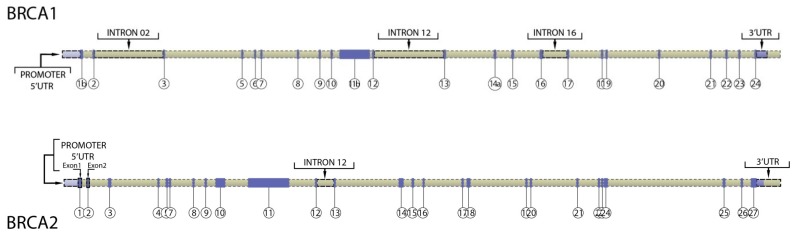
and are major breast cancer susceptibility genes whose pathogenic variants are associated with a significant increase in the risk of breast and ovarian cancers. Current genetic screening is generally limited to / exons and intron/exon boundaries. Most identified pathogenic variants cause the partial or complete loss of function of the protein. However, it is becoming increasingly clear that variants in these regions only account for a small proportion of cancer risk. The role of variants in non-coding regions beyond splice donor and acceptor sites, including those that have no qualitative effect on the protein, has not been thoroughly investigated. The key transcriptional regulatory elements of and are housed in gene promoters, untranslated regions, introns, and long-range elements. Within these sequences, germline and somatic variants have been described, but the clinical significance of the majority is currently unknown and it remains a significant clinical challenge. This review summarizes the available data on the impact of variants on non-coding regions of genes and their role on breast and ovarian cancer predisposition.
[基因名称1]和[基因名称2]是主要的乳腺癌易感基因,其致病变异与乳腺癌和卵巢癌风险的显著增加相关。目前的基因筛查通常局限于[具体基因区域]外显子以及内含子/外显子边界。大多数已鉴定的致病变异会导致蛋白质部分或完全功能丧失。然而,越来越清楚的是,这些区域的变异仅占癌症风险的一小部分。剪接供体和受体位点以外的非编码区域变异的作用,包括那些对蛋白质无定性影响的变异,尚未得到充分研究。[基因名称1]和[基因名称2]的关键转录调控元件存在于基因启动子、非翻译区、内含子和远距离元件中。在这些序列中,已描述了种系和体细胞变异,但大多数变异的临床意义目前尚不清楚,这仍然是一个重大的临床挑战。本综述总结了关于变异对[基因名称1]和[基因名称2]基因非编码区域的影响及其在乳腺癌和卵巢癌易感性中的作用的现有数据。