Faculty of Biology, Johannes Gutenberg University Mainz, Hans-Dieter-Hüsch-Weg 15, 55128, Mainz, Germany.
Universidad Pablo de Olavide, Sevilla, Spain.
BMC Bioinformatics. 2018 Nov 19;19(1):431. doi: 10.1186/s12859-018-2457-y.
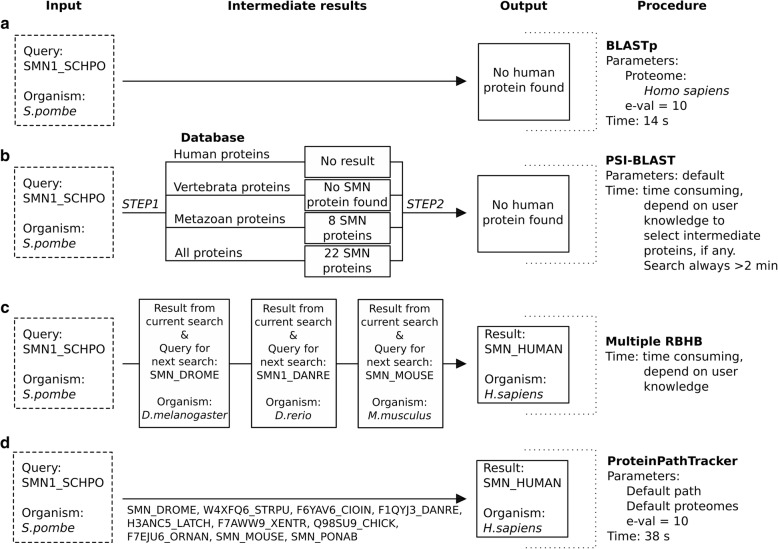
The selection of distant homologs of a query protein under study is a usual and useful application of protein sequence databases. Such sets of homologs are often applied to investigate the function of a protein and the degree to which experimental results can be transferred from one organism to another. In particular, a variety of databases facilitates static browsing for orthologs. However, these resources have a limited power when identifying orthologs between taxonomically distant species. In addition, in some situations, for a given query protein, it is advantageous to compare the sets of orthologs from different specific organisms: this recursive step-wise search might give an idea of the evolutionary path of the protein as a series of consecutive steps, for example gaining or losing domains. However, a step-wise orthology search is a time-consuming task if the number of steps is high.
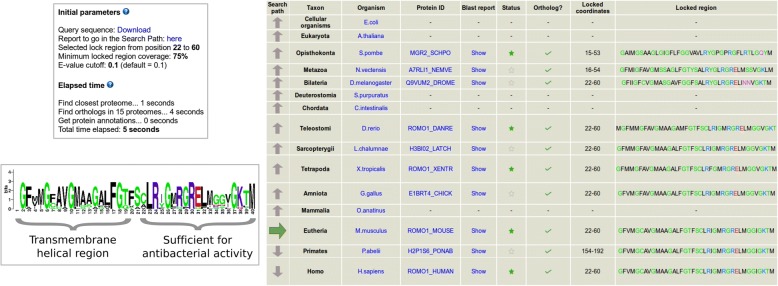
To illustrate a solution for this problem, we present the web tool ProteinPathTracker, which allows to track the evolutionary history of a query protein by locating homologs in selected proteomes along several evolutionary paths. Additional functionalities include locking a region of interest to follow its evolution in the discovered homologous sequences and the study of the protein function evolution by analysis of the annotations of the homologs.
ProteinPathTracker is an easy-to-use web tool that automatises the practice of looking for selected homologs in distant species in a straightforward way for non-expert users.
在研究的查询蛋白质的远亲同源物的选择是蛋白质序列数据库的常用且有用的应用。这样的同源物集合通常用于研究蛋白质的功能以及可以从一个生物体转移到另一个生物体的实验结果的程度。特别是,各种数据库都方便了同源物的静态浏览。但是,当识别分类学上距离较远的物种之间的同源物时,这些资源的能力有限。此外,在某些情况下,对于给定的查询蛋白质,比较来自不同特定生物体的同源物集是有利的:这种递归逐步搜索可能会给出蛋白质进化路径的概念,例如获得或失去结构域。但是,如果步骤数很高,则逐步同源性搜索是一项耗时的任务。
为了解决这个问题,我们提出了 Web 工具 ProteinPathTracker,它允许通过在选定的蛋白质组中定位同源物来跟踪查询蛋白质的进化历史,沿着几条进化路径。其他功能包括锁定感兴趣的区域,以跟踪其在发现的同源序列中的进化,并通过分析同源物的注释来研究蛋白质功能的进化。
ProteinPathTracker 是一个易于使用的 Web 工具,它以一种简单的方式为非专家用户自动执行在远亲物种中查找选定同源物的实践。