Division of Gastroenterology, Hepatology and Nutrition, Boston Children's Hospital, Boston, MA, United States.
Center for Motility and Functional Gastrointestinal Disorders Boston Children's Hospital, Boston, MA, United States.
Front Immunol. 2018 Nov 5;9:2059. doi: 10.3389/fimmu.2018.02059. eCollection 2018.
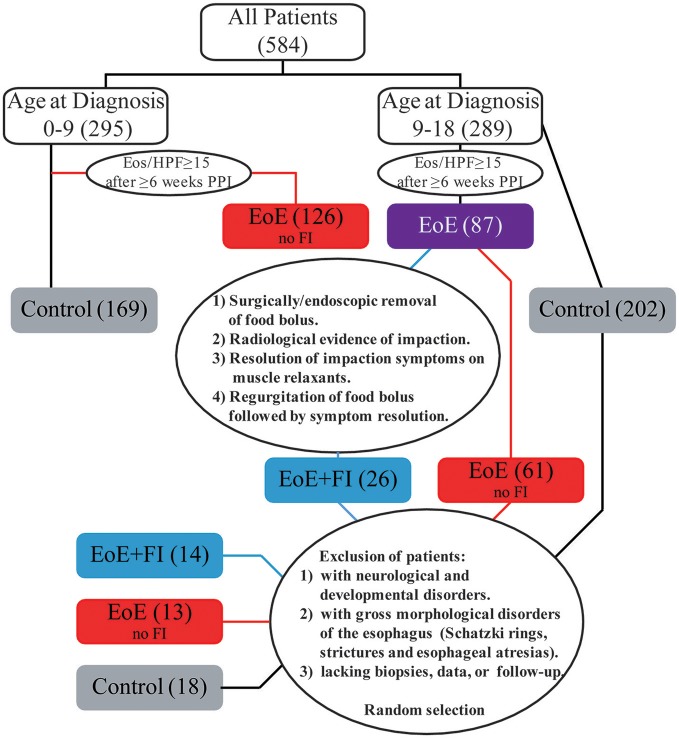
Eosinophilic esophagitis (EoE), a Th2-type allergic immune disorder characterized by an eosinophil-rich esophageal immune infiltrate, is often associated with food impaction (FI) in pediatric patients but the molecular mechanisms underlying the development of this complication are not well understood. We aim to identify molecular pathways involved in the development of FI. Due to large variations in disease presentation, our analysis was further geared to find markers capable of distinguishing EoE patients that are prone to develop food impactions and thus expand an established medical algorithm for EoE by developing a secondary analysis that allows for the identification of patients with food impactions as a distinct patient population. To this end, mRNA patterns from esophageal biopsies of pediatric EoE patients presenting with and without food impactions were compared and machine learning techniques were employed to establish a diagnostic probability score to identify patients with food impactions (EoE+FI). Our analysis showed that EoE patients with food impaction were indistinguishable from other EoE patients based on their tissue eosinophil count, serum IgE levels, or the mRNA transcriptome-based p(EoE). Irrespectively, an additional analysis loop of the medical algorithm was able to separate EoE+FI patients and a composite FI-score was established that identified such patients with a sensitivity of 93% and a specificity of 100%. The esophageal mRNA pattern of EoE+FI patients was typified by lower expression levels of mast cell markers and Th2 associated transcripts, such as , and . Furthermore, lower expression levels of regulators of esophageal motility ( and ) were detected in EoE+FI. The EoE+FI -specific mRNA pattern indicates that impaired motility may be one underlying factor for the development of food impactions in pediatric patients. The availability of improved diagnostic tools such as a medical algorithm for EoE subpopulations will have a direct impact on clinical practice because such strategies can identify molecular inflammatory characteristics of individual EoE patients, which, in turn, will facilitate the development of individualized therapeutic approaches that target the relevant pathways affected in each patient.
嗜酸细胞性食管炎(EoE)是一种以 Th2 型过敏免疫紊乱为特征的疾病,其特点是食管免疫浸润中有丰富的嗜酸性粒细胞。它常与小儿患者的食物嵌塞(FI)有关,但导致这种并发症发展的分子机制尚不清楚。我们旨在确定与 FI 发展相关的分子途径。由于疾病表现存在较大差异,我们的分析进一步旨在寻找能够区分易发生食物嵌塞的 EoE 患者的标志物,从而通过开发能够将食物嵌塞患者识别为一个独特患者群体的二次分析来扩展现有的 EoE 医疗算法。为此,我们比较了患有和不患有食物嵌塞的小儿 EoE 患者的食管活检组织中的 mRNA 模式,并采用机器学习技术建立了一种诊断概率评分,以识别有食物嵌塞的患者(EoE+FI)。我们的分析表明,基于组织嗜酸性粒细胞计数、血清 IgE 水平或基于 mRNA 转录本的 p(EoE),有食物嵌塞的 EoE 患者与其他 EoE 患者无法区分。尽管如此,医疗算法的额外分析循环能够将 EoE+FI 患者分开,并建立了一个复合 FI 评分,该评分能够以 93%的敏感性和 100%的特异性识别此类患者。EoE+FI 患者的食管 mRNA 模式的特点是肥大细胞标志物和 Th2 相关转录物的表达水平较低,如、和。此外,在 EoE+FI 中还检测到食管运动调节因子(和)的表达水平较低。EoE+FI 特有的 mRNA 模式表明,运动功能障碍可能是小儿患者发生食物嵌塞的一个潜在因素。改进的诊断工具(如 EoE 亚群的医疗算法)的可用性将直接影响临床实践,因为这些策略可以识别个体 EoE 患者的分子炎症特征,进而促进针对每个患者受影响相关途径的个体化治疗方法的发展。