Rezzoagli Chiara, Wilson David, Weigert Michael, Wyder Stefan, Kümmerli Rolf
Department of Plant and Microbial Biology, University of Zurich, Zurich, Switzerland.
Evol Med Public Health. 2018 Sep 10;2018(1):246-259. doi: 10.1093/emph/eoy026. eCollection 2018.
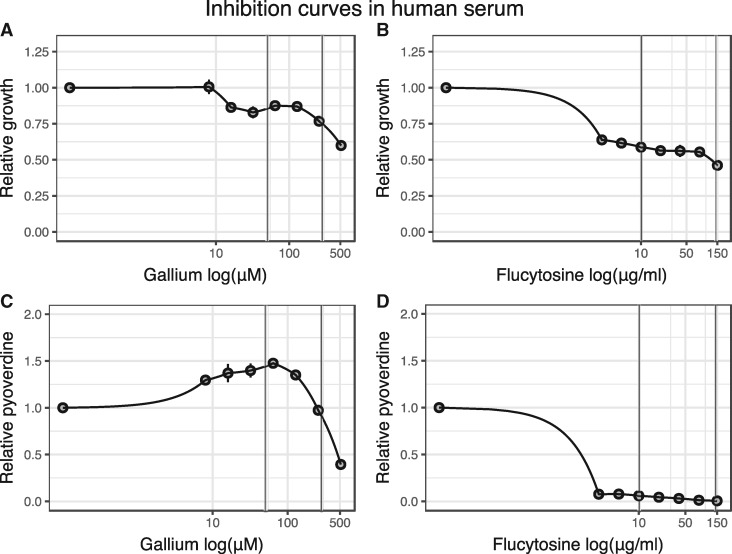
We probed the evolutionary robustness of two antivirulence drugs, gallium and flucytosine, targeting the iron-scavenging pyoverdine in the opportunistic pathogen . Using an experimental evolution approach in human serum, we showed that antivirulence treatments are not evolutionarily robust per se, but vary in their propensity to select for resistance.
Treatments that inhibit the expression or functioning of bacterial virulence factors hold great promise to be both effective and exert weaker selection for resistance than conventional antibiotics. However, the evolutionary robustness argument, based on the idea that antivirulence treatments disarm rather than kill pathogens, is controversial. Here, we probe the evolutionary robustness of two repurposed drugs, gallium and flucytosine, targeting the iron-scavenging pyoverdine of the opportunistic human pathogen .
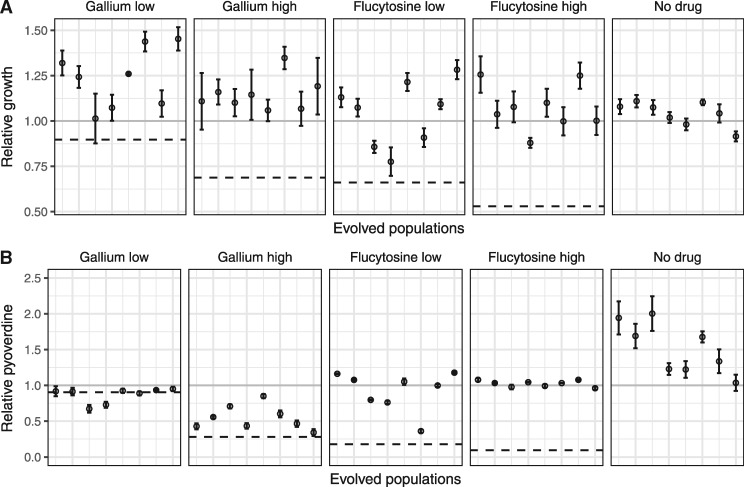
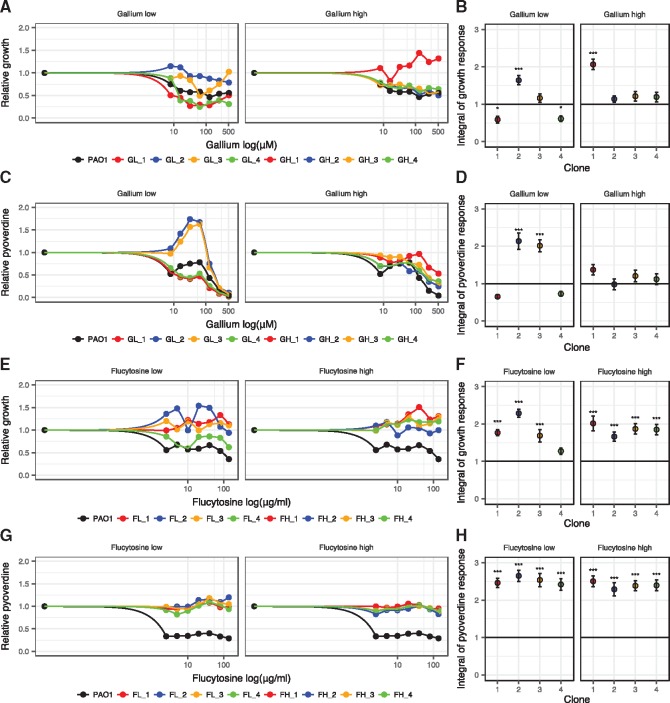
We subjected replicated cultures of bacteria to two concentrations of each drug for 20 consecutive days in human serum as an infection model. We screened evolved populations and clones for resistance phenotypes, including the restoration of growth and pyoverdine production, and the evolution of iron uptake by-passing mechanisms. We whole-genome sequenced evolved clones to identify the genetic basis of resistance.
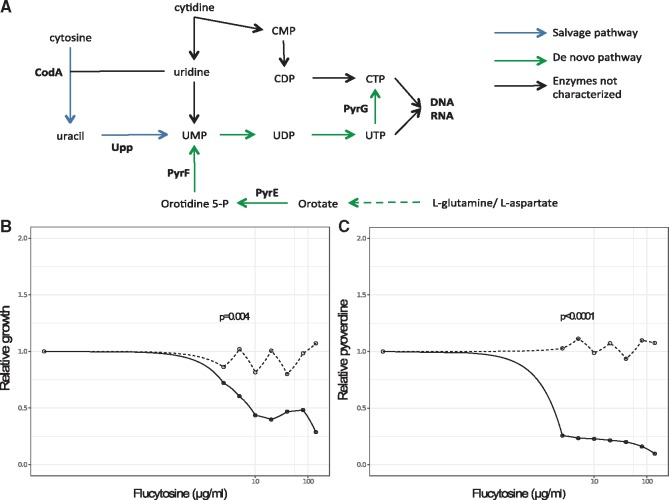
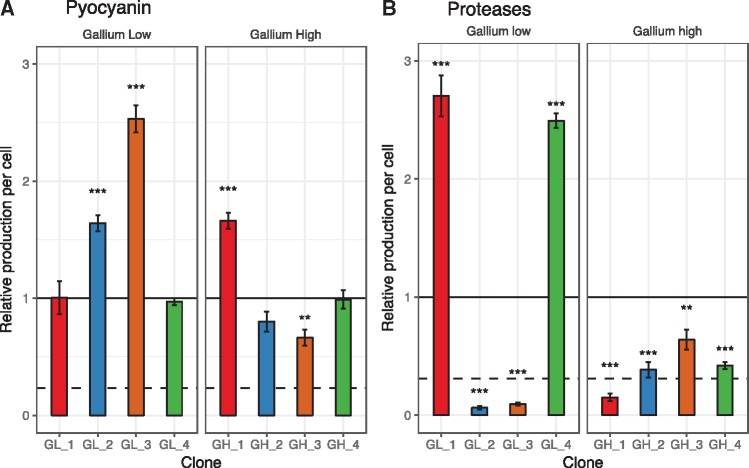
We found that mutants resistant against antivirulence treatments readily arose, but their selective spreading varied between treatments. Flucytosine resistance quickly spread in all populations due to disruptive mutations in , a gene encoding an enzyme required for flucytosine activation. Conversely, resistance against gallium arose only sporadically, and was based on mutations in transcriptional regulators, upregulating pyocyanin production, a redox-active molecule promoting siderophore-independent iron acquisition. The spread of gallium resistance was presumably hampered because pyocyanin-mediated iron delivery benefits resistant and susceptible cells alike.
Our work highlights that antivirulence treatments are not evolutionarily robust . Instead, evolutionary robustness is a relative measure, with specific treatments occupying different positions on a continuous scale.
我们探究了两种抗毒力药物(镓和氟胞嘧啶)针对机会性病原体中清除铁元素的绿脓菌素的进化稳健性。在人血清中采用实验进化方法,我们发现抗毒力治疗本身在进化上并不稳健,但其选择耐药性的倾向各不相同。
抑制细菌毒力因子表达或功能的治疗方法有望既有效又比传统抗生素对耐药性的选择作用更弱。然而,基于抗毒力治疗使病原体失能而非杀死病原体这一观点的进化稳健性论点存在争议。在此,我们探究了两种重新利用的药物(镓和氟胞嘧啶)针对人类机会性病原体清除铁元素的绿脓菌素的进化稳健性。
我们将细菌的重复培养物在人血清中作为感染模型,连续20天暴露于每种药物的两种浓度下。我们筛选进化后的群体和克隆的耐药表型,包括生长恢复、绿脓菌素产生恢复以及铁摄取旁路机制的进化。我们对进化后的克隆进行全基因组测序以确定耐药的遗传基础。
我们发现对抗毒力治疗产生抗性的突变体很容易出现,但它们在不同治疗之间的选择性传播有所不同。由于氟胞嘧啶激活所需的一种酶编码基因发生破坏性突变,氟胞嘧啶抗性在所有群体中迅速传播。相反,对镓的抗性只是偶尔出现,并且是基于转录调节因子的突变,上调了绿脓菌素的产生,绿脓菌素是一种促进不依赖铁载体获取铁的氧化还原活性分子。镓抗性的传播可能受到阻碍,因为绿脓菌素介导的铁传递对耐药和敏感细胞都有益。
我们的研究强调抗毒力治疗在进化上并不稳健。相反,进化稳健性是一个相对的衡量标准,特定治疗在连续尺度上占据不同位置。