Department of Microbiology and Immunology, University of North Carolina at Chapel Hill, Chapel Hill, North Carolina, USA.
Paul G. Allen School for Global Animal Health, Washington State University, Pullman, Washington, USA.
mBio. 2018 Nov 20;9(6):e01471-18. doi: 10.1128/mBio.01471-18.
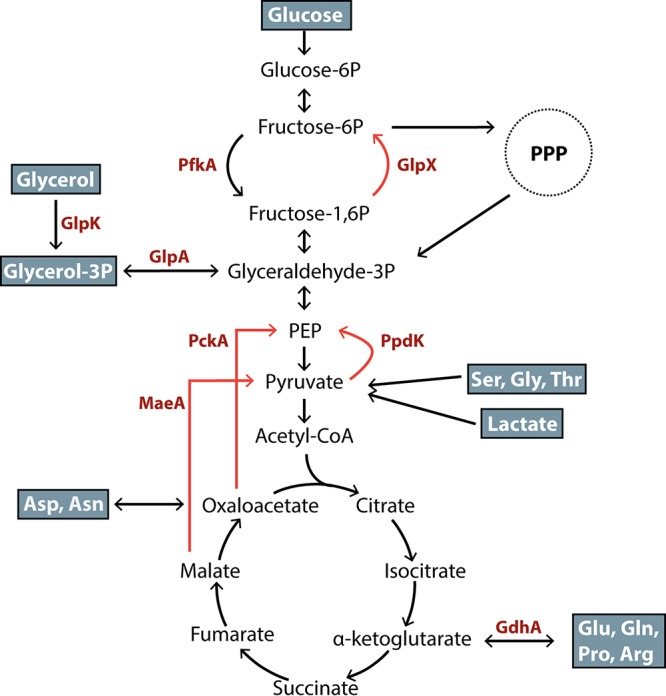
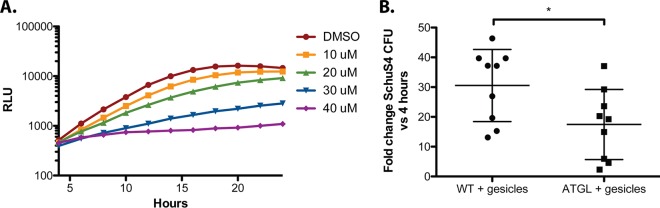
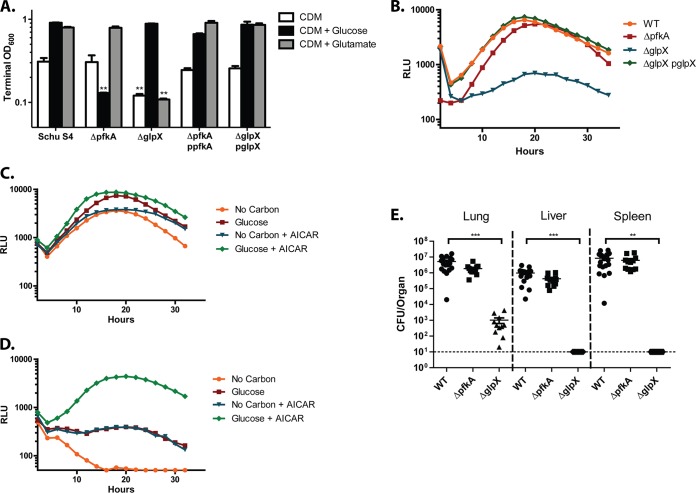
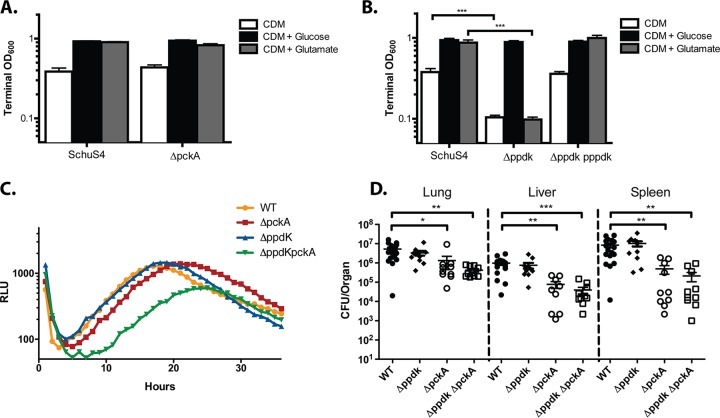
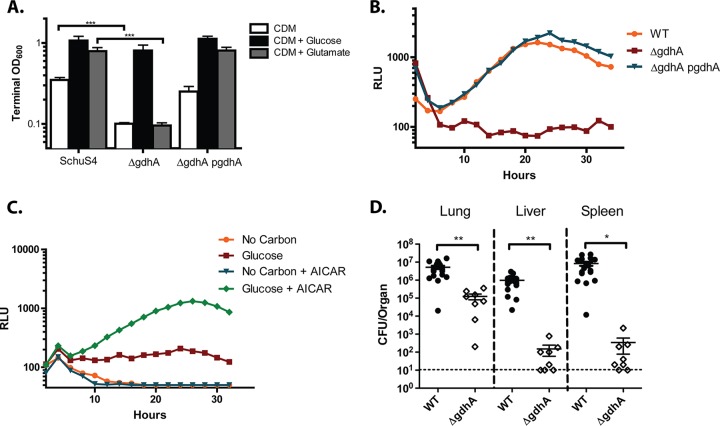
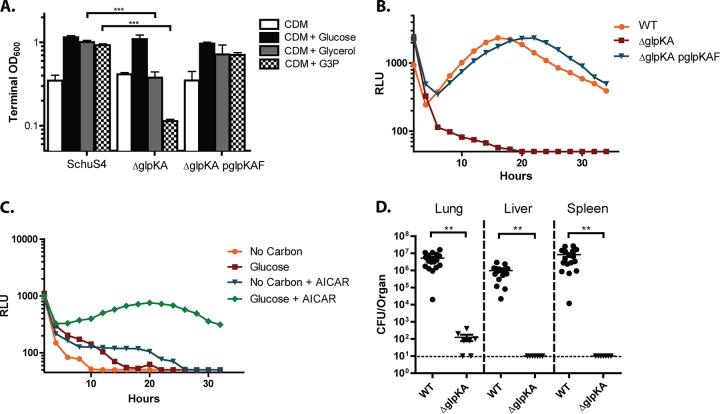
is a Gram-negative, facultative, intracellular bacterial pathogen and one of the most virulent organisms known. A hallmark of pathogenesis is the bacterium's ability to replicate to high densities within the cytoplasm of infected cells in over 250 known host species, including humans. This demonstrates that is adept at modulating its metabolism to fluctuating concentrations of host-derived nutrients. The precise metabolic pathways and nutrients utilized by during intracellular growth, however, are poorly understood. Here, we use systematic mutational analysis to identify the carbon catabolic pathways and host-derived nutrients required for intracellular replication. We demonstrate that the glycolytic enzyme phosphofructokinase (PfkA), and thus glycolysis, is dispensable for SchuS4 virulence, and we highlight the importance of the gluconeogenic enzyme fructose 1,6-bisphosphatase (GlpX). We found that the specific gluconeogenic enzymes that function upstream of GlpX varied based on infection model, indicating that alters its metabolic flux according to the nutrients available within its replicative niche. Despite this flexibility, we found that glutamate dehydrogenase (GdhA) and glycerol 3-phosphate (G3P) dehydrogenase (GlpA) are essential for intracellular replication in all infection models tested. Finally, we demonstrate that host cell lipolysis is required for intracellular proliferation, suggesting that host triglyceride stores represent a primary source of glycerol during intracellular replication. Altogether, the data presented here reveal common nutritional requirements for a bacterium that exhibits characteristic metabolic flexibility during infection. The widespread onset of antibiotic resistance prioritizes the need for novel antimicrobial strategies to prevent the spread of disease. With its low infectious dose, broad host range, and high rate of mortality, poses a severe risk to public health and is considered a potential agent for bioterrorism. reaches extreme densities within the host cell cytosol, often replicating 1,000-fold in a single cell within 24 hours. This remarkable rate of growth demonstrates that is adept at harvesting and utilizing host cell nutrients. However, like most intracellular pathogens, the types of nutrients utilized by and how they are acquired is not fully understood. Identifying the essential pathways for replication may reveal new therapeutic strategies for targeting this highly infectious pathogen and may provide insight for improved targeting of intracellular pathogens in general.
是一种革兰氏阴性、兼性、细胞内细菌病原体,也是已知最具毒性的生物体之一。其发病机制的一个标志是该细菌能够在超过 250 种已知宿主物种(包括人类)的感染细胞细胞质中高密度复制。这表明能够巧妙地调节其代谢以适应宿主来源营养物质的波动浓度。然而,在细胞内生长过程中利用的确切代谢途径和营养物质还知之甚少。在这里,我们使用系统的突变分析来确定细胞内复制所需的碳分解代谢途径和宿主来源的营养物质。我们证明糖酵解酶磷酸果糖激酶(PfkA),因此糖酵解,对于 SchuS4 毒力是可有可无的,并且突出了糖异生酶果糖 1,6-二磷酸酶(GlpX)的重要性。我们发现,根据感染模型的不同,作为 GlpX 上游起作用的特定糖异生酶也有所不同,这表明根据其复制生态位内可用的营养物质,改变其代谢通量。尽管具有这种灵活性,但我们发现谷氨酸脱氢酶(GdhA)和甘油 3-磷酸(G3P)脱氢酶(GlpA)在所有测试的感染模型中对于细胞内复制都是必不可少的。最后,我们证明宿主细胞脂肪分解对于细胞内增殖是必需的,这表明宿主甘油三酯储存物是细胞内复制期间甘油的主要来源。总的来说,这里呈现的数据揭示了一种在感染过程中表现出特征性代谢灵活性的细菌的常见营养需求。抗生素耐药性的广泛出现优先需要新型抗菌策略来防止疾病传播。由于其感染剂量低、宿主范围广和死亡率高,对公共健康构成严重威胁,并被认为是生物恐怖主义的潜在制剂。在宿主细胞细胞质中达到极高的密度,经常在 24 小时内单个细胞中复制 1000 倍。这种惊人的生长速度表明能够巧妙地收获和利用宿主细胞营养物质。然而,与大多数细胞内病原体一样,还不完全了解利用的营养物质类型以及它们是如何获得的。确定复制所需的必要途径可能会为针对这种高度传染性病原体的新治疗策略提供线索,并为一般情况下针对细胞内病原体的靶向提供见解。