Schweiger Martina, Eichmann Thomas O, Taschler Ulrike, Zimmermann Robert, Zechner Rudolf, Lass Achim
Institute of Molecular Biosciences, University of Graz, Graz, Austria.
Institute of Molecular Biosciences, University of Graz, Graz, Austria.
Methods Enzymol. 2014;538:171-93. doi: 10.1016/B978-0-12-800280-3.00010-4.
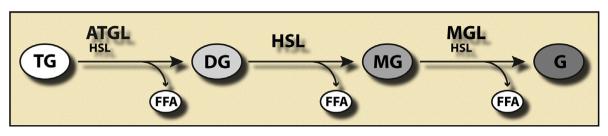
Lipolysis is defined as the hydrolytic cleavage of ester bonds in triglycerides (TGs), resulting in the generation of fatty acids (FAs) and glycerol. The two major TG pools in the body of vertebrates comprise intracellular TGs and plasma/nutritional TGs. Accordingly, this leads to the discrimination between intracellular and intravascular/gastrointestinal lipolysis, respectively. This chapter focuses exclusively on intracellular lipolysis, referred to as lipolysis herein. The lipolytic cleavage of TGs occurs in essentially all cells and tissues of the body. In all of them, the resulting FAs are utilized endogenously for energy production or biosynthetic pathways with one exception, white adipose tissue (WAT). WAT releases FAs and glycerol to supply nonadipose tissues at times of nutrient deprivation. The fundamental role of lipolysis in lipid and energy homeostasis requires the accurate measurement of lipase activities and lipolytic rates. The recent discovery of new enzymes and regulators that mediate the hydrolysis of TG has made these measurements more complex. Here, we describe detailed methodology for how to measure lipolysis and specific enzymes' activities in cells, organs, and their respective extracts.
脂解作用被定义为甘油三酯(TGs)中酯键的水解断裂,产生脂肪酸(FAs)和甘油。脊椎动物体内的两个主要甘油三酯库包括细胞内甘油三酯和血浆/营养性甘油三酯。因此,这分别导致了细胞内脂解和血管内/胃肠道脂解之间的区分。本章专门关注细胞内脂解作用,本文中简称为脂解。甘油三酯的脂解断裂基本上发生在身体的所有细胞和组织中。在所有这些细胞和组织中,产生的脂肪酸除了白色脂肪组织(WAT)外,都被内源性地用于能量产生或生物合成途径。在营养缺乏时,白色脂肪组织释放脂肪酸和甘油以供应非脂肪组织。脂解在脂质和能量稳态中的基本作用需要准确测量脂肪酶活性和脂解速率。最近发现了介导甘油三酯水解的新酶和调节剂,这使得这些测量更加复杂。在这里,我们描述了如何在细胞、器官及其各自提取物中测量脂解和特定酶活性的详细方法。