Division of Rheumatology, The Johns Hopkins University School of Medicine, Baltimore, MD, United States.
Klinik und Poliklinik für Rheumatologie, Klinische Immunologie, Asklepios Klinikum Bad Abbach, Bad Abbach, Germany.
Front Immunol. 2018 Oct 16;9:2352. doi: 10.3389/fimmu.2018.02352. eCollection 2018.
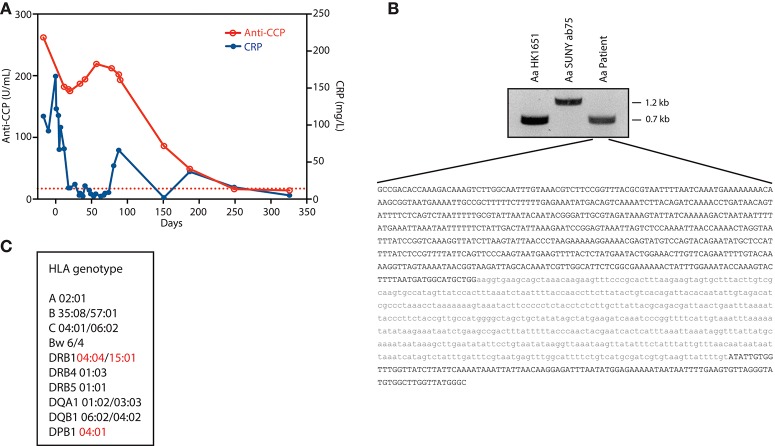
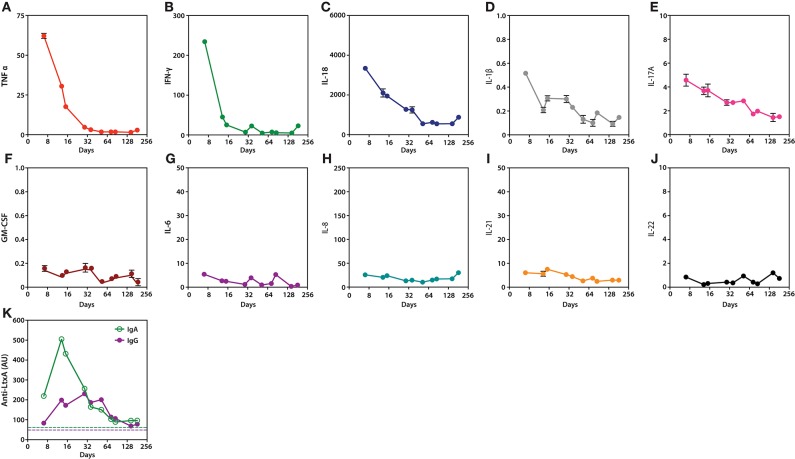
() is a Gram-negative coccobacillus recognized as a pathogen in periodontitis and infective endocarditis. By producing a toxin (leukotoxin A, LtxA) that triggers global hypercitrullination in neutrophils, has been recently linked to rheumatoid arthritis (RA) pathogenesis. Although mechanistic and clinical association studies implicate infection in the initiation of autoimmunity in RA, direct evidence in humans is lacking. We describe a 59-year-old man with anti-citrullinated protein antibody (ACPA)-positive RA who presented for evaluation of refractory disease. He was found to have endocarditis. Following antibiotic treatment, joint symptoms resolved and ACPAs normalized. Given the implications for RA immunopathogenesis, we further investigated the bacterial, genetic and immune factors that may have contributed to the patient's clinical and autoimmune phenotypes. DNA was extracted from serum and used to amplify the leukotoxin ( promoter region by PCR, which was further analyzed by Sanger sequencing. High-resolution identification of HLA alleles was performed by sequenced based typing (SBT). TNF-α, IFN-γ, GM-CSF, IL-1β, IL-6, IL-8, IL-17A, IL-18, IL-21, and IL-22 were quantified in serum by a multiplex immunoassay. IgG and IgA antibodies to LtxA were assayed by ELISA. genotyping confirmed infection with a highly leukotoxic strain carrying a 530-bp promoter deletion, shown to result in 10- to 20-fold higher bacterial expression of LtxA. Immuno-phenotyping showed high anti-LtxA antibodies, elevated cytokines implicated in RA pathogenesis (Th1/Th17), and specific host susceptibility conferred by three HLA alleles strongly linked to ACPAs and RA (DRB104:04, DRB115:01, and DPB104:01). One year after eradication of , the patient remained free of arthritis and anti-CCP antibodies. In the context of genetic risk for RA, systemic subacute infection with a leukotoxic strain of can drive ACPA production and a clinical phenotype similar to RA.
牙龈卟啉单胞菌是一种革兰氏阴性短小球杆菌,被认为是牙周炎和感染性心内膜炎的病原体。最近的研究表明,牙龈卟啉单胞菌通过产生一种毒素(白细胞毒素 A,LtxA),触发中性粒细胞的全细胞瓜氨酸化,与类风湿关节炎(RA)的发病机制有关。尽管机制和临床关联研究表明,感染在 RA 自身免疫的启动中起作用,但在人类中缺乏直接证据。我们描述了一名 59 岁男性,患有抗瓜氨酸蛋白抗体(ACPA)阳性的 RA,他因难治性疾病就诊。发现他患有心内膜炎。经过抗生素治疗,关节症状缓解,ACPA 恢复正常。鉴于其对 RA 免疫发病机制的影响,我们进一步研究了可能导致患者临床和自身免疫表型的细菌、遗传和免疫因素。从血清中提取 DNA,通过 PCR 扩增白细胞毒素(LtxA)的启动子区域,进一步通过 Sanger 测序进行分析。通过基于测序的分型(SBT)对 HLA 等位基因进行高分辨率鉴定。通过多重免疫分析定量检测血清中 TNF-α、IFN-γ、GM-CSF、IL-1β、IL-6、IL-8、IL-17A、IL-18、IL-21 和 IL-22。通过 ELISA 检测 IgG 和 IgA 抗体针对 LtxA 的抗体。基因分型证实感染了一种携带 530bp 启动子缺失的高度白细胞毒素菌株,该缺失导致 LtxA 的细菌表达增加 10-20 倍。免疫表型显示高抗 LtxA 抗体、RA 发病机制中涉及的升高细胞因子(Th1/Th17),以及与 ACPA 和 RA 强烈相关的三个 HLA 等位基因赋予的宿主易感性(DRB104:04、DRB115:01 和 DPB104:01)。在 RA 的遗传风险背景下,对白细胞毒素的毒性菌株的全身性亚急性感染可导致 ACPA 的产生,并出现类似于 RA 的临床表型。