Ricci Claudia, Marzocchi Carlotta, Battistini Stefania
Department of Medical, Surgical and Neurological Sciences, University of Siena, 53100 Siena, Italy.
Cells. 2018 Nov 20;7(11):219. doi: 10.3390/cells7110219.
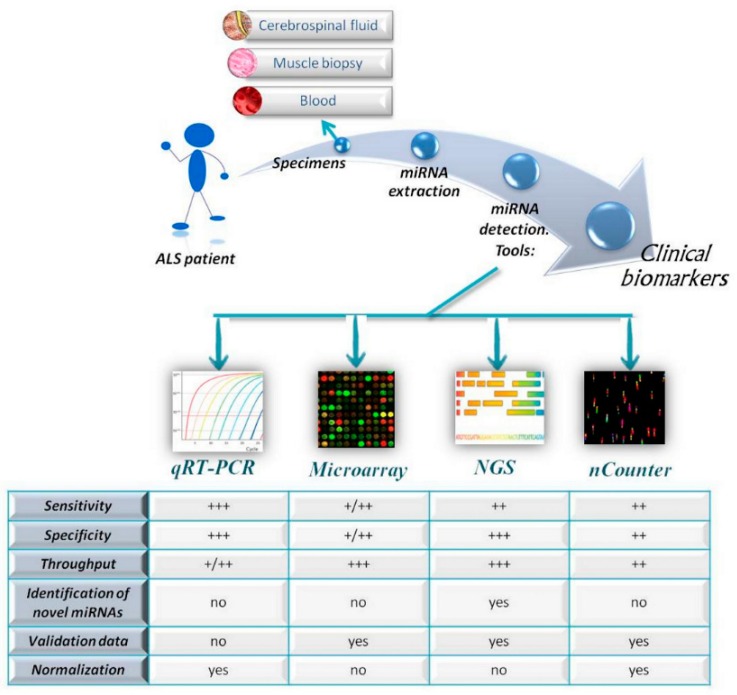
Amyotrophic lateral sclerosis (ALS) is an incurable and fatal disorder characterized by the progressive loss of motor neurons in the cerebral cortex, brain stem, and spinal cord. Sporadic ALS form accounts for the majority of patients, but in 1⁻13.5% of cases the disease is inherited. The diagnosis of ALS is mainly based on clinical assessment and electrophysiological examinations with a history of symptom progression and is then made with a significant delay from symptom onset. Thus, the identification of biomarkers specific for ALS could be of a fundamental importance in the clinical practice. An ideal biomarker should display high specificity and sensitivity for discriminating ALS from control subjects and from ALS-mimics and other neurological diseases, and should then monitor disease progression within individual patients. microRNAs (miRNAs) are considered promising biomarkers for neurodegenerative diseases, since they are remarkably stable in human body fluids and can reflect physiological and pathological processes relevant for ALS. Here, we review the state of the art of miRNA biomarker identification for ALS in cerebrospinal fluid (CSF), blood and muscle tissue; we discuss advantages and disadvantages of different approaches, and underline the limits but also the great potential of this research for future practical applications.
肌萎缩侧索硬化症(ALS)是一种无法治愈的致命性疾病,其特征是大脑皮层、脑干和脊髓中的运动神经元逐渐丧失。散发性ALS病例占大多数,但在1%至13.5%的病例中,该疾病是遗传性的。ALS的诊断主要基于临床评估和电生理检查,结合症状进展史,且从症状出现到确诊往往有显著延迟。因此,鉴定ALS特异性生物标志物在临床实践中可能至关重要。理想的生物标志物应具有高特异性和敏感性,以区分ALS与对照受试者、ALS模拟疾病及其他神经疾病,并且能够监测个体患者的疾病进展。微小RNA(miRNA)被认为是神经退行性疾病有前景的生物标志物,因为它们在人体体液中非常稳定,并且能够反映与ALS相关的生理和病理过程。在此,我们综述了脑脊液(CSF)、血液和肌肉组织中用于ALS的miRNA生物标志物鉴定技术的现状;我们讨论了不同方法的优缺点,并强调了该研究的局限性以及在未来实际应用中的巨大潜力。