Department of Microbiology and Immunology, School of Medical Sciences, CoHAS, University of Cape Coast, Private Mail bag, Cape Coast, Ghana.
Department of Internal Medicine and Therapeutics, School of Medical Sciences, University of Cape Coast, Cape Coast, Ghana.
BMC Nephrol. 2018 Nov 21;19(1):333. doi: 10.1186/s12882-018-1130-z.
Kidney diseases have emerged as significant cause of morbidity and mortality in HIV subject on antiretroviral therapy (ART). In Ghana, routine follow up of HIV positive clients is by estimation of serum creatinine and urea levels. Glomerular Filtration Rate (GFR) is not routinely calculated and proteinuria is not routinely checked. This study sought to investigate the kidney profiles of adult HIV/AIDS patients being managed on ART at the Cape Coast Teaching Hospital (CCTH), Ghana.
A hospital-based analytical cross sectional study with a retrospective component was conducted using systematic sampling method to recruit HIV/AIDS who visited the ART clinic. A total of 440 participants of both sexes aged 18 years and above, confirmed as HIV/AIDS positive and on ART were involved in this study. Blood and urine samples were collected from all subjects and the levels of serum creatinine and urea and proteinuria were estimated and eGFR calculated using the Modification of Diet in Renal Disease (MDRD) equations. Data analyses were performed using Stata version 13 software (Stata Corp, Texas USA).
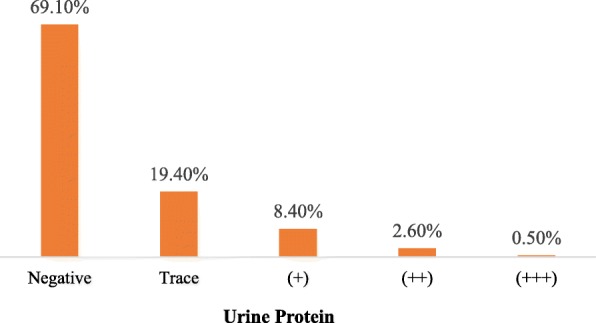
The mean age (years) of participants was 45.5 years (±11.6) with 288 (65.4%) being on Tenofovir based ART regimen. The mean eGFR was found to decrease from 112.4 ml/min/1.73 m at baseline, to 103.4 ml/min/1.73 m after 6 months on ART and to a mean of 99.4 ml/min/1.73 m at recruitment into this study. Factors which were found to be associated with having eGFR < 60 included age, gender and CD4 count though not statistically significant. Patients > 45 years had the highest odds with OR 2.0 (95% CI: 0.8-5.1), females had higher odds with OR 1.5 (95% CI: 0.5-5.2), and those with CD4 count > 350 had OR of 0.4 (95% CI 0.2-1.3). A total of 30.9% of the participants had proteinuria at recruitment. TDF based ART regimen had no statistically significant effect on serum creatinine and urea levels.
Estimated GFR decreased after 6 months among patients on ART despite normal serum creatinine and urea levels. This finding suggests that clients in care at HIV/ART clinics in Ghana may benefit from routine estimation of GFR and proteinuria.
在接受抗逆转录病毒疗法(ART)的 HIV 患者中,肾脏疾病已成为发病率和死亡率的重要原因。在加纳,对 HIV 阳性患者的常规随访是通过估计血清肌酐和尿素水平来进行的。肾小球滤过率(GFR)通常不计算,蛋白尿也不常规检查。本研究旨在调查加纳开普敦教学医院(CCTH)接受 ART 治疗的成年 HIV/AIDS 患者的肾脏情况。
本研究采用基于医院的分析性横断面研究,并结合回顾性部分,使用系统抽样方法招募了接受 ART 门诊治疗的 HIV/AIDS 患者。共有 440 名年龄在 18 岁及以上的男女参与者参与了这项研究,他们均被确认为 HIV/AIDS 阳性并正在接受 ART 治疗。从所有受试者中采集血液和尿液样本,并评估血清肌酐和尿素水平以及使用肾脏病饮食改良公式(MDRD)计算蛋白尿和 eGFR。数据分析使用 Stata 版本 13 软件(StataCorp,美国得克萨斯州)进行。
参与者的平均年龄(岁)为 45.5(±11.6)岁,其中 288 名(65.4%)正在接受基于替诺福韦的 ART 方案。研究发现,eGFR 从基线时的 112.4ml/min/1.73m 下降到 6 个月时的 103.4ml/min/1.73m,然后在招募入组时降至 99.4ml/min/1.73m。发现与 eGFR<60 相关的因素包括年龄、性别和 CD4 计数,但无统计学意义。年龄>45 岁的患者具有最高的 OR,为 2.0(95%CI:0.8-5.1),女性的 OR 较高,为 1.5(95%CI:0.5-5.2),CD4 计数>350 的患者的 OR 为 0.4(95%CI 0.2-1.3)。在招募时,总共有 30.9%的参与者有蛋白尿。基于 TDF 的 ART 方案对血清肌酐和尿素水平无统计学显著影响。
尽管血清肌酐和尿素水平正常,但接受 ART 治疗的患者在 6 个月后估计的 GFR 下降。这一发现表明,加纳 HIV/ART 诊所的患者可能受益于常规估计 GFR 和蛋白尿。