Centre for Excellence in Rural Sexual Health, Department of Rural Health, The University of Melbourne, PO Box 386, Wangaratta, VIC, 3677, Australia.
Department of Rural Health, The University of Melbourne, 49 Graham Street, Shepparton, VIC, 3055, Australia.
Int J Equity Health. 2018 Nov 21;17(1):172. doi: 10.1186/s12939-018-0888-8.
Medical termination of pregnancy (MToP) is a safe and acceptable abortion option. Depending on country context, MToP can be administered by general practitioners and mid-level healthcare providers in the first and second trimesters of pregnancy. Like other high-income countries, a range of social and structural barriers to MToP service provision exist in Australia. To counter some of these barriers, geographic decentralization of MToP was undertaken in rural Victoria, Australia, through training service providers about MToP to increase service delivery opportunities. The aim of this study was to investigate the factors that enabled and challenged the decentralization process.
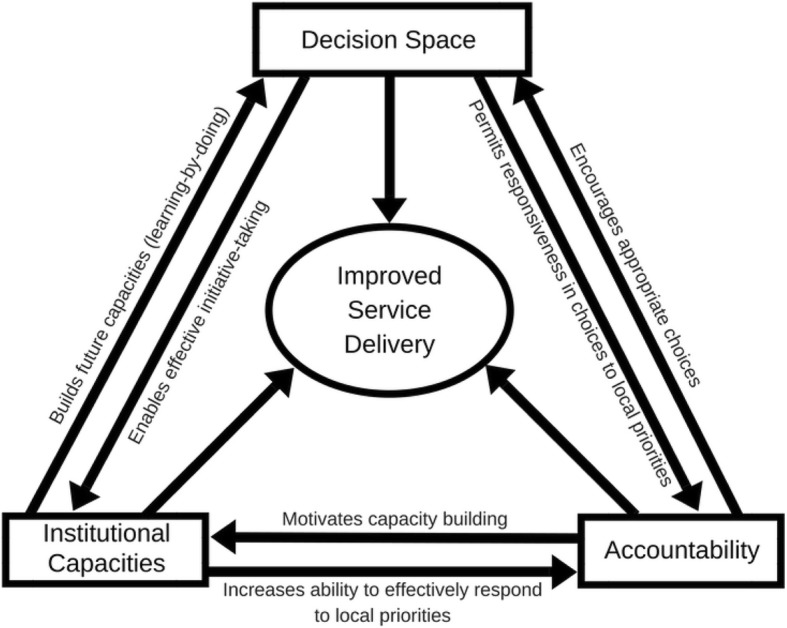
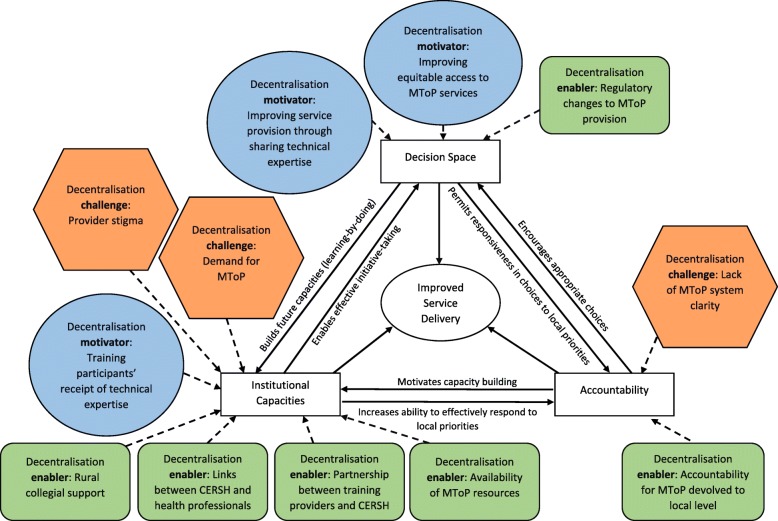
Face-to-face and telephone interviews were undertaken between April and June 2016 with a purposeful sample of six training providers and 13 general practitioners (GP) and nurse training participants. Study participants were asked about their perceptions of motivations, enablers and challenges to MToP provision. A published conceptual framework of synergies between decentralization and service delivery was used to analyse the study findings.
Three key themes emerged from the study findings. First, the effort to decentralize MToP was primarily supported by motivations related to making service access more equitable as well as the willingness of training providers to devolve their informal power, in the form of MToP medical expertise, to training participants. Next, the enablers for MToP decentralization included changes in the regulatory environment relating to decriminalization of abortion and availability of required medication, formation of partnerships to deliver training, provision of MToP clinical resources and local collegial support. Finally, challenges to MToP decentralization were few but significant. These included a lack of a state-wide strategy for service provision, provider concerns about coping with service demand, and provider stigma in the form of perceived negative community or collegial attitudes. These were significant enough to create caution for GPs and nurses considering service provision.
Decentralization concepts offer an innovative way for reframing and tackling issues associated with improving MToP service delivery. There is scope for more research about MToP decentralization in other country contexts. These findings are important for informing future rural MToP service expansion efforts that improve equity in service access.
医疗终止妊娠(MToP)是一种安全且可接受的堕胎选择。根据国家背景,在妊娠的第一和第二阶段,普通医生和中级医疗保健提供者可以进行 MToP。与其他高收入国家一样,澳大利亚也存在一系列阻碍 MToP 服务提供的社会和结构性障碍。为了应对其中的一些障碍,澳大利亚维多利亚州的农村地区对 MToP 进行了地理分散化,通过培训 MToP 服务提供者来增加服务提供机会。本研究的目的是调查使分散化过程得以实现的因素,以及挑战分散化过程的因素。
2016 年 4 月至 6 月期间,采用有针对性的样本,对六名培训提供者和 13 名普通医生(GP)和护士培训参与者进行了面对面和电话访谈。研究参与者被问及他们对提供 MToP 的动机、促进因素和挑战的看法。采用已发表的关于分散化和服务提供协同作用的概念框架来分析研究结果。
研究结果中出现了三个关键主题。首先,MToP 分散化的努力主要得到了使服务获取更加公平的动机以及培训提供者愿意将其非正式权力(以 MToP 医疗专业知识的形式)下放给培训参与者的支持。其次,MToP 分散化的促进因素包括与堕胎非刑事化和所需药物可用性相关的监管环境的变化、提供培训的伙伴关系的形成、MToP 临床资源的提供以及当地的同事支持。最后,MToP 分散化的挑战很少,但意义重大。这些挑战包括缺乏全州范围的服务提供战略、提供者对满足服务需求的担忧以及提供者的耻辱感,表现为对社区或同事的负面态度。这些挑战足以让考虑提供服务的普通医生和护士保持谨慎。
分散化概念为重新构建和解决与改善 MToP 服务提供相关的问题提供了一种创新的方法。在其他国家背景下,对 MToP 分散化进行更多研究是有意义的。这些发现对于为改善服务获取公平性的未来农村 MToP 服务扩展工作提供了信息。