Nugent Diane J, Romano Alicia A, Sabharwal Shreya, Cooper David L
Center for Inherited Bleeding Disorders, Children's Hospital of Orange County, Orange, CA, USA,
Department of Pediatrics, New York Medical College, Valhalla, NY, USA.
J Blood Med. 2018 Oct 23;9:185-192. doi: 10.2147/JBM.S164474. eCollection 2018.
Noonan syndrome (NS) is an autosomal dominant genetic condition that has a number of clinical features, including bleeding diathesis and a number of hematological abnormalities including clotting factor deficiencies, von Willebrand disease and abnormal platelet count/function.
We evaluated the frequency/types of bleeding disorders, and associated hematological laboratory findings, in patients with NS, using published data from 1965 to 2014.
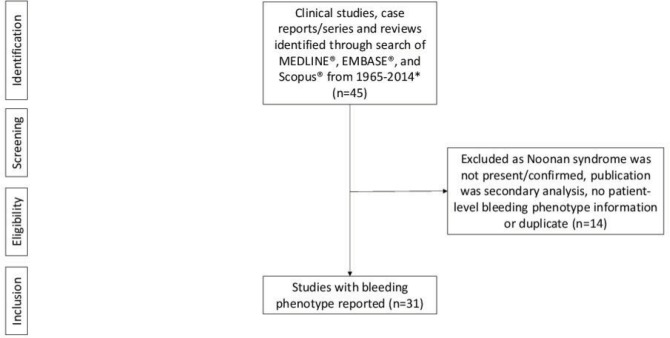
Of 45 studies identified, 31 included data for 428 patients with NS. Of these patients, 43% had reported bleeding, 26% had no reported bleeding and no bleed data was reported for 31%. Most patients (90%) had bleeding-related laboratory test abnormalities, but only 194 (45%) had a confirmed diagnosis of a specific bleeding disorder. Abnormal laboratory tests included: prolonged prothrombin time, activated partial thromboplastin time, and other platelet-related disorders. Of the 194 patients with a confirmed diagnosis of a specific bleeding disorder, 153 (79%) had single clotting factor deficiencies, von Willebrand disease or platelet-related disorders, and 41 (21%) had multiple deficiencies including platelet-related disorders.
As patients with NS can experience multiple bleeding disorders, including abnormal platelet function, clinical evaluations should be performed at diagnosis, after diagnosis, before any surgery is undertaken, and if patients become symptomatic.
努南综合征(NS)是一种常染色体显性遗传病,具有多种临床特征,包括出血素质以及多种血液学异常,如凝血因子缺乏、血管性血友病和血小板计数/功能异常。
我们利用1965年至2014年发表的数据,评估了NS患者出血性疾病的频率/类型以及相关的血液学实验室检查结果。
在确定的45项研究中,31项纳入了428例NS患者的数据。在这些患者中,43%有出血报告,26%无出血报告,31%未报告出血数据。大多数患者(90%)有与出血相关的实验室检查异常,但只有194例(45%)确诊为特定的出血性疾病。异常实验室检查包括:凝血酶原时间延长、活化部分凝血活酶时间延长以及其他与血小板相关的疾病。在194例确诊为特定出血性疾病的患者中,153例(79%)有单一凝血因子缺乏、血管性血友病或与血小板相关的疾病,41例(21%)有多种缺乏,包括与血小板相关的疾病。
由于NS患者可能出现多种出血性疾病,包括血小板功能异常,因此在诊断时、诊断后、进行任何手术前以及患者出现症状时均应进行临床评估。