Department of Neuroinflammation, UCL Institute of Neurology, Queen Square MS Centre, London, UK
Department of Neuroinflammation, UCL Institute of Neurology, Queen Square MS Centre, London, UK.
J Neurol Neurosurg Psychiatry. 2019 Feb;90(2):219-226. doi: 10.1136/jnnp-2018-318440. Epub 2018 Nov 22.
To evaluate whether structural brain network metrics correlate better with clinical impairment and information processing speed in multiple sclerosis (MS) beyond atrophy measures and white matter lesions.
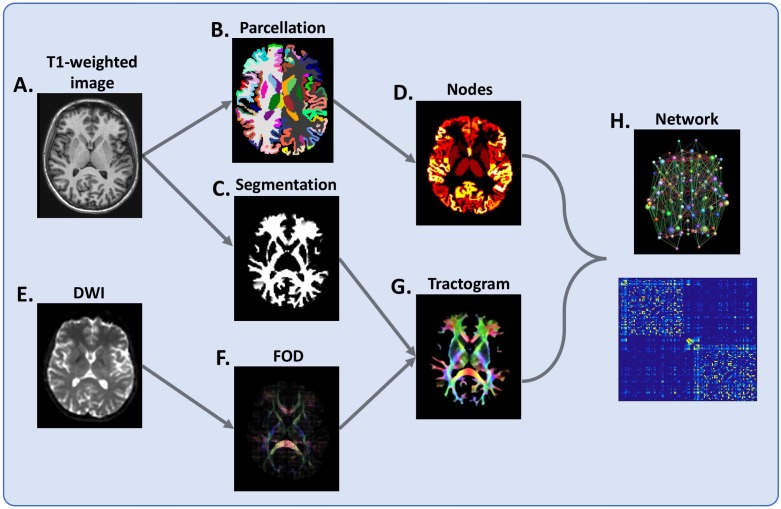
This cross-sectional study included 51 healthy controls and 122 patients comprising 58 relapsing-remitting, 28 primary progressive and 36 secondary progressive. Structural brain networks were reconstructed from diffusion-weighted MRIs and standard metrics reflecting network density, efficiency and clustering coefficient were derived and compared between subjects' groups. Stepwise linear regression analyses were used to investigate the contribution of network measures that explain clinical disability (Expanded Disability Status Scale (EDSS)) and information processing speed (Symbol Digit Modalities Test (SDMT)) compared with conventional MRI metrics alone and to determine the best statistical model that explains better EDSS and SDMT.
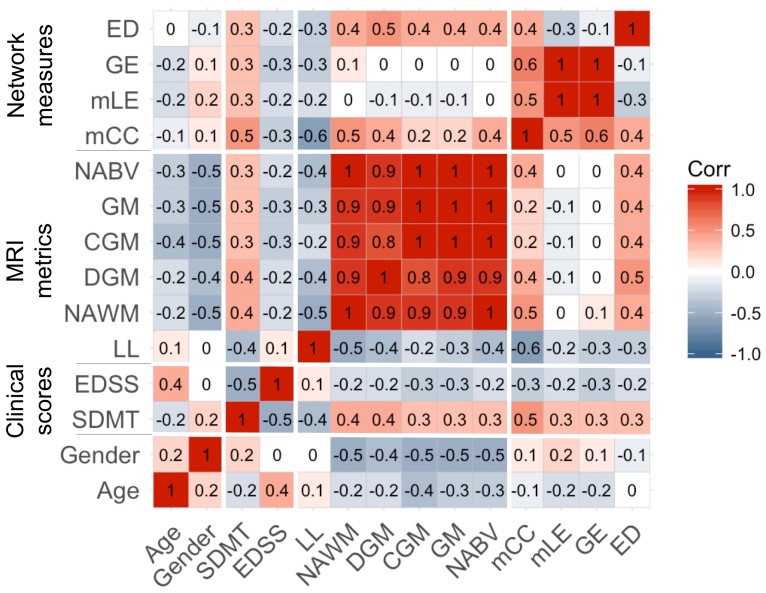
Compared with controls, network efficiency and clustering coefficient were reduced in MS while these measures were also reduced in secondary progressive relative to relapsing-remitting patients. Structural network metrics increase the variance explained by the statistical models for clinical and information processing dysfunction. The best model for EDSS showed that reduced network density and global efficiency and increased age were associated with increased clinical disability. The best model for SDMT showed that lower deep grey matter volume, reduced efficiency and male gender were associated with worse information processing speed.
Structural topological changes exist between subjects' groups. Network density and global efficiency explained disability above non-network measures, highlighting that network metrics can provide clinically relevant information about MS pathology.
评估结构脑网络指标是否比萎缩测量和白质病变更能与多发性硬化症(MS)的临床损伤和信息处理速度相关。
本横断面研究纳入了 51 名健康对照者和 122 名患者,包括 58 名复发缓解型、28 名原发性进展型和 36 名继发性进展型。从弥散加权 MRI 重建结构脑网络,并得出反映网络密度、效率和聚类系数的标准指标,并在受试者组之间进行比较。采用逐步线性回归分析,研究网络指标对临床残疾(扩展残疾状况量表(EDSS))和信息处理速度(符号数字模态测试(SDMT))的贡献,与单独使用常规 MRI 指标进行比较,并确定解释 EDSS 和 SDMT 更好的最佳统计模型。
与对照组相比,MS 患者的网络效率和聚类系数降低,而继发性进展型患者的这些指标也低于复发缓解型患者。结构网络指标增加了统计模型对临床和信息处理功能障碍的解释方差。EDSS 的最佳模型表明,网络密度和全局效率降低以及年龄增加与临床残疾加重相关。SDMT 的最佳模型表明,深部灰质体积降低、效率降低和男性与信息处理速度降低相关。
组间存在结构拓扑变化。网络密度和全局效率解释了残疾,而不是非网络指标,这突出了网络指标可以提供有关 MS 病理学的临床相关信息。