Department of Neurology, College of Medicine, Gyeongsang Institute of Health Science, Gyeongsang National University, Jinju, South Korea.
Department of Neurology, Gyeongsang National University Changwon Hospital, Changwon, South Korea.
Sci Rep. 2022 Mar 25;12(1):5152. doi: 10.1038/s41598-022-09065-4.
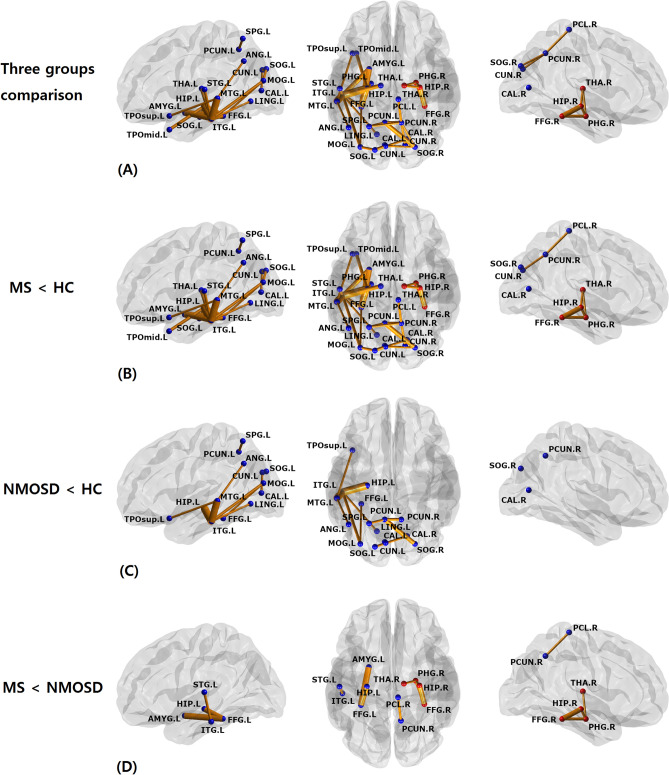
Multiple sclerosis (MS) and neuromyelitis optica spectrum disorder (NMOSD) are two representative chronic inflammatory demyelinating disorders of the central nervous system. We aimed to determine and compare the alterations of white matter (WM) connectivity between MS, NMOSD, and healthy controls (HC). This study included 68 patients with relapsing-remitting MS, 50 with NMOSD, and 26 HC. A network-based statistics method was used to assess disrupted patterns in WM networks. Topological characteristics of the three groups were compared and their associations with clinical parameters were examined. WM network analysis indicated that the MS and NMOSD groups had lower total strength, clustering coefficient, global efficiency, and local efficiency and had longer characteristic path length than HC, but there were no differences between the MS and NMOSD groups. At the nodal level, the MS group had more brain regions with altered network topologies than did the NMOSD group when compared with the HC group. Network alterations were correlated with Expanded Disability Status Scale score and disease duration in both MS and NMOSD groups. Two distinct subnetworks that characterized the disease groups were also identified. When compared with NMOSD, the most discriminative connectivity changes in MS were located between the thalamus, hippocampus, parahippocampal gyrus, amygdala, fusiform gyrus, and inferior and superior temporal gyri. In conclusion, MS patients had greater network dysfunction compared to NMOSD and altered short connections within the thalamus and inferomedial temporal regions were relatively spared in NMOSD compared with MS.
多发性硬化症 (MS) 和视神经脊髓炎谱系疾病 (NMOSD) 是两种代表性的中枢神经系统慢性炎症性脱髓鞘疾病。我们旨在确定和比较 MS、NMOSD 和健康对照 (HC) 之间的白质 (WM) 连接改变。这项研究包括 68 例复发缓解型 MS 患者、50 例 NMOSD 患者和 26 例 HC。采用基于网络的统计学方法评估 WM 网络中的破坏模式。比较了三组的拓扑特征,并研究了它们与临床参数的相关性。WM 网络分析表明,MS 和 NMOSD 组的总强度、聚类系数、全局效率和局部效率均低于 HC,特征路径长度也长于 HC,但 MS 和 NMOSD 组之间无差异。在节点水平,与 HC 相比,MS 组有更多的脑区网络拓扑发生改变,而 NMOSD 组无差异。网络改变与 MS 和 NMOSD 组的扩展残疾状况量表评分和疾病持续时间相关。还确定了两个区分疾病组的不同子网。与 NMOSD 相比,MS 最具鉴别力的连接变化位于丘脑、海马体、海马旁回、杏仁核、梭状回和颞下回和颞上回之间。总之,与 NMOSD 相比,MS 患者的网络功能障碍更大,与 NMOSD 相比,NMOSD 中丘脑和中内侧颞区的短连接改变相对较少。