Department of Pathology, Shanghai Chest Hospital, Shanghai Jiao Tong University, Shanghai, China.
Department of Pathology, Shanghai Pulmonary Hospital, Tongji University School of Medicine, Shanghai, China.
Thorac Cancer. 2019 Jan;10(1):47-53. doi: 10.1111/1759-7714.12899. Epub 2018 Nov 23.
The study was conducted to investigate the clinicopathological features and prevalence of ROS1 gene fusion in Chinese patients with non-small cell lung cancer (NSCLC).
The presence of ROS1 fusion was assessed by quantitative real-time PCR. Associations between ROS1 fusion and clinical characteristics were analyzed.
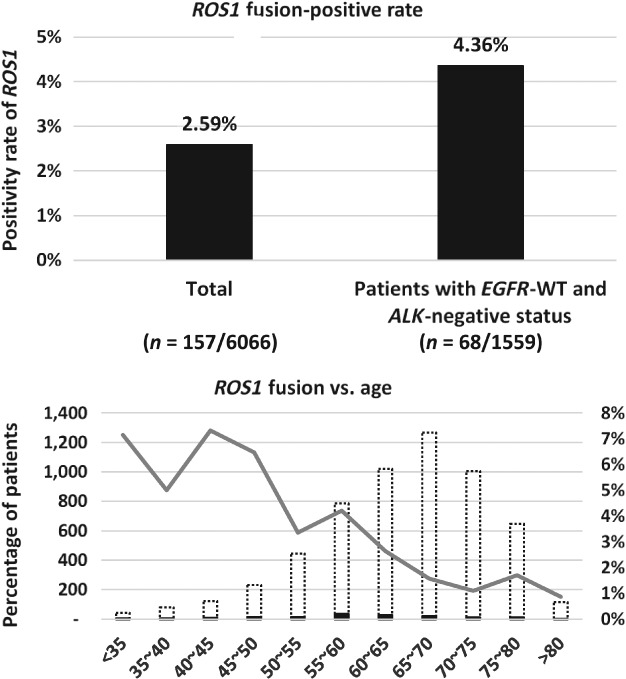
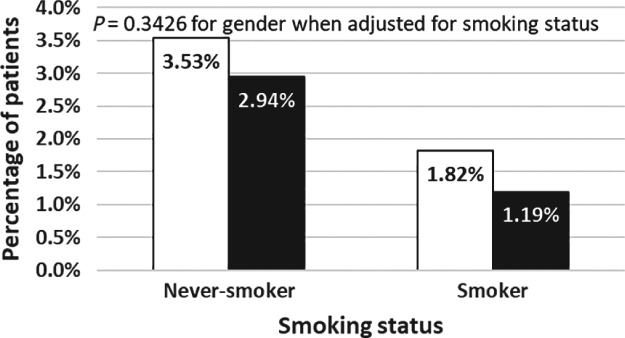
In total, 6066 patients with pathologically confirmed NSCLC and ROS1 fusion test results were enrolled. The average age was 60.89 ± 10.60 years and fusion was detected in 157 (2.59%) patients. Fusion frequency was significantly correlated with age, gender, smoking status (all P < 0.001), pathology type (P = 0.017), and lymph node metastasis stage (P = 0.027). ROS1 fusion-positive patients were significantly younger (55.68 ± 11.34 vs. negative 61.02 ± 10.44 years; P < 0.01). Fusion frequency was higher in women (3.71% vs. men 1.81%), never-smokers (3.33% vs. smokers 1.21%), and patients with adenocarcinoma (2.77% vs. squamous lung cancer 0.93%) and at advanced node stages (1.31%, 1.40%, 2.07%, and 3.23% for N0, N1, N2, and N3, respectively). No significant correlation between ROS1 fusion status and pathological stage was found in subgroups classified by pathological, tumor, or metastasis stage (P > 0.05). Age, smoking status, and lymph node stage were statistically significantly correlated with ROS1 fusion frequency (all P < 0.05); gender and pathology type were not significantly correlated with ROS1 fusion status after adjusting for smoking status.
An overall ROS1 fusion frequency of 2.59% was confirmed in this study. ROS1 fusion was more prevalent among younger patients, never-smokers, and those at advanced node stages.
本研究旨在探讨 ROS1 基因融合在中国非小细胞肺癌(NSCLC)患者中的临床病理特征和流行率。
采用实时荧光定量 PCR 检测 ROS1 融合情况,分析 ROS1 融合与临床特征的相关性。
共纳入 6066 例经病理证实的 NSCLC 患者和 ROS1 融合检测结果,平均年龄为 60.89±10.60 岁,其中 157 例(2.59%)患者检测到融合。融合频率与年龄、性别、吸烟状态(均 P<0.001)、病理类型(P=0.017)和淋巴结转移分期(P=0.027)显著相关。ROS1 融合阳性患者明显更年轻(55.68±11.34 岁比阴性患者 61.02±10.44 岁;P<0.01)。女性(3.71%比男性 1.81%)、不吸烟者(3.33%比吸烟者 1.21%)和腺癌患者(2.77%比鳞状肺癌 0.93%)以及淋巴结转移更晚期(N0、N1、N2、N3 分别为 1.31%、1.40%、2.07%和 3.23%)患者的融合频率更高。但在按病理、肿瘤或转移分期分组的亚组中,ROS1 融合状态与病理分期之间无显著相关性(P>0.05)。年龄、吸烟状态和淋巴结分期与 ROS1 融合频率显著相关(均 P<0.05);性别和病理类型在调整吸烟状态后与 ROS1 融合状态无显著相关性。
本研究证实 ROS1 融合总频率为 2.59%。ROS1 融合在年轻患者、不吸烟者和淋巴结转移更晚期患者中更为常见。