Betancor Mónica B, Ortega Aurelio, de la Gándara Fernando, Tocher Douglas R, Mourente Gabriel
Institute of Aquaculture, Faculty of Natural Sciences, University of Stirling, Stirling, Scotland, FK9 4LA, UK.
Planta Experimental de Cultivos Marinos, Instituto Español de Oceanografía (IEO), 30860 Puerto de Mazarrón, Murcia, Spain.
Fish Physiol Biochem. 2019 Apr;45(2):697-718. doi: 10.1007/s10695-018-0587-9. Epub 2018 Nov 23.
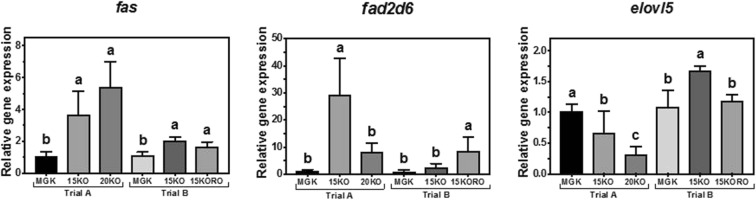
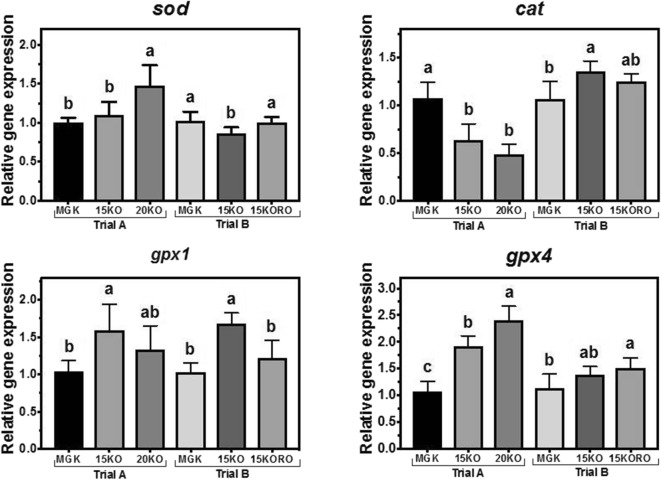
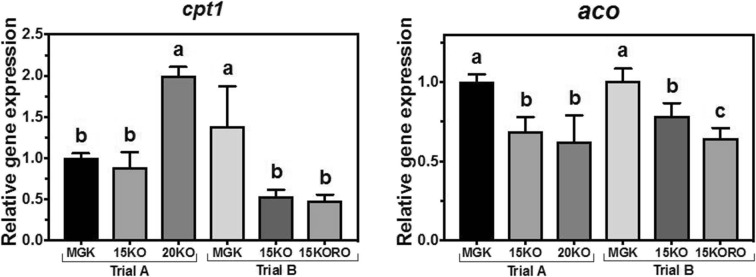
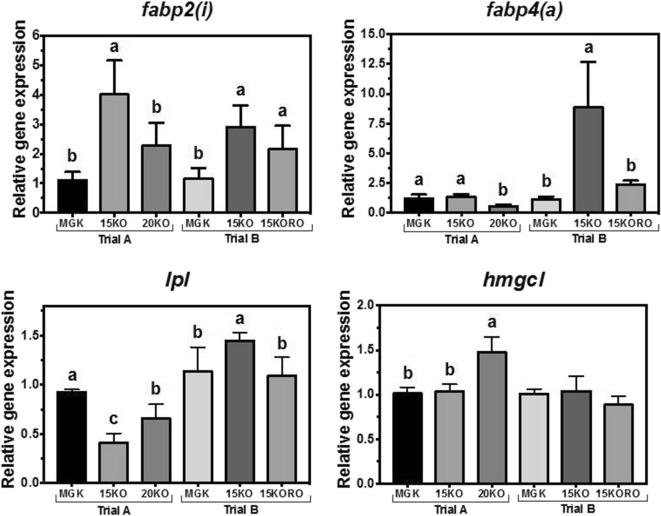
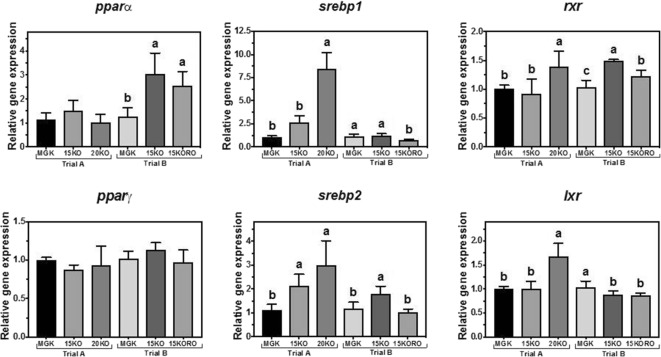
Two trials were performed using extruded diets as on-growing feeds for weaned Atlantic bluefin tuna (Thunnus thynnus; ABT) to establish adequate dietary levels of both lipid and omega-3 long-chain polyunsaturated fatty acids (LC-PUFAs), and impacts on lipid metabolism via liver gene expression. In trial A, ABT were fed with either a commercial feed (Magokoro®; MGK) as a reference diet or two experimental feeds differing in lipid levels (15 or 20%) using krill oil (KO) as the single lipid source in order to estimate suitable lipid content. Fish fed MGK displayed the highest growth, followed by 15KO, and therefore a dietary lipid content of 15% was considered preferable to 20% at this stage. In trial B, fish were fed MGK, 15KO, or a feed containing 15% lipid with a blend of KO and rapeseed oil (RO) (1:1, v/v; 15KORO). Fish fed 15KO and 15KORO showed no difference in weight gain, specific growth rate, and fork length. Increasing dietary lipid level or including vegetable oil, RO, in the feeds did not increase liver lipid content. Liver fatty acid compositions largely reflected dietary profiles confirming very limited endogenous LC-PUFA biosynthesis. Liver of ABT fed 15KO and 20KO displayed the highest contents of docosahexaenoic acid (DHA). The hepatic expression of genes encoding enzymes and transcription factors involved in lipid and fatty acid metabolism, as well as genes encoding antioxidant enzymes, showed that many of these genes were regulated by dietary lipid and LC-PUFA content. Results suggested that ABT juveniles can be on-grown on inert dry feeds that support good fish growth and the accumulation of DHA.
进行了两项试验,使用挤压饲料作为断奶大西洋蓝鳍金枪鱼(Thunnus thynnus;ABT)的育成饲料,以确定脂质和ω-3长链多不饱和脂肪酸(LC-PUFAs)的适宜日粮水平,以及通过肝脏基因表达对脂质代谢的影响。在试验A中,ABT分别喂食商业饲料(Magokoro®;MGK)作为对照日粮,或两种脂质水平不同(15%或20%)的试验饲料,使用磷虾油(KO)作为单一脂质来源,以估计适宜的脂质含量。喂食MGK的鱼生长最快,其次是15KO,因此在此阶段日粮脂质含量15%被认为优于20%。在试验B中,鱼分别喂食MGK、15KO或一种含有15%脂质且混合了KO和菜籽油(RO)(1:1,v/v;15KORO)的饲料。喂食15KO和15KORO的鱼在体重增加、特定生长率和叉长方面没有差异。增加日粮脂质水平或在饲料中添加植物油RO并没有增加肝脏脂质含量。肝脏脂肪酸组成在很大程度上反映了日粮情况,证实内源性LC-PUFA生物合成非常有限。喂食15KO和20KO的ABT肝脏中二十二碳六烯酸(DHA)含量最高。参与脂质和脂肪酸代谢的酶及转录因子编码基因,以及抗氧化酶编码基因的肝脏表达表明,许多这些基因受日粮脂质和LC-PUFA含量调控。结果表明,ABT幼鱼可以用支持良好鱼类生长和DHA积累的惰性干饲料进行育成。