Ananthasubramaniam Bharath, Diernfellner Axel, Brunner Michael, Herzel Hanspeter
Institute for Theoretical Biology, Humboldt-Universität zu Berlin, 10115 Berlin, Germany; Charité Universitätsmedizin, 10117 Berlin, Germany.
Biochemistry Center, Universität Heidelberg, 69120 Heidelberg, Germany.
iScience. 2018 Nov 30;9:475-486. doi: 10.1016/j.isci.2018.11.012. Epub 2018 Nov 10.
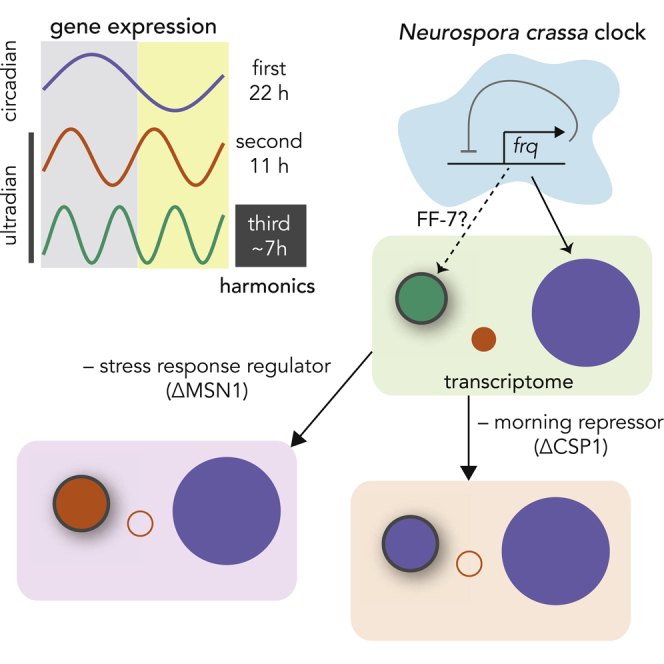
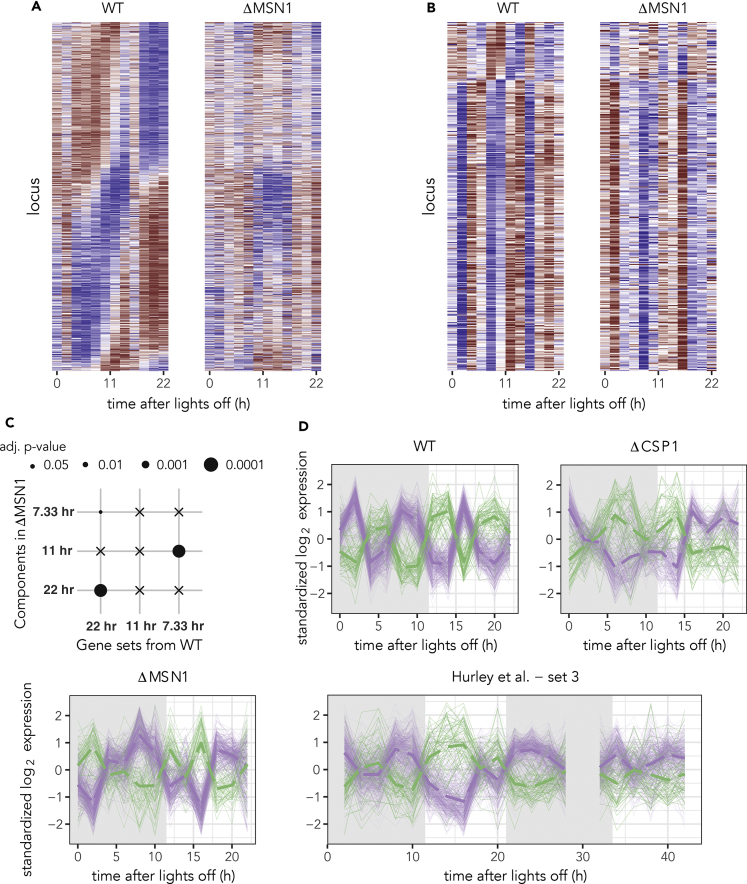
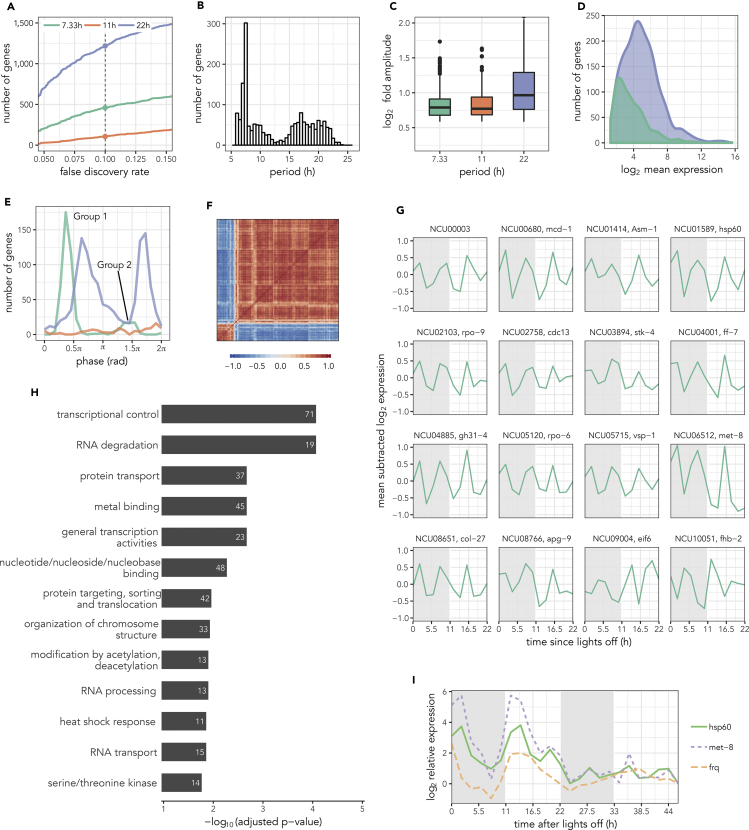
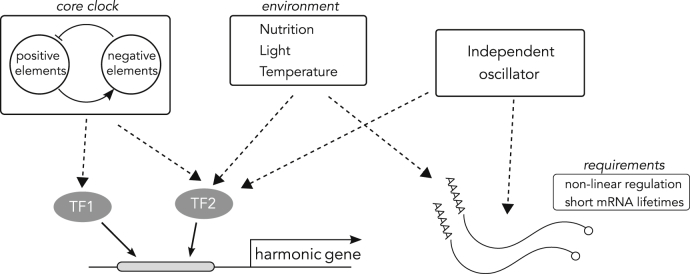
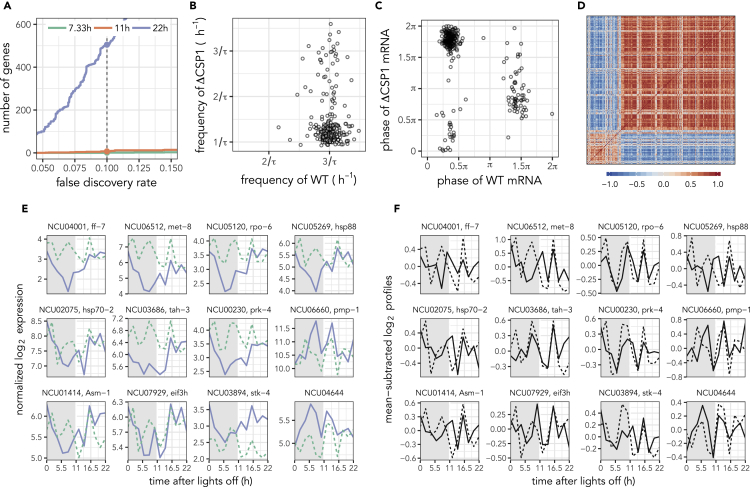
In many organisms, the circadian clock drives rhythms in the transcription of clock-controlled genes that can be either circadian (∼24-hr period) or ultradian (<24-hr period). Ultradian rhythms with periods that are a fraction of 24 hr are termed harmonics. Several harmonic transcripts were discovered in the mouse liver, but their functional significance remains unclear. Using a model-based analysis, we report for the first time ∼7-hr third harmonic transcripts in Neurospora crassa, a well-established fungal circadian model organism. Several third harmonic genes are regulated by female fertility 7 (FF-7), whose transcript itself is third harmonic. The knockout of circadian output regulator CSP1 superimposes circadian rhythms on the third harmonic genes, whereas the knockout of stress response regulator MSN1 converts third harmonic rhythms to second harmonic rhythms. The 460 ∼7-hr genes are co-regulated in two anti-phasic groups in multiple genotypes and include kinases, chromatin remodelers, and homologs of harmonic genes in the mouse liver.
在许多生物体中,生物钟驱动着生物钟控制基因的转录节律,这些节律可以是昼夜节律(约24小时周期)或超日节律(<24小时周期)。周期为24小时一部分的超日节律被称为谐波。在小鼠肝脏中发现了几种谐波转录本,但其功能意义仍不清楚。通过基于模型的分析,我们首次在粗糙脉孢菌(一种成熟的真菌昼夜节律模型生物)中报道了约7小时的三次谐波转录本。几个三次谐波基因受雌性育性7(FF-7)调控,其转录本本身就是三次谐波。昼夜节律输出调节因子CSP1的敲除将昼夜节律叠加在三次谐波基因上,而应激反应调节因子MSN1的敲除则将三次谐波节律转换为二次谐波节律。这460个约7小时的基因在多种基因型中被分为两个反相组共同调控,包括激酶、染色质重塑因子以及小鼠肝脏中谐波基因的同源物。