Department of Internal Medicine, Seoul National University College of Medicine, Seoul, Korea.
Department of Internal Medicine, Seoul National University Bundang Hospital, Seongnam, Korea.
J Korean Med Sci. 2018 Nov 9;33(48):e312. doi: 10.3346/jkms.2018.33.e312. eCollection 2018 Nov 26.
Obesity is related to several comorbidities and mortality, but its relationship with acute kidney injury (AKI) and long-term mortality remain undetermined in patients undergoing coronary artery bypass grafting.
Data from 3,018 patients (age ≥ 18 years) who underwent coronary artery bypass graft surgery from two tertiary referral centers were retrospectively reviewed between 2004 and 2015. Obesity was defined using the body mass index, according to the World Health Organization's recommendation. The odds and hazard ratios in post-surgical, AKI, and all-cause mortality were calculated after adjustment for multiple covariates. Patients were followed for 90 ± 40.9 months (maximum: 13 years).
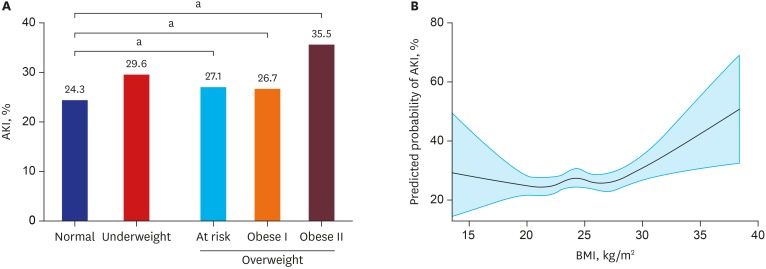
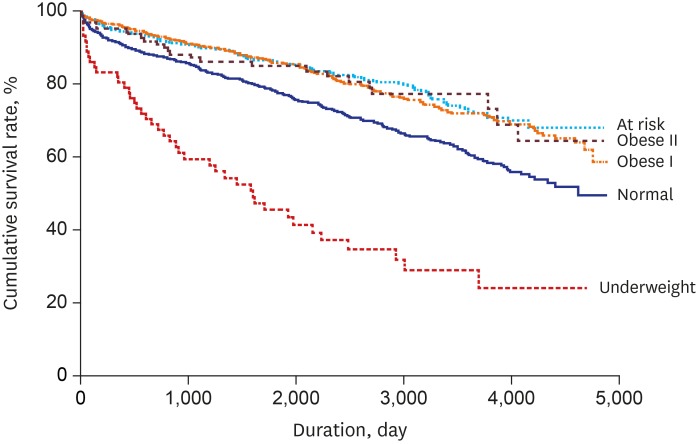
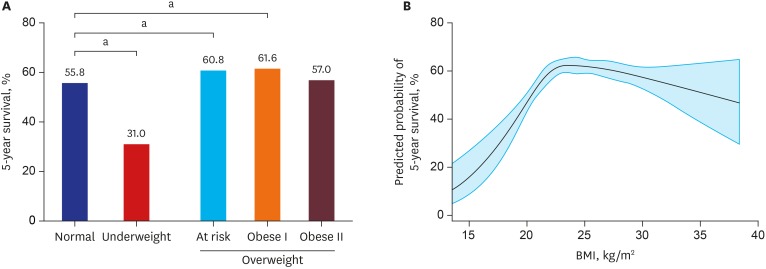
Among the cohort, 37.4%, 2.4%, 21.1%, 35.1%, and 4.0% of patients were classified as normal weight, underweight, overweight-at-risk, obese I, and obese II, respectively. Post-surgical AKI developed in 799 patients (26.5%). Patients in the obese groups (overweight-at-risk to obese II) had a higher risk of AKI than did those in the normal-weight group. During the follow-up period, 787 patients (26.1%) died. Underweight patients had a higher risk of mortality than did normal-weight patients, whereas overweight-at-risk, obese I, and obese II patients showed better survival rates.
After coronary artery bypass graft surgery, obese patients encountered a high risk of AKI, and underweight patients exhibited a low chance of survival. Awareness of both obese and underweight statuses should be raised in these patients.
肥胖与多种合并症和死亡率相关,但在接受冠状动脉旁路移植术的患者中,肥胖与急性肾损伤(AKI)和长期死亡率的关系仍不确定。
回顾性分析了 2004 年至 2015 年期间,来自两家三级转诊中心的 3018 名(年龄≥18 岁)接受冠状动脉旁路移植术的患者的数据。根据世界卫生组织的建议,使用体重指数定义肥胖。在调整了多个协变量后,计算了术后、AKI 和全因死亡率的优势比和风险比。患者随访 90±40.9 个月(最长:13 年)。
在队列中,分别有 37.4%、2.4%、21.1%、35.1%和 4.0%的患者被归类为正常体重、体重不足、超重风险、肥胖 I 和肥胖 II。799 例患者(26.5%)发生术后 AKI。超重风险至肥胖 II 组的患者发生 AKI 的风险高于正常体重组。在随访期间,787 例患者(26.1%)死亡。体重不足的患者死亡率高于正常体重的患者,而超重风险、肥胖 I 和肥胖 II 患者的生存率较高。
冠状动脉旁路移植术后,肥胖患者发生 AKI 的风险较高,体重不足的患者生存率较低。应提高这些患者对肥胖和体重不足状态的认识。