Zakkar Mustafa, Bruno Vito D, Guida Gustavo, Angelini Gianni D, Chivasso Pierpaulo, Suleiman M Sadeeh, Bryan Alan J, Ascione Raimondo
Bristol Heart Institute, Bristol Cardiovascular, University of Bristol and University Hospital Bristol National Health System Foundation Trust, Bristol, United Kingdom.
Bristol Heart Institute, Bristol Cardiovascular, University of Bristol and University Hospital Bristol National Health System Foundation Trust, Bristol, United Kingdom.
J Thorac Cardiovasc Surg. 2016 Jul;152(1):235-42. doi: 10.1016/j.jtcvs.2016.02.047. Epub 2016 Feb 27.
To investigate the impact of postoperative acute kidney injury (AKI) on early health outcome and on long-term survival in patients undergoing redo coronary artery bypass grafting (CABG).
We performed a Cox analysis with 398 consecutive patients undergoing redo CABG over a median follow-up of 7 years (interquartile range, 4-12.2 years). Renal function was assessed using baseline and peak postoperative levels of serum creatinine. AKI was defined according to the risk, injury, failure, loss, and end-stage (RIFLE) criteria. Health outcome measures included the rate of in-hospital AKI and all-cause 30-day and long-term mortality, using data from the United Kingdom's Office of National Statistics. Propensity score matching, as well as logistic regression analyses, were used. The impact of postoperative AKI at different time points was related to survival.
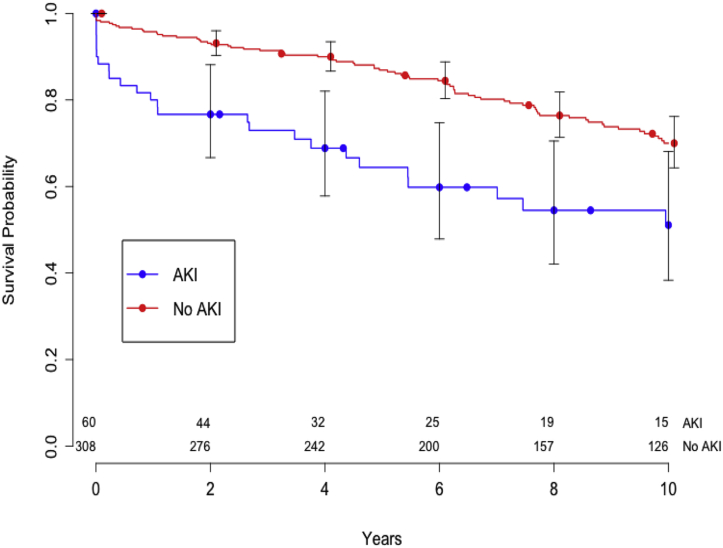
In patients with redo CABG, the occurrence of postoperative AKI was associated with in-hospital mortality (odds ratio [OR], 3.74; 95% confidence interval [CI], -1.3 to 10.5; P < .01], high Euroscore (OR, 1.27; 95% CI, 1.07-1.52; P < .01), use of IABP (OR, 6.9; 95% CI, 2.24-20.3; P < .01), and reduced long-term survival (hazard ratio [HR], 2.42; 95% CI, 1.63-3.6; P = .01). Overall survival at 5 and 10 years was lower in AKI patients with AKI compared with those without AKI (64% vs 85% at 5 years; 51% vs 68% at 10 years). On 1:1 propensity score matching analysis, postoperative AKI was independently associated with reduced long term survival (HR, 2.8; 95% CI, 1.15-6.7).
In patients undergoing redo CABG, the occurrence of postoperative AKI is associated with increased 30-day mortality and major complications and with reduced long-term survival.
探讨再次冠状动脉旁路移植术(CABG)患者术后急性肾损伤(AKI)对早期健康结局和长期生存的影响。
我们对398例连续接受再次CABG的患者进行了Cox分析,中位随访时间为7年(四分位间距,4 - 12.2年)。使用血清肌酐的基线水平和术后峰值水平评估肾功能。根据风险、损伤、衰竭、丧失和终末期(RIFLE)标准定义AKI。健康结局指标包括住院期间AKI发生率、全因30天和长期死亡率,数据来自英国国家统计局。采用倾向评分匹配以及逻辑回归分析。术后不同时间点的AKI对生存的影响进行了相关性分析。
在再次CABG患者中,术后AKI的发生与住院死亡率相关(比值比[OR],3.74;95%置信区间[CI],1.3至10.5;P <.01)、欧洲心脏手术风险评估系统(Euroscore)评分高(OR,1.27;95% CI,1.07 - 1.52;P <.01)、使用主动脉内球囊反搏(IABP)(OR,6.9;95% CI,2.24 - 20.3;P <.01)以及长期生存率降低(风险比[HR],2.42;95% CI,1.63 - 3.6;P =.01)。与无AKI的患者相比,发生AKI的患者5年和10年的总体生存率较低(5年时分别为64%对85%;10年时分别为51%对68%)。在1:1倾向评分匹配分析中,术后AKI与长期生存率降低独立相关(HR,2.8;95% CI,1.15 - 6.7)。
在接受再次CABG的患者中,术后AKI的发生与30天死亡率和主要并发症增加以及长期生存率降低相关。