Department of Internal Medicine, Goesan Sungmo Hospital, Goesan, Korea.
Division of Nephrology, Department of Internal Medicine, Korea University Guro Hospital, Korea University College of Medicine, Seoul, Korea.
J Korean Med Sci. 2024 Jan 22;39(3):e12. doi: 10.3346/jkms.2024.39.e12.
The obesity epidemic is associated with the emergence of new kidney diseases including obesity-related glomerulopathy (ORG) and metabolic syndrome-associated disorders. However, the effects of obesity on prevalence and outcome of biopsy-proven kidney disease are not well known.
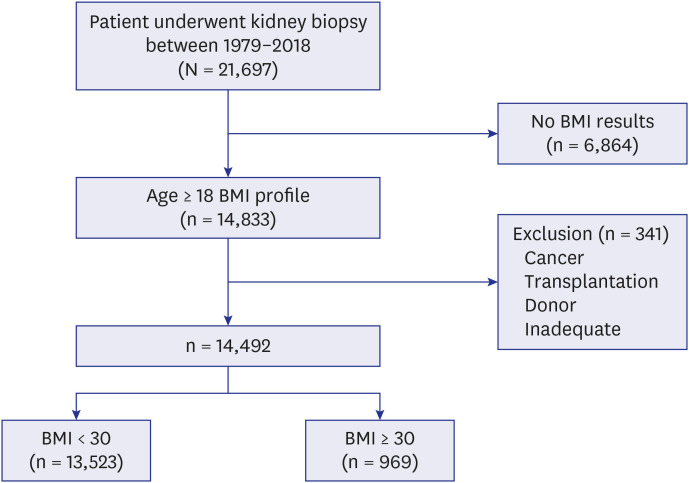
We analyzed 14,492 kidney biopsies in 18 hospitals from 1979 to 2018 in Korea. Obesity was defined as a body mass index value of ≥ 30 kg/m².
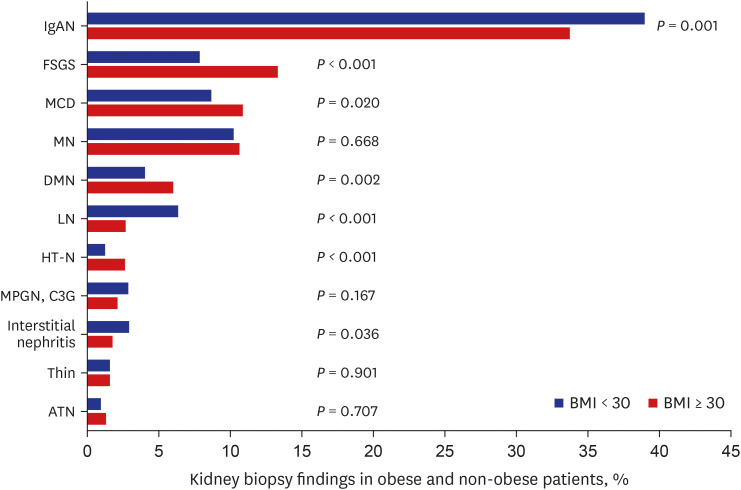
The most common disease was IgA nephropathy (IgAN) in both obese and non-obese participants (33.7% vs. 38.9%). Obesity was associated with a higher risk of focal segmental glomerulosclerosis (FSGS) and hypertensive nephropathy (HT-N) (odds ratio [OR], 1.72, 95% confidence interval [CI], 1.37-2.17; OR, 1.96, 95% CI, 1.21-3.19) and a lower risk of IgAN (OR, 0.74, 95% CI, 0.62-0.88). During the median follow up of 93.1 ± 88.7 months, obesity increased the risk of end-stage kidney disease (ESKD) in patients with IgAN (relative risk [RR], 1.49, 95% CI, 1.01-2.20) and lupus nephritis (LN) (RR, 3.43, 95% CI, 1.36-8.67). Of 947 obese individuals, ORG was detected in 298 (31.5%), and 230 participants had other kidney diseases, most commonly, IgAN (40.9%) followed by diabetic nephropathy (15.2%). Participants with ORG, when combined with other renal diseases, showed higher risks for developing ESKD compared to those with ORG alone (RR, 2.48, 95% CI, 1.09-5.64).
Obesity is associated with an increased risk of FSGS and HT-N, and also increase the ESKD risk in IgAN and LN patients. ORG in obese participants may have favorable renal outcomes if it occurs alone without any other renal disease.
肥胖症的流行与新的肾脏疾病的出现有关,包括肥胖相关性肾小球病(ORG)和代谢综合征相关疾病。然而,肥胖对活检证实的肾脏疾病的患病率和结局的影响尚不清楚。
我们分析了 1979 年至 2018 年韩国 18 家医院的 14492 例肾脏活检。肥胖定义为体重指数(BMI)值≥30kg/m²。
在肥胖和非肥胖参与者中,最常见的疾病均为 IgA 肾病(IgAN)(33.7% vs. 38.9%)。肥胖与局灶节段性肾小球硬化症(FSGS)和高血压性肾病(HT-N)的风险增加相关(优势比[OR],1.72,95%置信区间[CI],1.37-2.17;OR,1.96,95%CI,1.21-3.19),而与 IgAN 的风险降低相关(OR,0.74,95%CI,0.62-0.88)。在中位随访 93.1±88.7 个月期间,肥胖增加了 IgAN(相对风险[RR],1.49,95%CI,1.01-2.20)和狼疮性肾炎(LN)(RR,3.43,95%CI,1.36-8.67)患者发生终末期肾病(ESKD)的风险。在 947 名肥胖者中,发现 298 名(31.5%)患有 ORG,230 名参与者患有其他肾脏疾病,最常见的是 IgAN(40.9%),其次是糖尿病肾病(15.2%)。与仅患有 ORG 的参与者相比,同时患有 ORG 和其他肾脏疾病的参与者发生 ESKD 的风险更高(RR,2.48,95%CI,1.09-5.64)。
肥胖与 FSGS 和 HT-N 的风险增加有关,并且还会增加 IgAN 和 LN 患者的 ESKD 风险。如果肥胖患者仅患有 ORG 而无其他任何肾脏疾病,则其肾脏结局可能较好。