Reader Arran T, Holmes Nicholas P
Department of Neuroscience, Karolinska Institutet, Stockholm, Sweden.
Centre for Integrative Neuroscience and Neurodynamics, School of Psychology and Clinical Language Sciences, University of Reading, Reading, UK.
R Soc Open Sci. 2018 Oct 10;5(10):181356. doi: 10.1098/rsos.181356. eCollection 2018 Oct.
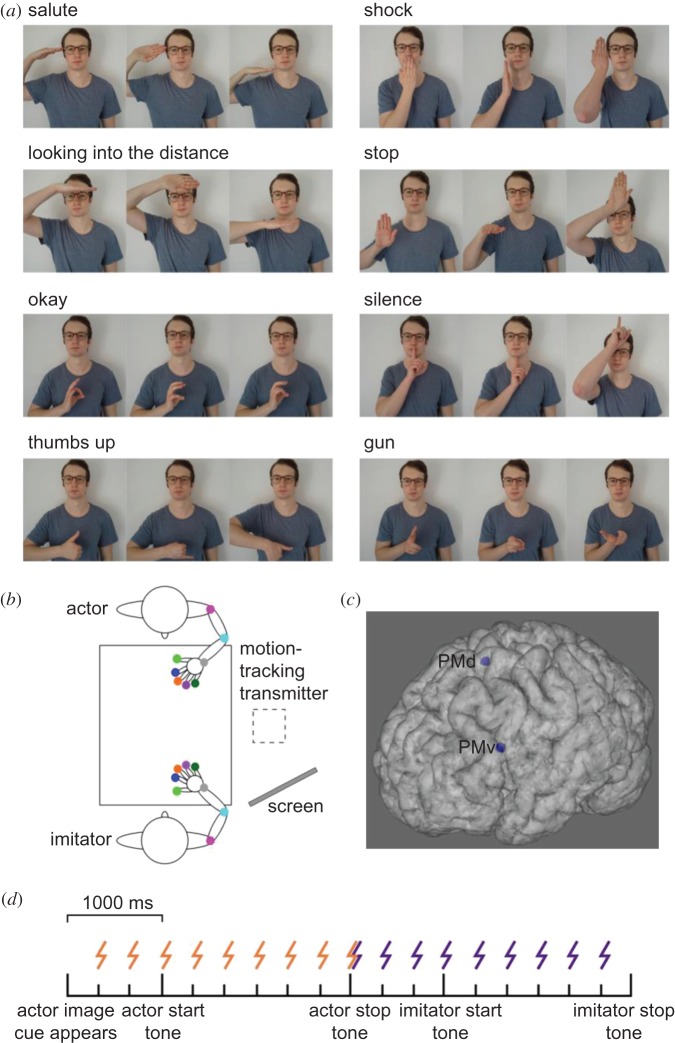
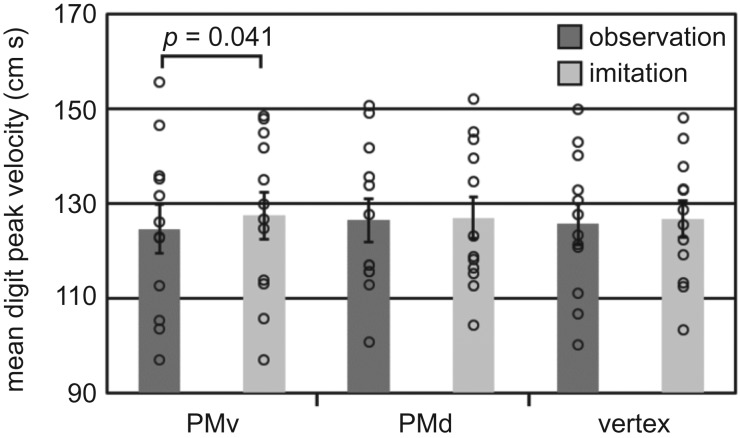
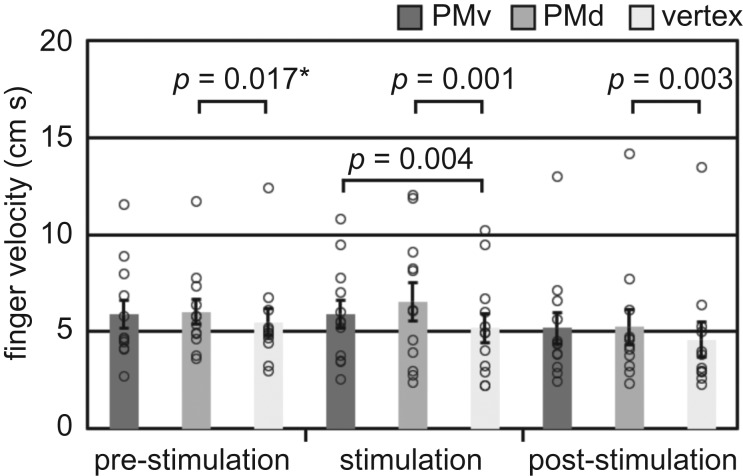
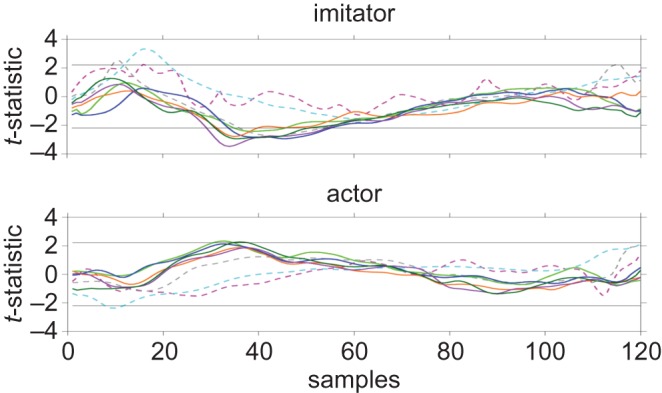
The ventral premotor cortex (PMv) is involved in grasping and object manipulation, while the dorsal premotor cortex (PMd) has been suggested to play a role in reaching and action selection. These areas have also been associated with action imitation, but their relative roles in different types of action imitation are unclear. We examined the role of the left PMv and PMd in meaningful and meaningless action imitation by using repetitive transcranial magnetic stimulation (rTMS). Participants imitated meaningful and meaningless actions performed by a confederate actor while both individuals were motion-tracked. rTMS was applied over the left PMv, left PMd or a vertex control site during action observation or imitation. Digit velocity was significantly greater following stimulation over the PMv during imitation compared with stimulation over the PMv during observation, regardless of action meaning. Similar effects were not observed over the PMd or vertex. In addition, stimulation over the PMv increased finger movement speed in a (non-imitative) finger-thumb opposition task. We suggest that claims regarding the role of the PMv in object-directed hand shaping may stem from the prevalence of object-directed designs in motor control research. Our results indicate that the PMv may have a broader role in 'target-directed' hand shaping, whereby different areas of the hand are considered targets to act upon during intransitive gesturing.
腹侧运动前皮层(PMv)参与抓握和物体操作,而背侧运动前皮层(PMd)被认为在伸手和动作选择中起作用。这些区域也与动作模仿有关,但它们在不同类型动作模仿中的相对作用尚不清楚。我们使用重复经颅磁刺激(rTMS)研究了左侧PMv和PMd在有意义和无意义动作模仿中的作用。参与者模仿由一名同谋演员执行的有意义和无意义动作,同时对两人进行动作追踪。在动作观察或模仿期间,将rTMS施加于左侧PMv、左侧PMd或头顶控制部位。与观察期间对PMv的刺激相比,模仿期间对PMv的刺激后手指速度显著更快,无论动作意义如何。在PMd或头顶未观察到类似效果。此外,在(非模仿性的)拇指对掌任务中,对PMv的刺激增加了手指移动速度。我们认为,关于PMv在目标导向手部塑形中作用的说法可能源于运动控制研究中目标导向设计的普遍性。我们的结果表明,PMv可能在“目标导向”手部塑形中具有更广泛的作用,即在非传递性手势中,手部的不同区域被视为要作用的目标。