Mackay Fraser D, Zhou Felix, Lewis David, Fraser Jacqueline, Atkinson Paul R
Family Medicine, Dalhousie University, Saint John, CAN.
Medical Education, Memorial University of Newfoundland, Saint John, CAN.
Cureus. 2018 Sep 17;10(9):e3320. doi: 10.7759/cureus.3320.
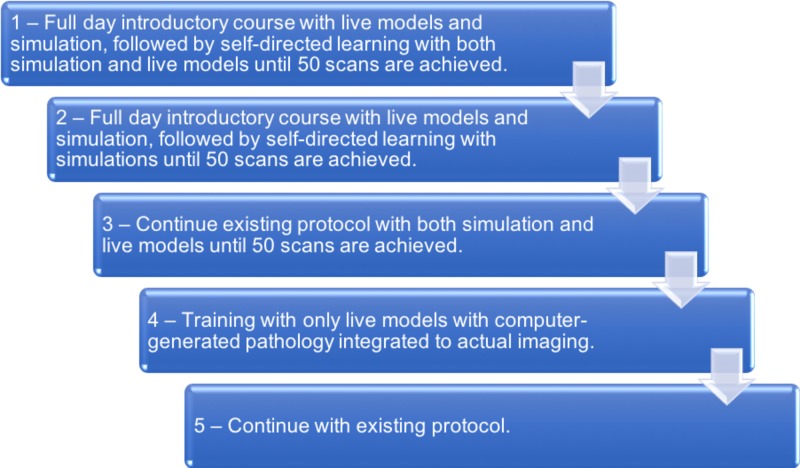
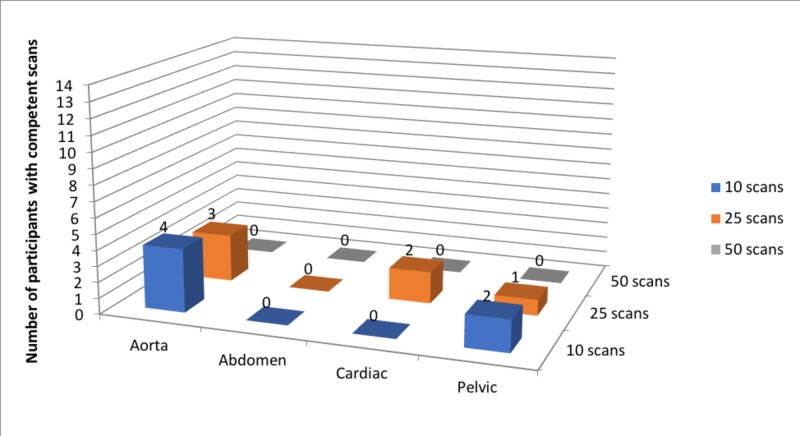
Introduction Self-directed learning in medical professions is established as an effective method of training in certain modalities. Furthermore, simulation technology is becoming widely used and accepted as a valid method of training for various medical skills, with ultrasound being one of the best studied. The use of point-of-care ultrasound (PoCUS) in the practice of emergency medicine is well established, and PoCUS is a core competency of the Royal College of Physicians and Surgeons of Canada emergency medicine standards. The primary goal of our study was to assess the effectiveness of a self-directed simulation-based training program for medical students, in terms of achieving competency in basic PoCUS scans. Methods Fourteen second-year medical students with no prior ultrasound experience were provided access to online study modules created by SonoSim ultrasound training solutions (SonoSim, Santa Monica, CA, US), covering ultrasound theory and methodology, and attended a two-hour introductory session where they were introduced to the study protocol, simulation equipment, and software. Participants then undertook self-directed ultrasound simulation training throughout the year, using the CAE Vimedix PoCUS simulator (CAE Healthcare, Sarasota, FL, US) and the SonoSim ultrasound training solution system. Upon reaching 10 (and 25) scans in each of the four categories (cardiac, abdomen, aorta, and pelvic), a triggered assessment was arranged in which participants scanned a live volunteer under the direct supervision of PoCUS-certified physicians. The physicians scored the participant attempts in terms of image acquisition, interpretation, and clinical understanding. No feedback was provided to the participants. Following the study, participants submitted feedback regarding the design of the study and were asked to rank their preferred training program protocols out of a provided list of five different options. Results At the first triggered assessment (after completing only 10 scans in each category), four out of 14 participants were scored as competent in the aorta scan, two out of 14 participants were competent in the pelvic scan, and none of the participants were competent in both the cardiac and abdominal scans. Only nine out of 14 participants completed the second triggered assessment (after completing 25 scans in each category). At the second assessment, only three participants were scored as competent in the aorta scan, two participants were competent in the cardiac scan, and one participant was competent in the pelvic scan. None of the 14 learners completed the final phase of the training and assessment protocol. Feedback following the termination of the study showed that none of the participants supported continuing the study protocol as designed originally, and the preferred study design consisted of a full-day introductory course with live models and simulation, followed by self-directed learning with simulation and live models until 50 scans in each category were achieved. Conclusion We were unable to demonstrate the achievement of competence in PoCUS in medical learners engaged in our combined self-directed simulation-based training program. This is in contrast to the considerable literature supporting self-directed learning and simulation-based learning for other skills. Feedback from faculty, curriculum integration, and alignment with clinical experience may be beneficial.
引言
医学专业中的自主学习已被确立为一种在某些模式下有效的培训方法。此外,模拟技术正被广泛应用并被接受为各种医学技能培训的有效方法,超声检查是研究最为深入的领域之一。即时超声检查(PoCUS)在急诊医学实践中的应用已得到充分确立,并且PoCUS是加拿大皇家内科医师和外科医师学院急诊医学标准的一项核心能力。我们研究的主要目标是评估一项针对医学生的基于模拟的自主培训计划在使学生掌握基本PoCUS扫描技能方面的有效性。
方法
为14名此前没有超声检查经验的二年级医学生提供了由SonoSim超声培训解决方案(美国加利福尼亚州圣莫尼卡市的SonoSim公司)创建的在线学习模块,内容涵盖超声理论和方法,并参加了为期两小时的介绍性课程,在课程中向他们介绍了研究方案、模拟设备和软件。参与者随后全年进行自主超声模拟培训,使用CAE Vimedix PoCUS模拟器(美国佛罗里达州萨拉索塔市的CAE Healthcare公司)和SonoSim超声培训解决方案系统。在四个类别(心脏、腹部、主动脉和盆腔)中的每一个类别达到10次(以及25次)扫描后,安排一次触发式评估,参与者在获得PoCUS认证的医师的直接监督下对一名活体志愿者进行扫描。医师根据图像采集、解读和临床理解对参与者的操作进行评分。未向参与者提供反馈。研究结束后,参与者提交了关于研究设计的反馈,并被要求从提供的五个不同选项列表中对他们偏好的培训计划方案进行排名。
结果
在第一次触发式评估(每个类别仅完成10次扫描后)中,14名参与者中有4名在主动脉扫描中被评为合格,14名参与者中有2名在盆腔扫描中合格,没有参与者在心脏和腹部扫描中均合格。14名参与者中只有9名完成了第二次触发式评估(每个类别完成25次扫描后)。在第二次评估中,只有3名参与者在主动脉扫描中被评为合格,2名参与者在心脏扫描中合格,1名参与者在盆腔扫描中合格。14名学习者中没有一人完成培训和评估方案的最后阶段。研究结束后的反馈表明,没有参与者支持按原设计继续研究方案,偏好的研究设计包括一整天的有活体模型和模拟的入门课程,随后进行有模拟和活体模型的自主学习,直到每个类别达到50次扫描。
结论
我们无法证明参与我们基于模拟的联合自主培训计划的医学学习者在PoCUS方面达到了合格水平。这与支持针对其他技能的自主学习和基于模拟的学习的大量文献形成对比。来自教员的反馈、课程整合以及与临床经验的契合可能会有所帮助。