Department of Social Work, Education and Community Wellbeing, Northumbria University, Room B018, Coach Lane Campus, Benton, Newcastle-Upon-Tyne, NE7 7XA, UK.
Division of Rehabilitation and Ageing, University of Nottingham, The Medical School, Derby Road, Nottingham, NG7 2UH, UK.
BMC Public Health. 2018 Nov 26;18(1):1293. doi: 10.1186/s12889-018-6200-4.
Housing adaptations have been identified as an important environmental and prevention intervention for older adults, which may improve health and quality of life. The onset of disability in bathing can act as a warning for further disability in other activities and may therefore be a judicious time-point for intervention. The aim of this study was to determine the feasibility of conducting a Randomised Controlled Trial (RCT) of bathing adaptations, to evaluate whether they improve older adults' perceived health status and quality of life, prevent further functional deterioration, and reduce the use of other health and social care resources. This study was conducted in preparation for a powered RCT.
Eligibility criteria were aged > 65 and referred to local authority housing adaptations service for an accessible flush-floor shower. Participants were randomised to either usual adaptations (3-4 month wait) or immediate adaptations (no wait). Outcomes were assessed at 3, 6 and 9 months and included perceived physical and mental health status, health and social care related quality of life, independence in activities of daily living (ADL) and bathing, and falls. Data on costs and the use of health and social care resources were collected during follow-up in order to inform a definitive health economic evaluation.
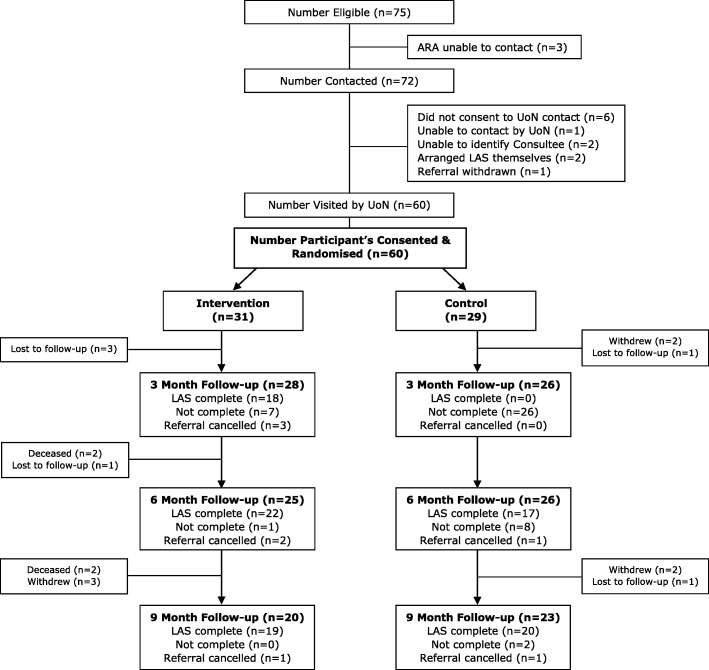
Sixty participants were recruited and randomised, 31 to immediate adaptations and 29 to waiting list control. Mean age was 77(SD8), 58% women and 58% living alone. Follow-ups were completed with 90, 85 and 72% at 3, 6 and 9 months respectively. Adaptations were delivered to 65% of participants within the requisite timescales as there were delays with some privately owned properties. There were improvements from baseline in both groups on all outcome measures following the completion of the adaptations.
This is the first RCT of housing adaptations in the UK. We demonstrated the feasibility of using a waiting list control, subject to minor alterations to the timescales for privately owned properties. A powered trial would evaluate the impact on older adults' quality of life and investigate the impact of waiting times on functional outcomes and health and care resource use.
ISRCTN14876332 Registered 12 July 2016.
住房改造已被确定为改善老年人健康和生活质量的重要环境和预防干预措施。洗澡能力下降可能是其他活动能力进一步下降的预警,因此可能是干预的明智时机。本研究旨在确定对洗澡改造进行随机对照试验 (RCT) 的可行性,评估其是否能改善老年人的健康感知状况和生活质量,防止进一步的功能恶化,并减少其他卫生和社会保健资源的使用。本研究是为了进行一项更有力的 RCT 而进行的。
入选标准为年龄 > 65 岁,并向地方当局住房改造服务部门申请无障碍冲洗式淋浴。参与者被随机分配到常规改造组(等待 3-4 个月)或立即改造组(无需等待)。在 3、6 和 9 个月时评估结果,包括感知身体和心理健康状况、健康和社会保健相关生活质量、日常生活活动(ADL)和洗澡的独立性以及跌倒情况。在随访期间收集了成本和卫生及社会保健资源使用情况的数据,以便为明确的健康经济评估提供信息。
共招募并随机分配了 60 名参与者,31 名接受立即改造,29 名接受候补名单对照。平均年龄为 77(8)岁,58%为女性,58%独居。分别有 90%、85%和 72%的参与者在 3、6 和 9 个月时完成了随访。由于一些私人拥有的房产存在延迟,在规定的时间范围内,有 65%的参与者完成了改造。在完成改造后,两组在所有结果测量上均有改善。
这是英国首次对住房改造进行 RCT。我们证明了使用候补名单对照的可行性,但需要对私人拥有房产的时间安排进行微小调整。一项更有力的试验将评估对老年人生活质量的影响,并研究等待时间对功能结果以及卫生和保健资源使用的影响。
ISRCTN83435625 于 2016 年 7 月 12 日注册。