Radiotherapy and Radiosurgery Department, Humanitas Cancer Center, Humanitas Clinical and Research Center, Via Manzoni 56, 20089, Rozzano, Milan, Italy.
Department of Biomedical Sciences, Humanitas University, Via Manzoni 113, 20089, Rozzano, Milan, Italy.
Radiat Oncol. 2018 Nov 26;13(1):234. doi: 10.1186/s13014-018-1185-9.
The aim of this study was to evaluate long-term efficacy and survival prognostic factors of stereotactic body radiation therapy (SBRT) for un-resectable liver metastases in patients enrolled in a prospective phase II trial.
5-year local control (LC), overall survival (OS), progression free survival (PFS) and toxicity rates were analyzed in patients with un-resectable liver metastases enrolled in a Phase II Trial on liver SBRT, with a prescription dose of 75Gy in 3 consecutive fractions.
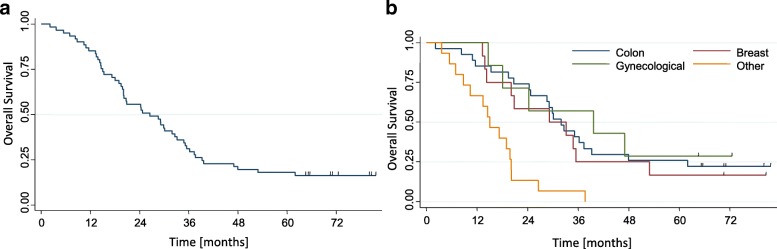
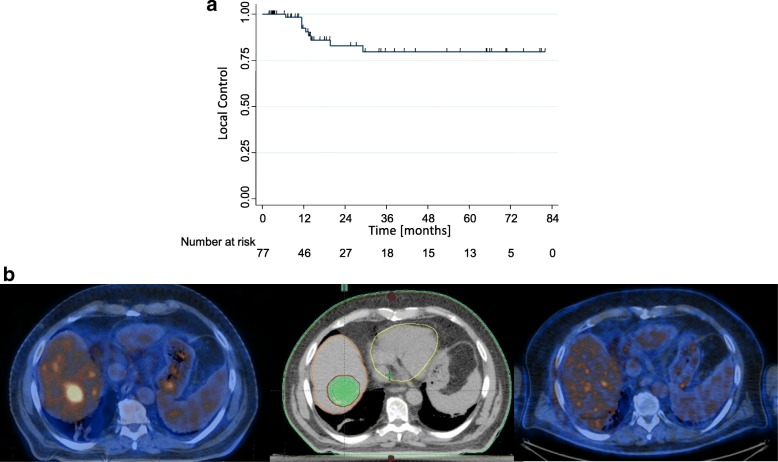
A total of 61 patients with 76 lesions were enrolled, with a median follow-up time of 6.1 years. One, three and 5 year LC rates were 94 ± 3.1%, 78.0 ± 5.9% and 78.0 ± 5.9%, without reaching the median LC time. Median OS was 27.6 months and the survival rates were 85.2 ± 4.5%, 31.1 ± 5.9% and 18.0 ± 4.9% at 1, 3 and 5-year after SBRT, respectively. Univariate analysis showed that favorable primary site (colorectal, breast and gynecological) of metastases (p = 0.001) improved survival. Toxicity was moderate. One patient experienced G3 late chest wall pain, which resolved within 1 year from SBRT. No cases of Radiation Induced Liver Disease (RILD) were detected.
Long-term results of this Phase II study suggest the efficacy and safety of SBRT for un-resectable liver metastases after 5-year of follow up. Selection of cases with positive prognostic factors may improve long-term survival of these oligo-metastastic patients and may confirm the role of SBRT as an effective alternative local therapy for liver metastases.
本研究旨在评估不可切除肝转移患者接受立体定向体部放疗(SBRT)的长期疗效和生存预后因素,该研究纳入了一项前瞻性 II 期试验。
对纳入 II 期肝 SBRT 试验的不可切除肝转移患者的 5 年局部控制率(LC)、总生存率(OS)、无进展生存率(PFS)和毒性反应率进行分析,肝 SBRT 的处方剂量为 75Gy,分 3 次给予。
共纳入 61 例 76 个病灶的患者,中位随访时间为 6.1 年。1、3 和 5 年 LC 率分别为 94±3.1%、78.0±5.9%和 78.0±5.9%,未达到中位 LC 时间。中位 OS 为 27.6 个月,SBRT 后 1、3 和 5 年的生存率分别为 85.2±4.5%、31.1±5.9%和 18.0±4.9%。单因素分析显示,转移灶的原发灶(结直肠、乳腺和妇科)情况良好(p=0.001),可改善生存。毒性反应为中度。1 例患者发生 G3 级迟发性胸壁疼痛,SBRT 后 1 年内缓解。未发现放射性肝损伤(RILD)病例。
该 II 期研究的长期结果表明,SBRT 治疗不可切除肝转移的疗效和安全性在 5 年随访后得到证实。选择具有阳性预后因素的病例可能会提高这些寡转移患者的长期生存率,并进一步证实 SBRT 作为肝转移的有效局部治疗替代方法的作用。