Lo Wai Leung Ambrose, Lei Di, Li Le, Huang Dong Feng, Tong Kin-Fai
Guangdong Engineering and Technology Research Center for Rehabilitation Medicine and Translation, Department of Rehabilitation Medicine, The First Affiliated Hospital, Sun Yat-sen University, Guangzhou, China.
Department of Electronic and Electrical Engineering, University College London, London, United Kingdom.
JMIR Mhealth Uhealth. 2018 Nov 26;6(11):e198. doi: 10.2196/mhealth.8127.
Chronic musculoskeletal neck and back pain are disabling conditions among adults. Use of technology has been suggested as an alternative way to increase adherence to exercise therapy, which may improve clinical outcomes.
The aim was to investigate the self-perceived benefits of an artificial intelligence (AI)-embedded mobile app to self-manage chronic neck and back pain.
A total of 161 participants responded to the invitation. The evaluation questionnaire included 14 questions that were intended to explore if using the AI rehabilitation system may (1) increase time spent on therapeutic exercise, (2) affect pain level (assessed by the 0-10 Numerical Pain Rating Scale), and (3) reduce the need for other interventions.
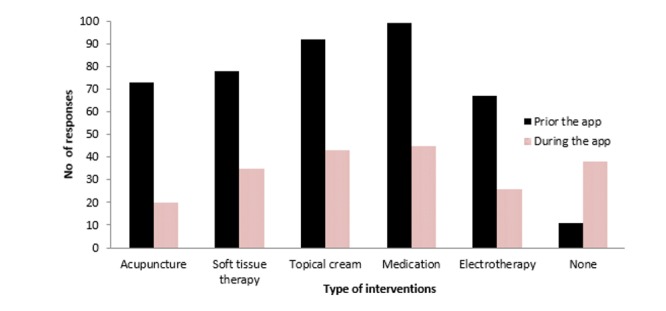
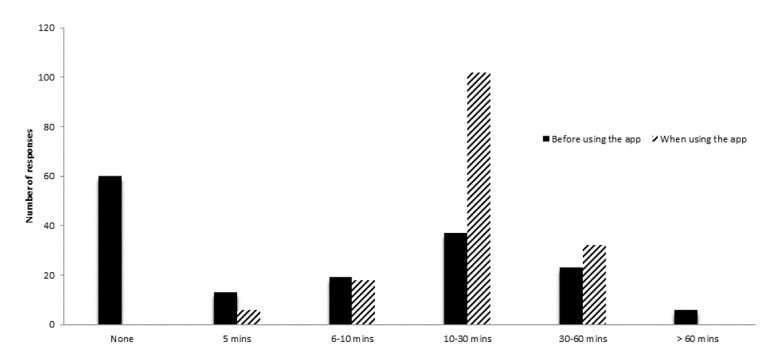
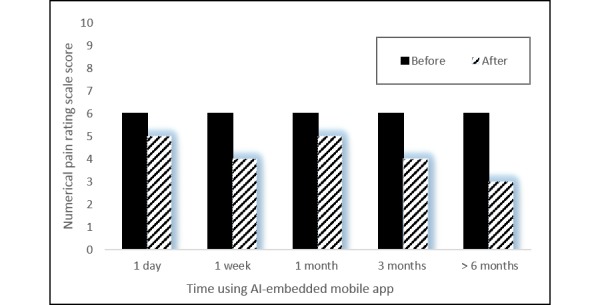
An increase in time spent on therapeutic exercise per day was observed. The median Numerical Pain Rating Scale scores were 6 (interquartile range [IQR] 5-8) before and 4 (IQR 3-6) after using the AI-embedded mobile app (95% CI 1.18-1.81). A 3-point reduction was reported by the participants who used the AI-embedded mobile app for more than 6 months. Reduction in the usage of other interventions while using the AI-embedded mobile app was also reported.
This study demonstrated the positive self-perceived beneficiary effect of using the AI-embedded mobile app to provide a personalized therapeutic exercise program. The positive results suggest that it at least warrants further study to investigate the physiological effect of the AI-embedded mobile app and how it compares with routine clinical care.
慢性肌肉骨骼性颈肩腰背痛是成年人的致残性疾病。有人建议使用技术作为提高运动疗法依从性的替代方法,这可能会改善临床结果。
旨在研究一款嵌入人工智能(AI)的移动应用程序对慢性颈肩腰背痛自我管理的自我感知益处。
共有161名参与者响应了邀请。评估问卷包括14个问题,旨在探讨使用AI康复系统是否(1)增加治疗性运动的时间,(2)影响疼痛程度(通过0-10数字疼痛评分量表评估),以及(3)减少对其他干预措施的需求。
观察到每天治疗性运动的时间有所增加。使用嵌入AI的移动应用程序之前,数字疼痛评分量表的中位数为6(四分位间距[IQR]5-8),之后为4(IQR 3-6)(95%CI 1.18-1.81)。使用嵌入AI的移动应用程序超过6个月的参与者报告疼痛评分降低了3分。还报告了在使用嵌入AI的移动应用程序期间其他干预措施的使用减少。
本研究证明了使用嵌入AI的移动应用程序提供个性化治疗性运动计划具有积极的自我感知有益效果。这些积极结果表明,至少值得进一步研究以调查嵌入AI的移动应用程序的生理效应以及它与常规临床护理的比较情况。