Department of Public and Occupational Health, Amsterdam Public Health Research Institute, Amsterdam UMC, VU University Amsterdam, Amsterdam, The Netherlands.
Department of Public Health, Erasmus MC University Medical Center, Rotterdam, The Netherlands.
J Epidemiol Community Health. 2019 Feb;73(2):136-141. doi: 10.1136/jech-2018-211107. Epub 2018 Nov 26.
This study aims to provide insight into (1) the associations between having a chronic disease and participation in paid work, volunteer activities or informal care, (2) the associations between the onset of a chronic disease and these forms of societal participation, and (3) whether these associations differ across educational level and gender.
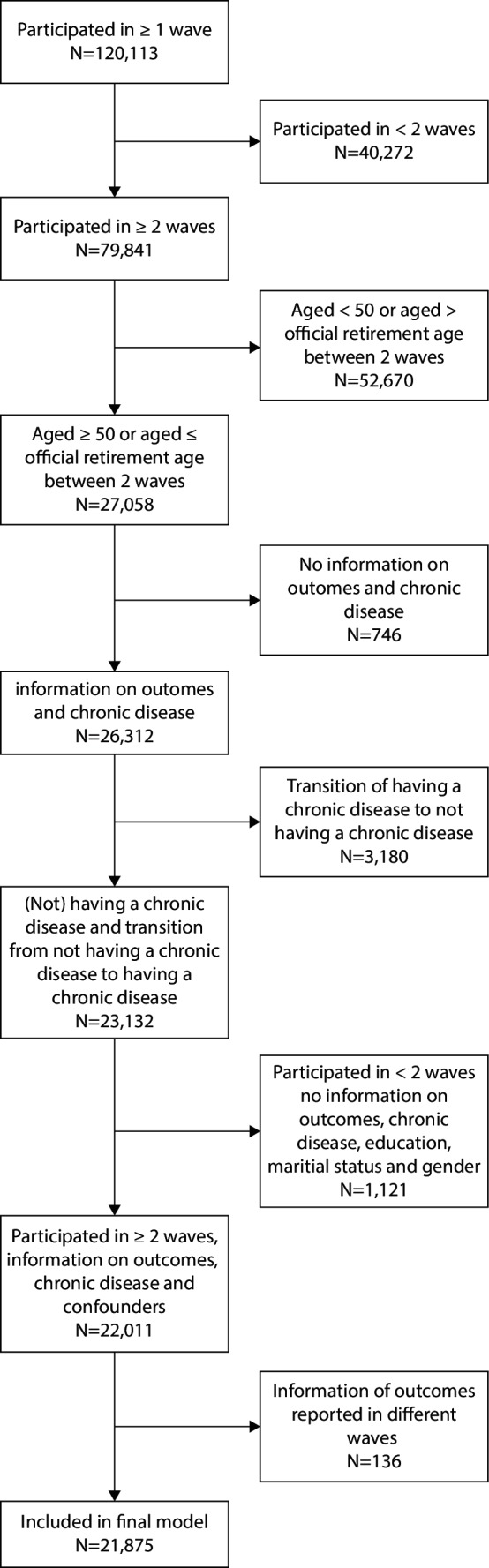
The study population consisted of n=21 875 respondents of the Survey of Health, Ageing and Retirement in Europe aged between 50 years and the country-specific retirement age. The influence of having and the onset of a chronic disease on societal participation was analysed using a hybrid Poisson regression model, combining fixed and random effects, and presented by relative risks (RRs).
Individuals with a chronic disease were less likely to participate in paid work (RR: 0.69; 95% CI 0.67 to 0.71) and volunteer activities (RR: 0.92; 95% CI 0.88 to 0.97), but more likely to give informal care (RR: 1.05; 95% CI 1.01 to 1.08). Onset of a chronic disease was associated with a higher likelihood to quit paid work (RR: 0.91; 95% CI 0.86 to 0.97) and to give informal care (RR: 1.08; 95% CI 1.01 to 1.16). Lower educated individuals with a chronic disease or with the onset of a chronic disease were less likely to have paid work than higher educated individuals.
Individuals with a chronic disease were less likely to participate in paid work and volunteer activities, and more likely to provide informal care. Educational inequalities were present for paid work. More insight into which factors hinder societal participation among individuals with a chronic disease is needed.
本研究旨在探讨:(1)患有慢性病与参与有偿工作、志愿活动或非正式护理之间的关系;(2)慢性病的发生与这些形式的社会参与之间的关系;(3)这些关联是否因教育程度和性别而异。
研究人群由 n=21875 名年龄在 50 岁及以下的欧洲健康、老龄化和退休调查受访者组成,该调查针对特定国家的退休年龄。使用混合泊松回归模型(结合固定和随机效应)分析了患有和发生慢性病对社会参与的影响,并通过相对风险(RR)表示。
患有慢性病的个体参与有偿工作(RR:0.69;95%置信区间 0.67 至 0.71)和志愿活动(RR:0.92;95%置信区间 0.88 至 0.97)的可能性较小,但更有可能提供非正式护理(RR:1.05;95%置信区间 1.01 至 1.08)。慢性病的发生与更高的有偿工作离职可能性(RR:0.91;95%置信区间 0.86 至 0.97)和提供非正式护理(RR:1.08;95%置信区间 1.01 至 1.16)相关。患有慢性病或发生慢性病的受教育程度较低的个体从事有偿工作的可能性低于受教育程度较高的个体。
患有慢性病的个体更不可能参与有偿工作和志愿活动,而更有可能提供非正式护理。在有偿工作方面存在教育不平等现象。需要进一步深入了解哪些因素阻碍了慢性病患者的社会参与。