Respiratory Inflammation and Autoimmunity Research, MedImmune LLC, Gaithersburg, MD.
Leidos Biomedical, Inc, National Cancer Institute, National Institutes of Health, Frederick, MD.
Blood Adv. 2018 Nov 27;2(22):3163-3176. doi: 10.1182/bloodadvances.2017015172.
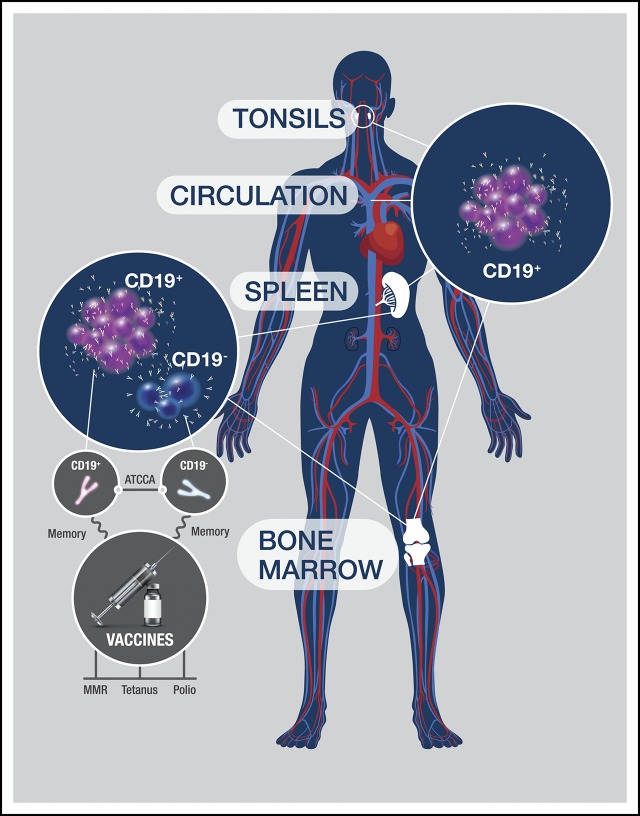
Long-lived antibody-secreting cells (ASCs) are critical for the maintenance of humoral immunity through the continued production of antibodies specific for previously encountered pathogen or vaccine antigens. Recent reports describing humoral immune memory have suggested the importance of long-lived CD19 bone marrow (BM) ASCs, which secrete antibodies recognizing previously encountered vaccine antigens. However, these reports do not agree upon the unique contribution of the CD19 BM ASC subset toward humoral immunity. Here, we found both CD19 and negative ASCs from human BM were similar in functional capacity to react to a number of vaccine antigens via ELISpot assays. The CD19 cells were the predominant ASC population found in lymphoid tissues, and unlike the CD19 ASCs, which were found only in spleen and BM, the CD19 ASCs were found in tonsil and blood. CD19 ASCs from the BM, spleen, and tonsil were capable of recognizing polio vaccine antigens, indicating the CD19 ASC cells play a novel role in long-lasting immune defense. Comparative gene expression analysis indicated CD19 and negative BM ASCs differed significantly by only 14 distinct messenger RNAs and exhibited similar gene expression for cell cycle, autophagy, and apoptosis control necessary for long life. In addition, we show identical CDR-H3 sequences found on both BM ASC subsets, indicating a shared developmental path. Together, these results provide novel insight for the distribution, function, genetic regulation, and development of long-lived ASCs and may not only impact improved cell therapies but also enhance strategies for vaccine development.
长寿的抗体分泌细胞 (ASCs) 通过持续产生针对先前遇到的病原体或疫苗抗原的特异性抗体,对于维持体液免疫至关重要。最近描述体液免疫记忆的报告表明了长寿的 CD19 骨髓 (BM) ASC 的重要性,它们分泌识别先前遇到的疫苗抗原的抗体。然而,这些报告对于 CD19 BM ASC 亚群对体液免疫的独特贡献并没有达成一致意见。在这里,我们发现来自人 BM 的 CD19 和阴性 ASC 在通过 ELISpot 测定对多种疫苗抗原的反应功能能力上相似。CD19 细胞是在淋巴组织中发现的主要 ASC 群体,与仅在脾脏和 BM 中发现的 CD19 ASC 不同,CD19 ASC 存在于扁桃体和血液中。来自 BM、脾脏和扁桃体的 CD19 ASC 能够识别脊髓灰质炎疫苗抗原,表明 CD19 ASC 细胞在持久的免疫防御中发挥新的作用。比较基因表达分析表明,CD19 和阴性 BM ASC 仅通过 14 种不同的信使 RNA 显著不同,并且表现出相似的细胞周期、自噬和凋亡控制基因表达,这对于长寿是必要的。此外,我们还显示了两个 BM ASC 亚群上相同的 CDR-H3 序列,表明存在共享的发育途径。总之,这些结果为长寿 ASC 的分布、功能、遗传调控和发育提供了新的见解,不仅可能影响改进的细胞治疗,而且还可能增强疫苗开发的策略。