Leeds Institute of Medical Research, University of Leeds, St. James's University Hospital, Beckett Street, Leeds, LS9 7TF, UK.
Department of Clinical Immunology and Allergy, St James's University Hospital, 5.18 Clinical Sciences Building, Beckett Street, Leeds, LS9 7TF, UK.
J Clin Immunol. 2023 Oct;43(7):1543-1556. doi: 10.1007/s10875-023-01511-w. Epub 2023 May 29.
The human CD19 antigen is expressed throughout B cell ontogeny with the exception of neoplastic plasma cells and a subset of normal plasma cells. CD19 plays a role in propagating signals from the B cell receptor and other receptors such as CXCR4 in mature B cells. Studies of CD19-deficient patients have confirmed its function during the initial stages of B cell activation and the production of memory B cells; however, its role in the later stages of B cell differentiation is unclear.
Using B cells from a newly identified CD19-deficient individual, we investigated the role of CD19 in the generation and function of plasma cells using an in vitro differentiation model.
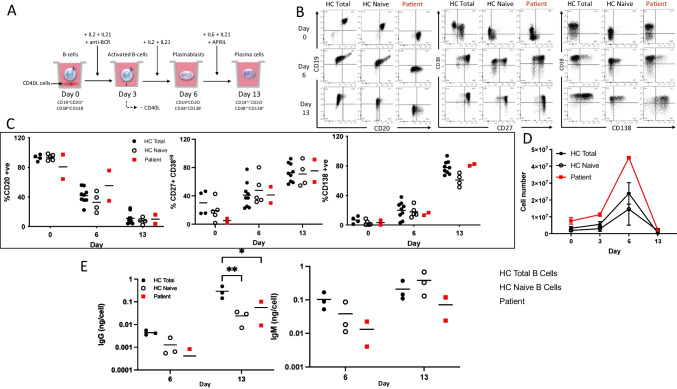
Flow cytometry and long-read nanopore sequencing using locus-specific long-range amplification products were used to screen a patient with suspected primary immunodeficiency. Purified B cells from the patient and healthy controls were activated with CD40L, IL-21, IL-2, and anti-Ig, then transferred to different cytokine conditions to induce plasma cell differentiation. Subsequently, the cells were stimulated with CXCL12 to induce signalling through CXCR4. Phosphorylation of key downstream proteins including ERK and AKT was assessed by Western blotting. RNA-seq was also performed on in vitro differentiating cells.
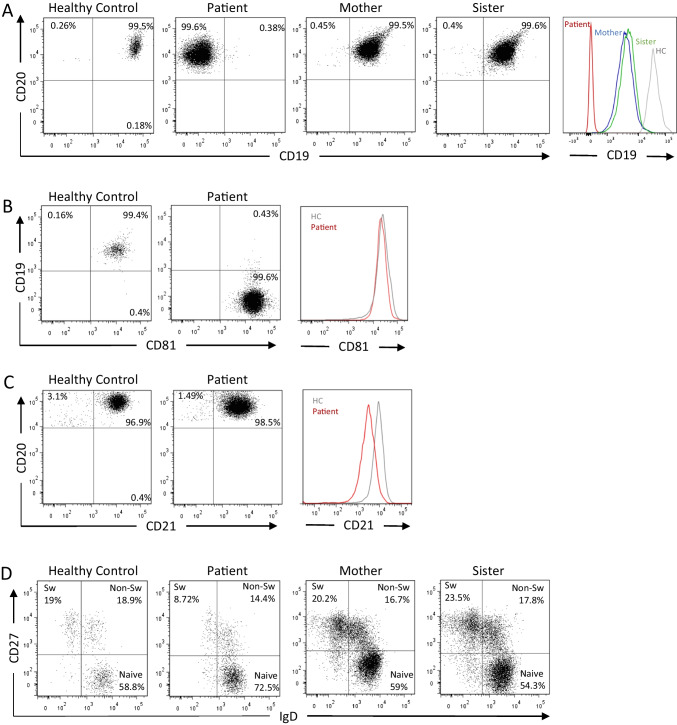
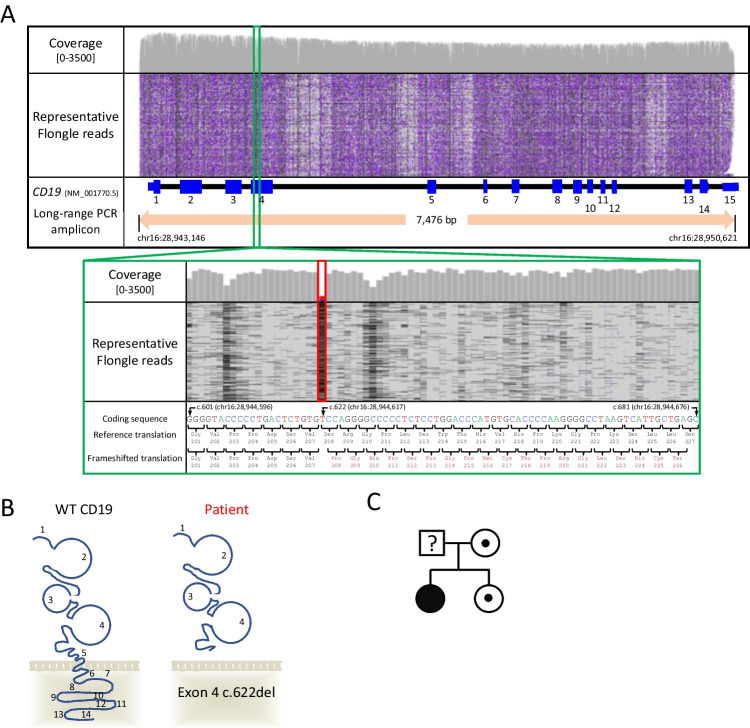
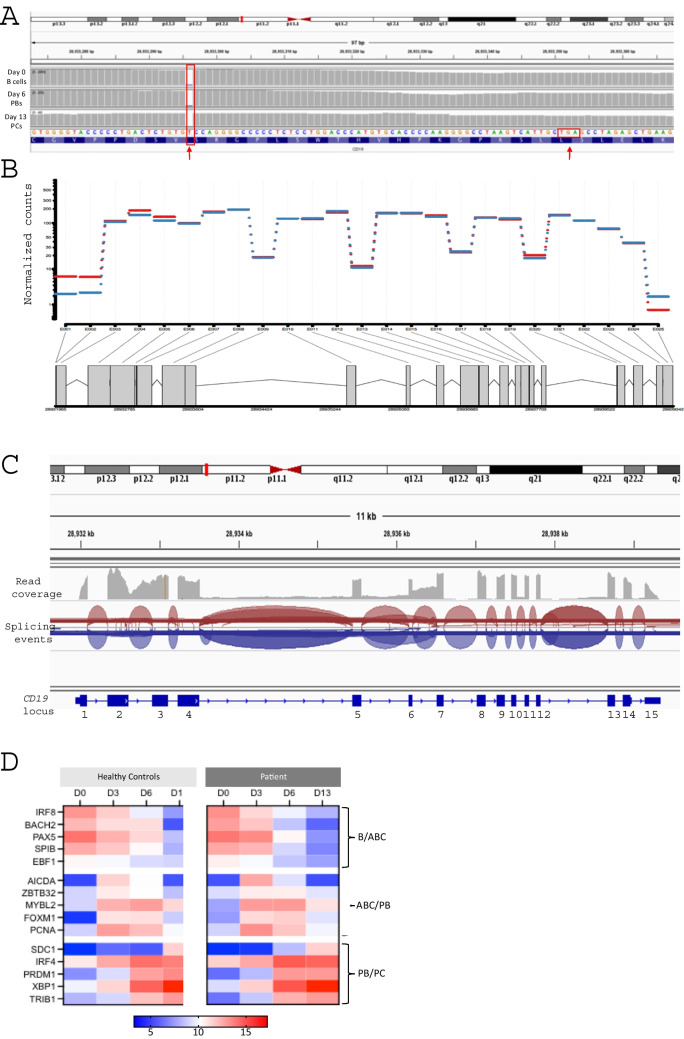
Long-read nanopore sequencing identified the homozygous pathogenic mutation c.622del (p.Ser208Profs*19) which was corroborated by the lack of CD19 cell surface staining. CD19-deficient B cells that are predominantly naïve generate phenotypically normal plasma cells with expected patterns of differentiation-associated genes and normal levels of CXCR4. Differentiated CD19-deficient cells were capable of responding to CXCL12; however, plasma cells derived from naïve B cells, both CD19-deficient and sufficient, had relatively diminished signaling compared to those generated from total B cells. Additionally, CD19 ligation on normal plasma cells results in AKT phosphorylation.
CD19 is not required for generation of antibody-secreting cells or the responses of these populations to CXCL12, but may alter the response other ligands that require CD19 potentially affecting localization, proliferation, or survival. The observed hypogammaglobulinemia in CD19-deficient individuals is therefore likely attributable to the lack of memory B cells.
人类 CD19 抗原在 B 细胞发生过程中均有表达,除了肿瘤性浆细胞和一部分正常浆细胞。CD19 在成熟 B 细胞中发挥着从 B 细胞受体和其他受体(如 CXCR4)传递信号的作用。对 CD19 缺陷患者的研究证实了其在 B 细胞激活和记忆 B 细胞产生的初始阶段的功能;然而,其在 B 细胞分化的后期阶段的作用尚不清楚。
利用新鉴定的 CD19 缺陷个体的 B 细胞,我们使用体外分化模型研究了 CD19 在浆细胞的产生和功能中的作用。
使用针对特定基因座的长程扩增产物的流式细胞术和长读长纳米孔测序来筛选疑似原发性免疫缺陷的患者。从患者和健康对照者中纯化 B 细胞,然后用 CD40L、IL-21、IL-2 和抗 Ig 激活,再转移到不同的细胞因子条件下诱导浆细胞分化。随后,用 CXCL12 刺激细胞以诱导 CXCR4 信号转导。通过 Western blot 评估包括 ERK 和 AKT 在内的关键下游蛋白的磷酸化。还对体外分化细胞进行了 RNA-seq。
长读长纳米孔测序鉴定出纯合致病性突变 c.622del(p.Ser208Profs*19),这与 CD19 细胞表面染色缺失相符。主要为幼稚状态的 CD19 缺陷 B 细胞产生表型正常的浆细胞,具有预期的分化相关基因模式和正常水平的 CXCR4。分化后的 CD19 缺陷细胞能够对 CXCL12 作出反应;然而,与源自总 B 细胞的细胞相比,源自幼稚 B 细胞(包括 CD19 缺陷和正常)的浆细胞的信号相对减弱。此外,CD19 对正常浆细胞的结合导致 AKT 磷酸化。
CD19 对于抗体分泌细胞的产生或这些群体对 CXCL12 的反应不是必需的,但可能改变对其他需要 CD19 的配体的反应,从而可能影响定位、增殖或存活。因此,CD19 缺陷个体的低丙种球蛋白血症可能归因于缺乏记忆 B 细胞。