Department of Rehabilitation, Herzog Hospital, Jerusalem, Israel.
Medtronic, 7 HaMarpe st, 97774, Jerusalem, Israel.
J Clin Monit Comput. 2020 Feb;34(1):139-146. doi: 10.1007/s10877-018-0222-4. Epub 2018 Nov 26.
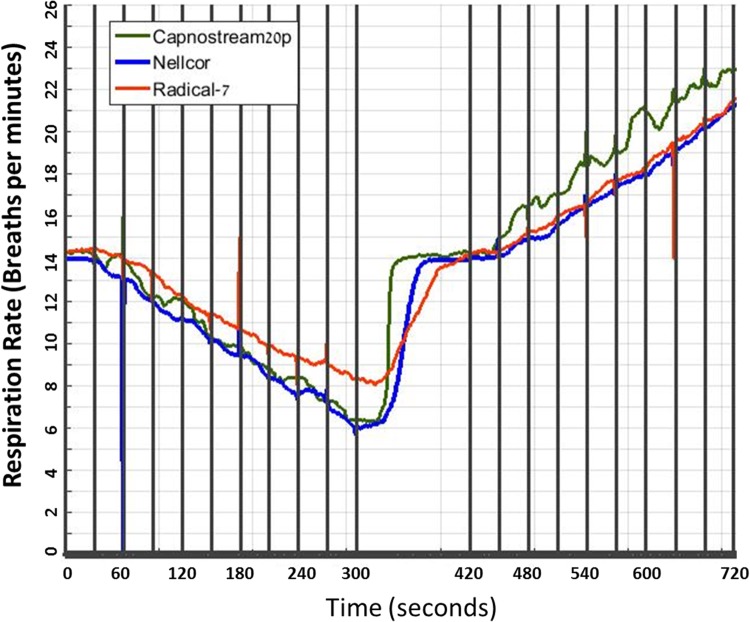
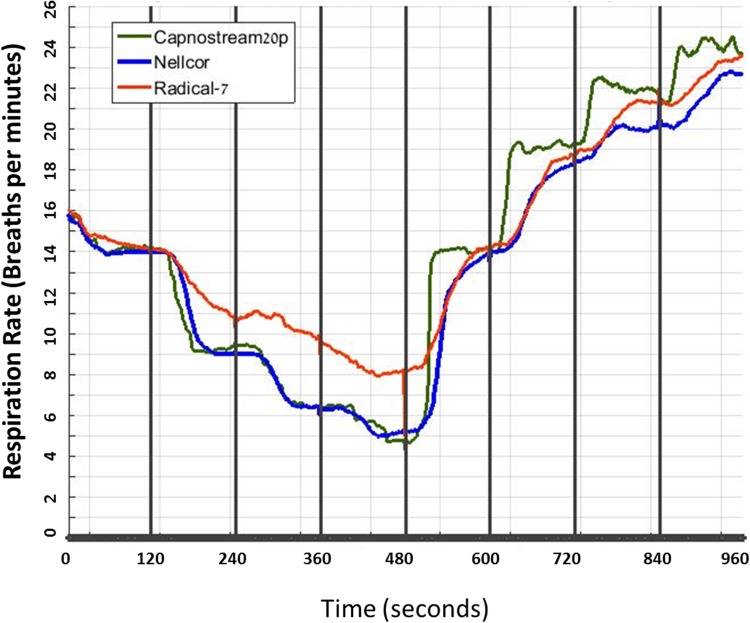
Respiration rate (RR) is a critical vital sign that provides early detection of respiratory compromise. The acoustic technique of measuring continuous respiration rate (RR) interprets the large airway sound envelope to calculate respiratory rate while pulse oximetry-derived respiratory rate (RR) interprets modulations of the photoplethsymograph in response to hemodynamic changes during the respiratory cycle. The aim of this study was to compare the performance of these technologies to each other and to a capnography-based reference device. Subjects were asked to decrease their RR from 14 to 4 breaths per minute (BPM) and then increase RR from 14 to 24 BPM. The effects of physiological noise, ambient noise, and head movement and shallow breathing on device performance were also evaluated. The test devices were: (1) RR, Radical-7 (Masimo Corporation), (2) RR, Nellcor™ Bedside Respiratory Patient Monitoring System (Medtronic), and (3) reference device, Capnostream20p™ (Medtronic). All devices were configured with their default settings. Twenty-nine healthy adult subjects were included in the study. During abrupt changes in breathing, overall RR was accurate for longer periods of time than RR; specifically, RR was more accurate during low and normal RR, but not during high RR. RR also displayed a value for significantly longer time periods than RR when the subjects produced physiological sounds and moved their heads, but not during shallow breathing or ambient noise. RR may be more accurate than RR during development of bradypnea. Also, RR may display a more reliable RR value during routine patient activities.
呼吸频率(RR)是一项关键的生命体征,可早期发现呼吸功能受损。测量连续呼吸频率(RR)的声学技术通过解读大气道声音包络来计算呼吸频率,而脉搏血氧仪衍生的呼吸频率(RR)则通过解释呼吸周期中血流动力学变化引起的光容积描记图的调制来计算呼吸频率。本研究旨在比较这些技术彼此之间以及与基于二氧化碳描记法的参考设备的性能。要求受试者将 RR 从 14 次/分钟降至 4 次/分钟,然后从 14 次/分钟增至 24 次/分钟。还评估了生理噪声、环境噪声、头部运动和浅呼吸对设备性能的影响。测试设备为:(1)RR,Radical-7(Masimo 公司);(2)RR,Nellcor™床边呼吸患者监测系统(美敦力);(3)参考设备,Capnostream20p™(美敦力)。所有设备均采用默认设置进行配置。共有 29 名健康成年受试者参与了这项研究。在呼吸突然变化时,RR 的整体 RR 准确性能维持更长时间,尤其是在低和正常 RR 时,但在高 RR 时则不然。当受试者产生生理声音和移动头部时,RR 也会显示出更长的时间间隔,但在浅呼吸或环境噪声时则不会。在发生呼吸过缓时,RR 可能比 RR 更准确。此外,RR 可能在患者日常活动中显示出更可靠的 RR 值。